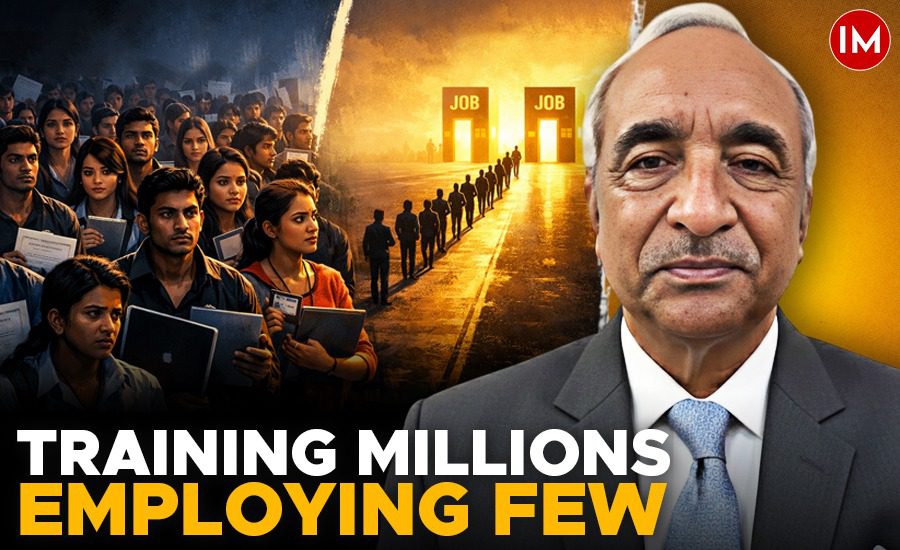
Last month Controller and Auditor General submitted a detailed report on the Pradhan Mantri Kaushal Vikas Yojana (PMKVY) 2015-2022 that revealed massive irregularities, including 53% of beneficiaries having invalid/blank bank account details, low 41% placement rates, and systemic data falsification. The audit flagged non-existent training centers, duplicate records, and poor alignment with industry skill requirements. Key findings from the CAG report include massive data falsification and fraud and found that over 90 lakh (53%) candidates had incomplete or blank bank account details on the Skill India Portal. Over 12,000 unique bank accounts were used for 52,381 candidates, including fake numbers like “11111111111”.
Report also disclosed that the scheme had very low placement and full of mismanagement as only 23 lakh (41%) of the 56 lakh candidates certified under short-term training were placed. CAG reported that in 84% of cases, geotagging for physical inspections was absent, and in some cases, the same photo was used for multiple, different candidates and thousands of underage candidates were certified, including over 52,000 in “Group Farming” and 40,000 as “Self-Employed Tailors”. Training was not aligned with skill-gap requirements, as 40% of certifications were concentrated in only 10 job roles rather than high-demand sectors like construction or logistics. The CAG report criticized the Ministry of Skill Development for extremely poor monitoring, as Aadhaar-linked payments were successful for only 18.44% of candidates under PMKVY.
India speaks often of becoming a developed nation by 2047. Yet one uncomfortable statistic threatens to derail this ambition: barely 4–5 per cent of India’s workforce has formal vocational or technical training. No major economy has ever reached high-income status with such a fragile skills base. The issue is not merely about employment or education. It is about productivity, industrial competitiveness, social mobility, and dignity of labour.
According to multiple government and research estimates, only around 4–5 % of India’s workforce has undergone formal vocational or skills training. In contrast United Kingdom: about 68 % of workers have formal vocational skills, in Germany roughly 75 % of the workforce is formally skilled, in United States , there is close to 52 % participation in formal skills training. In Japan about 80 % of workers have some form of vocational competence and in South Korea, an extraordinary 96% of its workforce is formally skilled. This gap is not marginal — it is structural, and India lags even many developing economies. Beyond mere percentages, participation rates in formal vocational programmes among school leavers illustrate the problem further: in India this is reported at just around 1.4 %, compared with 31.8 % in the UK, 19.2 % in Germany, 11.4 % in Japan, and nearly 29 % in Australia.
These advanced economies have long integrated vocational education with school systems, allowing students to pursue skills early and receive recognised credentials linked to real jobs. India’s system, by contrast, often treats training as a remedial option after academic failure, reinforcing stigma and limiting participation. Germany, Japan and South Korea—countries that rebuilt themselves after war and poverty—invested early and decisively in vocational education. In these societies, a skilled technician commands social respect and economic security. Vocational careers are not a consolation prize; they are a mainstream pathway. India stands in stark contrast. Despite having the world’s largest youth population, over 85 per cent of its workforce remains informal and low-skilled. Productivity levels reflect this reality.
Since last several decades, successive governments have placed vocational education and skill development at the center of our policy framework but without much success. On paper, the scale is impressive—over 1.6 crore certifications issued. But scale is not the same as success.
The failure is structural, not accidental. First, vocational education in India arrives too late—usually after school dropout—rather than being integrated into mainstream education. Second, training courses are too short and generic, unable to create deep competence. Third, industry participation remains token, with employers preferring experienced workers over freshly certified trainees. Finally, there is a persistent social bias that places academic degrees above skills, regardless of employability.
No country has industrialized on such foundations.
If India is serious about becoming a developed nation, it must rethink vocational education from first principles. Vocational training must begin in schools, not after failure elsewhere. Apprenticeships should become the backbone of skill formation, with legal and fiscal incentives for firms to train. Public money must be tied to verifiable employment outcomes, not training headcounts. Certification standards must align with global benchmarks so that Indian skills are portable and respected. Above all, India must restore parity of esteem between vocational and academic pathways. Without dignity, no skill system can succeed.
The demographic dividend is not automatic. Without skills, it turns into a demographic burden—restless, underemployed and resentful. The CAG report should be read not as an indictment of one scheme, but as a warning about a deeper policy malaise. India can either continue celebrating training numbers or build a system that genuinely transforms lives and productivity. The choice will determine whether Viksit Bharat remains a slogan—or becomes a reality.
At the heart of the problem is a simple fact: India invests far less in formal vocational training than major economies, and the outcomes reflect that.
(Vijay Shankar Pandey is former Secretary Government of India)