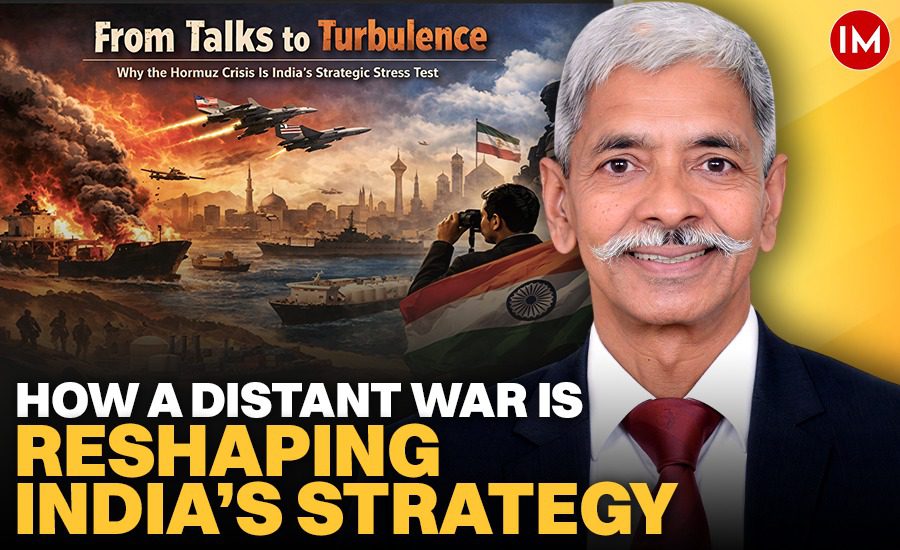
“When diplomats were still talking, the missiles had already decided.”
That, in one line, captures the defining contradiction of the current West Asian crisis.
Negotiations in motion, goalposts shifting, and then kinetic reality taking over.
Backchannel diplomacy involving Iran and Western interlocutors was active. Mediators were engaged. Assurances were being calibrated. Then the script changed rapidly, almost abruptly.
Strikes followed.
The United States and Israel framed these as precision actions aimed at decapitation, degrading strategic capabilities and overthrowing a regime. Objectives, they claimed, were achieved.
But wars do not end with stated objectives. They evolve with the progress of operations.
Tehran too responded not symmetrically, but strategically though. Proxy networks activated. Maritime signalling intensified. And then came the most critical lever, the closure of the Strait of Hormuz.
At that point, the conflict stopped being regional as its shadow crept longer and longer. It became systemic.
And India stepped into the frame not by choice, but by consequence.
Diplomacy Overtaken: When Negotiations Lose Tempo
The first lesson clearly which emerged from the evolving situation was that
Diplomacy is no longer the pace-setter.
Negotiations were ongoing. Yet escalation occurred. This is not a collapse of diplomacy. Instead, it is a compression of timelines.
Can traditional diplomatic cycles keep up with modern conflict velocity? That is the precise question that must be doing the rounds in foreign affairs of late.
For India, which prides itself on dialogue across divides, this is a doctrinal challenge.
Because engagement without contingency is optimism. Not strategy.
Expanding Theatre: Proxies, Hormuz and the New Battlespace
Once proxies enter, control exits.
Iran’s extended influence—across non-state actors and regional affiliates—ensures that conflict is never confined.
We have already seen indicators:
Maritime threats around Hormuz
Indirect strikes and signalling beyond primary theatres
Regional unease spilling into Gulf states
Now bring in the Gulf Cooperation Council (GCC).
These states—economically interlinked with India—are walking a fine line. Stability is their currency. Escalation is their risk.
They are not participants. But they are exposed.
And exposure, in geopolitics, translates into pressure.
NATO Fatigue, Russia-China Calculus
Another quiet shift—less discussed, but critical.
The cohesion of Western alliances is showing strain. Prolonged engagements, resource prioritisation, and domestic political pressures are creating visible fatigue within NATO structures.
At the same time, Russia and China are observing and calibrating.
Not intervening overtly. But positioning strategically.
Energy markets. Diplomatic narratives. Strategic opportunism.
So, the question now is
Is this conflict contained, or is it reordering alignments quietly?
The answer is unfolding in real time.
India’s Strategic Dilemma: Partner to All, Aligned to None
India today finds itself in a uniquely complex position.
Defence and technology ties with Israel.
Energy and diaspora dependence on GCC nations.
Connectivity and strategic engagement with Iran.
Normally, this is called multi-alignment.
Today, it feels like multi-directional pressure.
Because when partners are in conflict, neutrality is not passive,it is scrutinised.
India’s trade routes, energy imports, and foreign policy credibility are all in play.
And here comes the deeper question—
Can India remain equidistant without appearing indecisive?
This is where strategic signalling matters as much as strategic intent.
Domestic Theatre: The War Within the Economy
How do the tremors first arrive home?
The first tremors are not military. They are economic.
Oil flows through Hormuz are under threat. Even partial disruption alters pricing dynamics.
The safe passage of the Indian LPG carrier Green Sanvi was quietly hailed as a diplomatic success. But it also exposed fragility.
Shipping costs rise. Insurance premiums spike. Supply chains tighten.
Then comes the second layer—fertilizers.
India’s agricultural ecosystem is linked to Gulf supply chains. Disruptions here do not create headlines but they create inflation.
Third-the conflict has disrupted key industrial minerals and related commodities and their supply chains- aluminium, sulphur and graphite besides fertilizer minerals.
And inflation creates political and economic pressure.
Now the battlefield shifts.
From deserts of West Asia to markets of Mumbai to farms of Punjab.
This is the new domestic theatre.
Diaspora and Internal Security: The Invisible Frontline
Over 9 million Indians live across the Gulf.
They are not statistics. They are strategic assets.
But in conflict, assets can become vulnerabilities.
Recent drone incidents in parts of the Gulf—Kuwait, Abu Dhabi—are early indicators of spillover risk.
Now imagine escalation widening.
A multi-country Non-Combatant Evacuation Operation (NEO) becomes inevitable.
India has executed such operations before. But scale and simultaneity will define this one.
This is where governance becomes operational.
Diplomatic coordination
Military logistics
Administrative precision
The Indian Administrative and External Services will be at the forefront.
The real question is therefore,
Are we preparing in advance, or waiting for crisis triggers?
Because evacuation success is decided before the first aircraft takes off.
Mediation Attempts and Tehran’s Calculated Responses
Multiple actors have attempted mediation from regional players, intermediaries, quiet diplomatic channels.
But Tehran’s responses have followed a pattern.
Not impulsive. Not escalatory in a conventional sense.
But calibrated.
Each response signals capability without full commitment. Pressure without closure thus
keeping the conflict alive without resolving it.
Strategic patience exhibited also prolongs uncertainty.
The Big Question: Where is this conflict heading?
Three possible trajectories emerge.
Controlled De-escalation– A ceasefire framework emerges. Negotiations resume. Hormuz stabilises.
Sustained Low-Intensity Conflict- Strikes continue intermittently. Proxies remain active. Economic disruption persists.
Major Escalation- Hormuz closure becomes real. US ground involvement is considered. Regional spillover expands.
Which scenario is India best prepared for?
Because preparation defines resilience.
The Strategic Test
This crisis began with conversations and then overtook them. It is being fought with precision but unfolding with unpredictability.
For India, it is no longer about distant alignments. It is about immediate consequences.
Energy security. Trade stability. Diaspora safety. Diplomatic credibility.
All converging at once.
India’s silence on certain actions will be interpreted. Its statements will be measured. Its actions always closely watched. And interpretations shapes perceptions
As a nation aspiring for a permanent seat at the UNSC, its stance on sovereignty versus regime change defines its credibility.
Because a nation that aspires to be a “Vishwa-Mitra” cannot afford ambiguity when the world is polarising.
What must India therefore do?
Stay engaged but not entangled.
Stay principled but not rigid.
Stay prepared above everything else.
Today, in this evolving world order, influence will not come from choosing sides.
It will come from shaping stability.
And if India can get its balance right, it has not only navigated the crisis successfully but also defined its role in the new global world order that emerges after it.
(Col. MV Shashidhar is An Army Veteran with vast domain experience in J&K, specialisation in management , a multi-dimensional sportsman, outdoor and yoga enthusiast and prolific writer/ blogger.)