“Victorious warriors win first and then go to war.”- Sun Tzu
Wars used to hinge on who had the most tanks, the biggest carrier fleet, or the most advanced fighters. That notion is no longer sufficient. Today, the decisive factor in future conflicts will not be the individual service with the formidable hardware but rather how all domains from intelligence and cyber to logistics and shooter units will all operate as a unified system. Victory will accrue to the side that integrates capabilities and not to the service with the best standalone platforms.
A recent geopolitical event illustrates this shift. The capture of Venezuelan President Nicolás Maduro by United States forces in early January 2026 highlights how modern operations depend on cross-domain integration rather than single-service dominance. A coordinated operation involving special forces, air strikes, intelligence assets, naval transport, and legal authorities resulted in the apprehension and transfer of Maduro and his wife to the United States to face charges as reported by multiple agencies. This was not a routine infantry raid or an aerial strike in isolation.
It required precision intelligence, synchronized kinetic action, secure communication networks, special operations expertise, and logistical coordination spanning multiple domains. That mosaic of capability exemplifies what integrated warfighting looks like.
We can no longer believe to segregate warfare the old way. The era of precision weapons, autonomous systems, cyber engagement with real-time data flows all converge into a single operational picture as an integrated capability with nations. In the Maduro example, space and cyber sensors, real-time intelligence, air assets, naval carrier coupled with legal-political apparatus all contributed to achieving the objective. Teams that operate in silos cannot deliver this kind of synchronization. Integrated systems thinking within a unified command only can.
This does not mean services will lose their identity or value. In fact, they will continue to remain indispensable. The culture within many militaries has been constantly evolving and particularly so in the Indian Armed Forces context. Over the past decade, there has been a gradual shift from rigid service parochialism towards collaborative frameworks that emphasize joint planning, integrated training, and shared objectives.
The appointment of a Chief of Defence Staff within the Department of Military Affairs and the development of integrated theatre commands have begun to synergise the employment and application of tri-services. Forces are still proud of their institutional histories but they increasingly recognize that dominance in one domain alone will not secure success in future conflicts. Integration is not about erasing tradition instead it is about building a culture where combined synergy will be the norm rather than an exception.
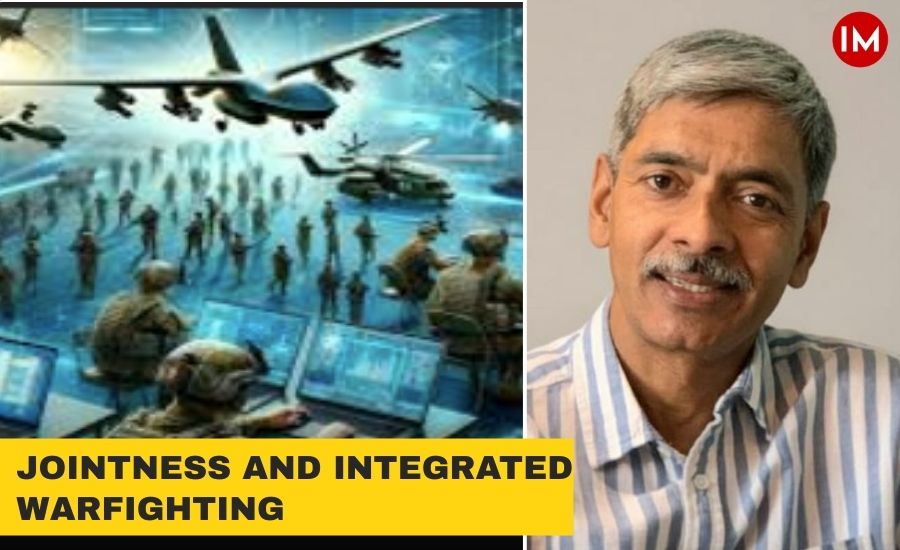
In modern war-fighting when a brigade commander needs immediate, precise targeting data from aerial drones and space-based sensors to mount a precision strike it entails cyber units must be plugged into logistics grids to anticipate and mitigate disruptions, artillery engagements require air and electronic warfare support to suppress enemy air defences. Without systems that communicate and operate seamlessly, tempo and decision superiority will evaporate in the battle space of today.
The prevailing geopolitics in Asia, especially for India, make this systemic approach even more urgent. India faces a multifaceted threat environment – a contested frontier in the Himalayas where terrain and terrain intelligence matter, potential maritime competition in the Indian Ocean, hybrid threats including cyber and information operations and the spectre of cross-domain escalation. These are not isolated challenges for they interact, overlap, and cascade. This means doctrine must evolve from service-centric models toward multi-domain joint warfighting frameworks that can exploit precision effects and data advantage across theatres.
In practical terms, this shift demands a few things. Doctrine must define clear command hierarchy that reduce ambiguity during high-tempo operations. Joint training must become habitual, not episodic, so that units learn to operate as cohesive nodes within an expanded spectrum. Procurements must prioritize interoperability, not just service-specific capability. Communication architecture must be resilient and secure because fractured networks will only end up as an operational liability. Winning future conflicts requires synchronized action from all elements of national power with onus on collective purposeful leadership to decisively act given these complex narratives.
India’s current strategy reflects awareness of these needs, but the pace of adaptation must keep up with the changing character of war. Precision weapons, cyber warfare, unmanned platforms, space‐based ISR and AI-enabled decision support are no longer supplementary instead they are foundational to combat power.
The example of the Maduro capture shows that even politically complex, sovereignty-sensitive operations rely on systemic cooperation across branches and domains. The military that can think and act as a system rather than as segmented services will not only win battles but shape strategic outcomes. Systems, not services, will define victory in the wars ahead.
“Power is multidimensional; he who combines its elements prevails.”
Chanakya (Arthashastra)