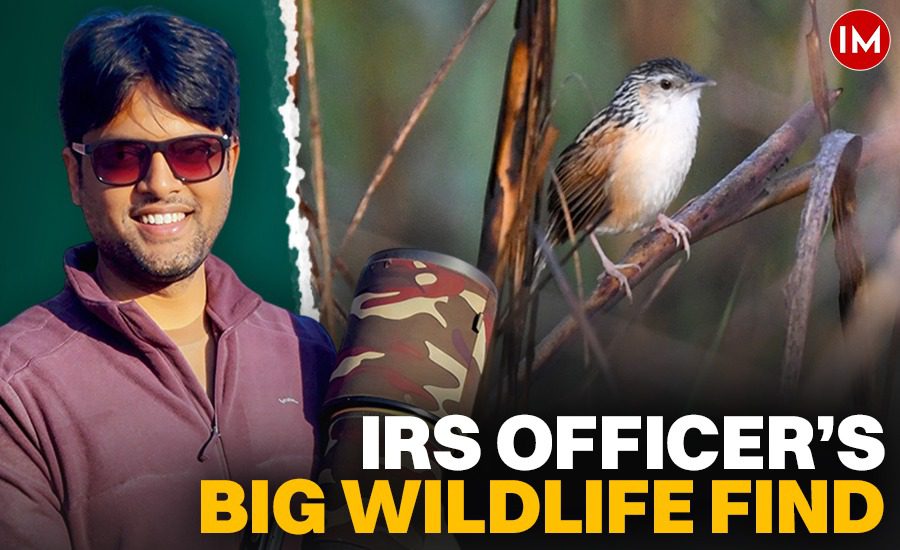
On a quiet Saturday morning inside the lush expanse of Katarniaghat Wildlife Sanctuary in Bahraich, Uttar Pradesh, what began as a routine safari turned into a moment of ecological significance.
IRS officer Raghav Gupta (2012 batch), currently posted in the Ministry of Home Affairs, Delhi, was navigating through the sanctuary when a faint, scratchy “churring” call cut through the stillness. For most, it would have been just another forest sound. But for Gupta, a seasoned wildlife enthusiast, it was a clue.
“The call was distinctive. I had a strong feeling it could be the Indian Grassbird,” he recalls.
He asked the vehicle to halt.
What followed was a patient, almost meditative scan of the surrounding reedbeds: dense, swaying, and concealing life within. In an exclusive conversation with Indian Masterminds, he shared details about the same.
THE ELUSIVE BIRD REVEALS ITSELF
Moments later, after the initial call, there was movement.
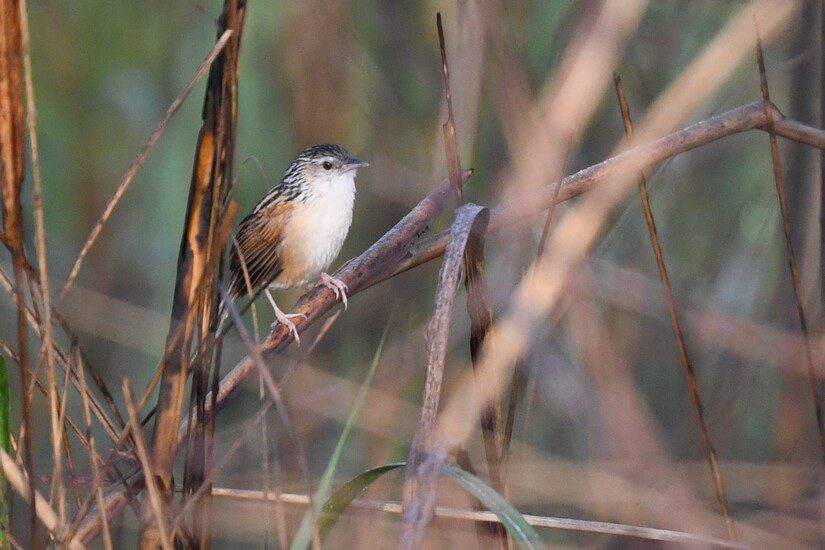
Deep within the grasses, a faint silhouette flickered… barely visible, almost ghost-like. The bird stayed low, flitting through the base of the vegetation, living up to its reputation as a “skulker”, a species far more often heard than seen.
Through the lens of his camera, Gupta slowly brought the subject into focus.
“The bird stayed low in the grasses, exactly as described in literature. When the calls shifted from churrs to low rattling notes, it strengthened the identification,” he explains.
With steady hands, he captured photographs and recorded the bird’s calls: two crucial pieces of evidence. The images and audio together confirmed what few had witnessed in the region before.
It was the first photographic record of the Indian Grassbird in Katarniaghat Wildlife Sanctuary, and possibly in the Bahraich district itself.
AN ENIGMATIC RESIDENT OF INDIA’S VANISHING GRASSLANDS
The Indian Grassbird is no ordinary sighting.
Found primarily in the floodplains of the Ganga and Brahmaputra rivers, this shy bird remains one of the least understood species of the Indian grasslands. Its secretive nature means it often escapes even the most trained eyes.
Despite its quiet presence, its situation is far from secure. The species is classified as Near Threatened by the International Union for Conservation of Nature (IUCN), with populations fragmented and steadily declining.
The primary reason: disappearing grasslands.
A WARNING HIDDEN IN THE GRASS
For Gupta, the sighting is not just about documentation; it carries a deeper ecological message.
“The Terai region consists of rich and highly diverse grasslands and wetlands undergoing rapid habitat loss,” he says. “Bird species such as the Indian Grassbird are indicators that the grassland is in healthy condition.”
His voice carries both excitement and concern.
“Such fragile ecosystems must be protected. Conservation of grasslands is critical for ensuring that these birds continue to survive and thrive.”
He points to other rare and endangered grassland birds that depend on these habitats: lesser florican, Bengal florican, swamp francolin, Finn’s weaver, bristled grassbird, Jerdon’s babbler, marsh babbler, and swamp prinia, each a thread in a delicate ecological fabric.
A PASSION ROOTED IN THE WILD
Hailing from Kanpur, Raghav Gupta’s journey reflects a rare intersection of governance and grassroots conservation.
While his professional role lies within the corridors of policymaking, his work outside office hours speaks a different language, one of wetlands, grasslands, and patient observation.
This is not his first notable contribution. He is credited with Kanpur’s first photographic record of the endangered Bristled Grassbird, further establishing his eye for rare and elusive species.
His work in wildlife photography has earned him recognition at both national and international platforms, including an award from the Union Finance Minister.
TAKING CONSERVATION TO THE NEXT GENERATION
Gupta’s commitment extends beyond the lens.
As a lifetime member of the Bombay Natural History Society (BNHS), he actively engages with young minds across India, conducting wildlife conservation and awareness programmes. His goal is simple: to make people notice what is often overlooked.
“Awareness is the first step. When people begin to value grasslands, conservation will follow,” he says.
A MOMENT THAT ECHOES BEYOND THE FRAME
In a world increasingly dominated by concrete and expansion, moments like these… quiet, patient, and deeply observant, carry immense value.
A faint call in the grass.
A pause.
A photograph.
And suddenly, a species steps out of obscurity, reminding us that entire ecosystems depend on what we choose to protect, or ignore.