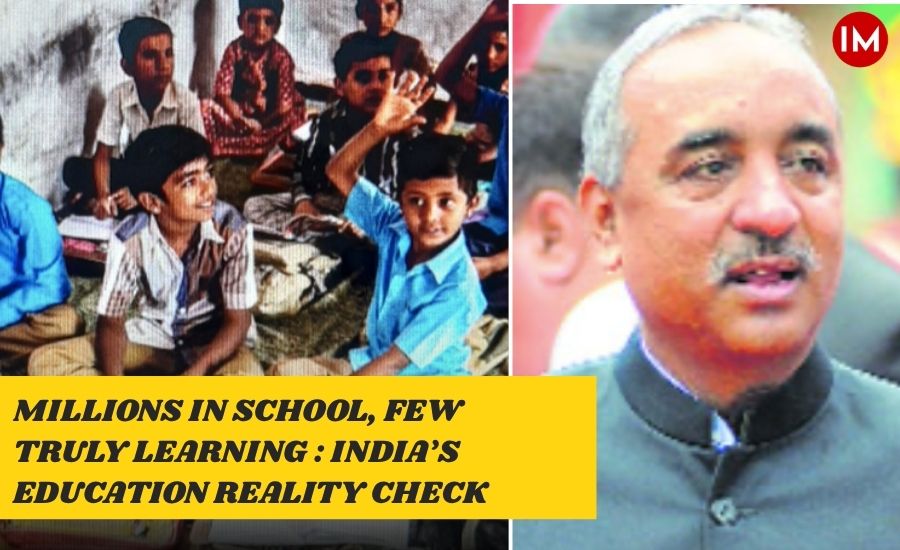
India’s achievement in expanding access to elementary education is undeniable. However, the next phase of reform must confront the harder challenge of delivering quality. Until then, the paradox will persist: a system that educates millions, yet struggles to truly teach them, writes former IAS officer V.S.Pandey
India’s elementary education system presents a striking paradox. Over the past three decades, the country has achieved what was once considered an ambitious goal—near-universal enrollment at the primary level. Yet, beneath this quantitative success lies a deeper structural crisis: a steady erosion of trust in government schools and a corresponding surge in private schooling, even among lower-income households. This divergence is not merely a matter of parental preference; it reflects fundamental policy and governance flaws that have shaped the trajectory of education in India.
At the heart of the issue lies a sequencing problem. Unlike many European countries, where state capacity and institutional robustness preceded mass expansion of schooling, India expanded access rapidly without building adequate administrative and accountability frameworks. The result has been a system where physical infrastructure and enrollment indicators improved, but learning outcomes remained stubbornly weak. Repeated independent assessments have shown that a significant proportion of children in elementary grades struggle with basic reading and arithmetic, raising questions about the effectiveness of the system.
One of the most critical fault lines is teacher accountability. Government school teachers in India are relatively well-compensated and enjoy job security, yet mechanisms to monitor performance and ensure classroom effectiveness remain weak. Administrative oversight is often diluted by bureaucratic inefficiencies and political interference, particularly in transfers and postings. In contrast, countries with high-performing public education systems invest heavily not only in teacher training but also in continuous evaluation and professional development. India’s policy framework, however, has tended to prioritize inputs—such as salaries and infrastructure—over outputs, namely student learning.
The rise of low-fee private schools across urban and semi-urban India is a direct response to this governance deficit. These institutions, often operating with modest infrastructure and less formally trained teachers, have managed to attract large numbers of parents. The reasons are revealing: regular teacher attendance, perceived discipline, and English-medium instruction. This trend underscores a critical reality—parents are willing to pay, even at significant financial strain, for what they perceive as better accountability and outcomes. In effect, the private sector has stepped in to fill a vacuum created by the state.
Policy interventions have not adequately addressed this core issue. The Right to Education Act marked a landmark step in making education a fundamental right, but its implementation has been heavily compliance-driven. The focus on infrastructure norms, pupil-teacher ratios, and regulatory checklists has often overshadowed the central objective of improving learning outcomes. Moreover, the Act imposed stringent norms on private schools without creating robust mechanisms to improve government schools, leading to unintended distortions in the system.
Another significant flaw lies in the political economy of education. As the middle class increasingly exits government schools, the constituency with the strongest voice and influence over public policy becomes disengaged from the public education system. This weakens the pressure on governments to improve school quality. In many developed countries, like US, UK, France , Germany where nearly ninety percent students are enrolled in government funded schools ,the middle class remains invested in public schooling, ensuring sustained political attention and accountability. India, by contrast, faces a situation where government schools are predominantly attended by the economically weaker sections, further marginalizing their concerns.
Public spending patterns also reveal structural inefficiencies. While India allocates a reasonable share of its budget to education, the per-student expenditure remains low compared to developed nations. More importantly, the allocation is skewed towards salaries, leaving limited resources for critical areas such as teacher training, school leadership, and monitoring systems. Without addressing these qualitative dimensions, increased spending alone is unlikely to yield better outcomes.
Urbanization and rising aspirations have compounded these challenges. Education is no longer viewed merely as a basic service but as a pathway to economic mobility. English-medium instruction, in particular, has become a powerful symbol of opportunity. Government schools, often perceived as lagging in this regard, struggle to compete with even modest private institutions. This has created a self-reinforcing cycle: declining trust leads to reduced enrollment among aspirational families, which in turn weakens accountability and accelerates further decline.
The regulatory environment adds another layer of complexity. India has neither fully embraced public provision nor effectively regulated private participation. Elite private schools operate at one end of the spectrum, while a vast network of low-fee schools caters to the masses, often with limited oversight. The absence of a coherent policy framework to integrate these segments has resulted in fragmentation rather than complementarity.
The consequences of these policy flaws are far-reaching. An education system that fails to deliver foundational skills undermines not only individual potential but also the country’s long-term economic prospects. The demographic dividend that India aspires to harness risks turning into a liability if the workforce remains inadequately skilled.
Addressing this crisis requires a shift in policy focus from access to outcomes. Strengthening teacher accountability, investing in school leadership, and building robust monitoring systems must become central priorities. Equally important is restoring public trust in government schools by ensuring consistent quality. Without re-engaging the middle class and creating a broad-based constituency for public education, meaningful reform will remain elusive.
India’s achievement in expanding access to elementary education is undeniable. However, the next phase of reform must confront the harder challenge of delivering quality. Until then, the paradox will persist: a system that educates millions, yet struggles to truly teach them.
(Vijay Shankar Pandey is former Secretary Government of India)