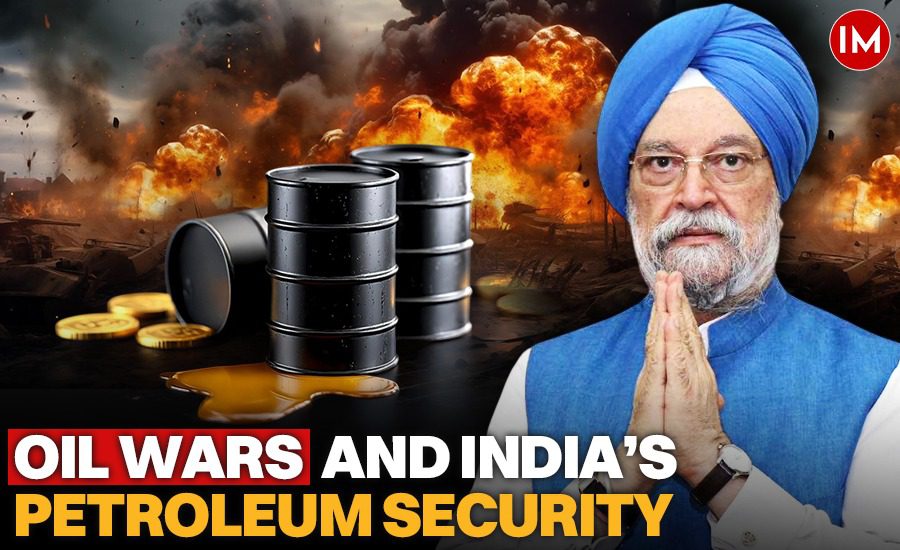
On a humid morning in Delhi, commuters lined up at petrol pumps as usual. The price board flickered quietly, changing by a few paise. No one noticed that thousands of kilometres away, warships were shadowing oil tankers in the Persian Gulf. Yes, those silent manoeuvres would soon ripple into India’s economy. Because every conflict in oil-rich regions has one predictable consequence—crude prices rise, currencies tremble, and inflation knocks at India’s door.
In early 2026, when tensions between the United States, Israel and Iran escalated, oil prices jumped nearly 15 percent within days. Disruption in the Strait of Hormuz, through which almost one-fifth of the world’s oil flows, spooked the markets, the world over. India’s rupee slipped, stocks wobbled, and economists began recalculating inflation forecasts.
The question that follows every such crisis is uncomfortable but unavoidable. Are these confrontations really about nuclear weapons and security fears—or about securing precious crude that fuels rich economies?
The answer is complicated. But history tells us one thing clearly—whenever guns fire near oil fields, crude prices move, and India pays.
Oil markets have always reacted dramatically to conflict. During the 1973 Arab oil embargo, crude prices first doubled and then quadrupled, plunging Western economies into recession. Petrol queues stretched for miles, and the modern idea of “energy security” was born. A few years later, the Iranian Revolution and the Iran-Iraq War again sent prices soaring. In 1990, when Iraq invaded Kuwait, crude nearly doubled within months as traders feared supply disruption.
Even in recent times, the pattern repeats. During Israel-Iran tensions in 2025, oil climbed from below $70 to over $80 in less than two weeks. In 2026, fresh conflict fears again pushed crude toward $80, with analysts warning it could cross $100 if shipping routes were hit. Economists call it the “war premium.” The moment conflict threatens supply routes, traders bid prices up—even before a single barrel stops flowing.
Why Oil Matters So Much
Oil is not just another commodity. It runs trucks, aircraft, factories, tractors and power plants. Every supermarket shelf and every smartphone depends on fuel somewhere in its supply chain. Nearly a third of global oil comes from the Middle East. About 20 percent passes through the narrow Strait of Hormuz. If that channel is blocked even briefly, global supply shrinks instantly.
Also Read : Vishwajeet Gupta’s Grounded, Gritty Journey to AIR 67 in UPSC CSE 2025 | Exclusive
That is why naval fleets patrol these waters and why even rumours of war can shake markets. Insurance costs rise, shipping slows, and panic buying begins.
Nuclear Fear or Oil Anxiety?
Officially, Western pressure on Iran is about stopping nuclear weapons. Nuclear proliferation is indeed a real and serious concern. But Iran also sits on some of the world’s largest oil reserves. Whenever sanctions restrict Iranian exports, global supply tightens and prices rise.
When U.S. sanctions hit Iran in 2019, India had to abruptly stop buying its crude. Refineries scrambled for alternatives, often paying more. The episode showed how geopolitics can reshape India’s fuel supply overnight. Wars are rarely fought only for oil. But energy always sits quietly behind strategy.
The Venezuelan Oil
Venezuela offers another example. It has the world’s largest proven oil reserves, yet sanctions have crippled its exports. When Venezuelan crude disappears from markets, supply shrinks and prices firm up. Alternative producers step in. Trade routes shift. Energy geopolitics reshapes quietly, without dramatic headlines.
Officially, sanctions aim to pressure governments. In reality, they also influence energy flows. The two realities coexist.
The Iraq War Lesson
The 2003 Iraq War was justified by fears of weapons of mass destruction. Those weapons were never found. But Iraq’s oil reserves were undeniable.
Before the invasion, oil prices hovered around $25–30 per barrel. As tensions rose, prices climbed sharply. After the invasion, instability reduced production, pushing prices higher in the years that followed. Energy may not have been the only cause. But it shaped the stakes.
India’s Vulnerability
India’s economy is expanding rapidly. Cars are multiplying, airlines are growing, industries are booming. All this runs largely on imported oil. India imports nearly 88 percent of its crude. Every $10 rise in oil prices adds billions to the import bill. Inflation rises, the rupee weakens, and government finances tighten.
During the 2026 Iran crisis, analysts warned oil could cross $100 if the Strait of Hormuz closed. Such a spike would immediately push petrol and diesel prices higher across India. For Indian households, geopolitics shows up at the fuel pump.
Protecting Petroleum Security
India has learned from past shocks. It now buys oil from more than thirty countries, reducing dependence on any single supplier. Strategic petroleum reserves store emergency fuel underground, inspired by lessons from the 1973 crisis. These reserves act as a buffer during sudden disruptions.
India also buys opportunistically. Discounted Russian oil after the Ukraine war saved billions. Indian companies invest in overseas oil fields to secure supply. At the same time, India is pushing electric vehicles, ethanol blending and renewable energy to reduce long-term dependence.
The Union Minister for Petroleum and Natural Gas Mr Hardeep Singh Puri put it so succinctly at India Energy Week in Goa: For us, energy security for 1.4 billion citizens is non-negotiable. Every policy we frame, every partnership we pursue, is guided by a simple principle: energy must be available, accessible and affordable. When global crude prices spiked and traditional supply chains were disrupted, we acted swiftly.
We diversified our crude sourcing, expanded our supplier base and leveraged diplomatic engagement to ensure uninterrupted supplies. As a result, India not only safeguarded its own interests but also contributed to stabilising global markets.
Lessons for India
India cannot stop global wars. But it can build resilience. Diversifying imports, expanding reserves, strengthening diplomacy and accelerating clean energy are essential steps. Energy security must become national strategy.
Because in a world where crude prices jump overnight during conflict, true independence comes from needing less oil. One day, India’s vast solar parks, electric vehicles and hydrogen plants may reduce dependence on imported crude. That future is slowly arriving.
Until then, every missile fired in the Gulf will echo in India’s economy. Every sanction on an oil-rich nation will affect Indian households. Oil may not be the only reason wars are fought. But it is always present in the calculations of power. And for India, securing petroleum supply is not just an economic necessity—it is a national priority.
Because when the world fights over energy, the real victory lies in not needing someone else’s fuel.
(The article is by Hardeep Singh Puri who is an Indian politician and retired diplomat of Indian Foreign Service who is serving as the Minister of Petroleum and Natural Gas since 2021.)