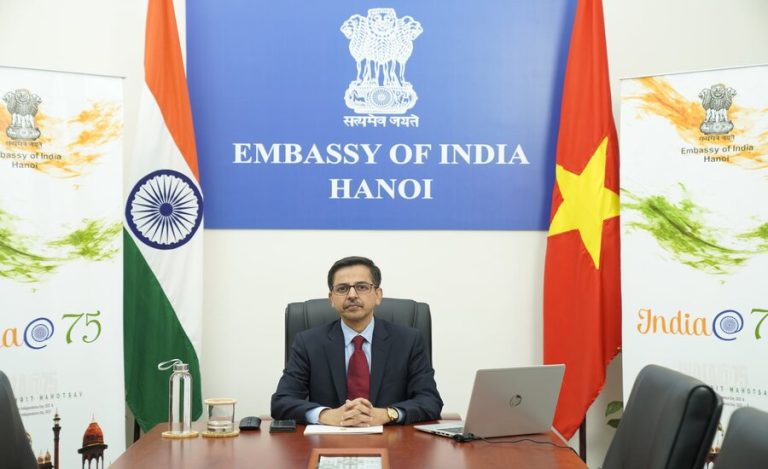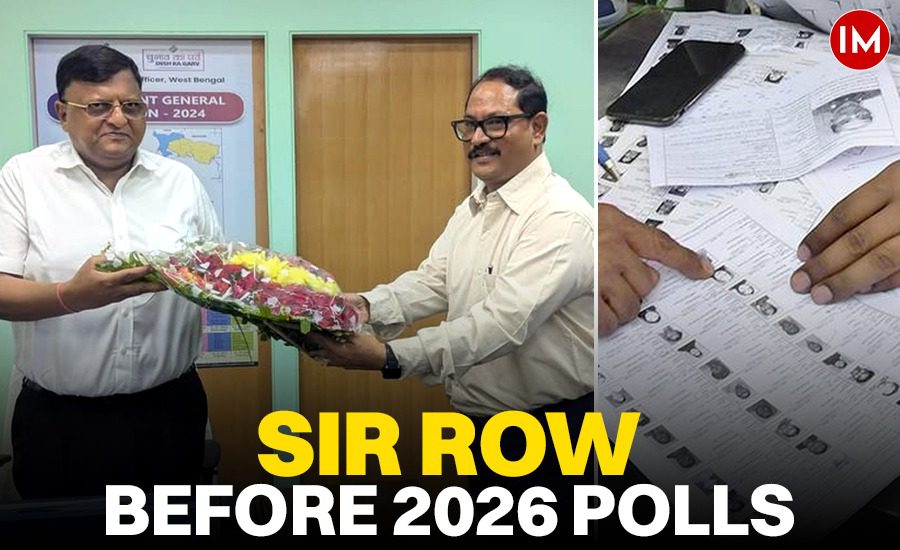
In West Bengal’s fraught political landscape, where every administrative decision is weighed for electoral consequence, a quiet bureaucrat has suddenly become a lightning rod. Manoj Kumar Agrawal, a 1990-batch IAS officer, now finds himself at the centre of a controversy that could shape the state’s political future as much as any campaign speech or party rally. As Chief Electoral Officer, he oversaw the Special Intensive Revision (SIR) of electoral rolls, an exercise that concluded on Saturday, February 28, 2026.
Notably, SIR has not been undertaken in Bengal for two decades. It is meant to be a technical, routine exercise of cleaning and updating voter lists. Instead, it has become a battleground of narratives, fears, and accusations in a highly politically charged atmosphere, with both the BJP (the party ruling the Centre) and the Trinamool Congress (the party ruling the state) indulging in a no-holds-barred slugfest. Agrawal stood his ground at its uneasy epicentre.
The revision began with door-to-door enumeration in November 2025, and from the start, it carried political weight. The Election Commission of India described it as a deep revision aimed at cleansing the rolls. The Bharatiya Janata Party argued that bogus voters and inflated rolls had distorted past elections. The ruling Trinamool Congress countered that the exercise was a tool to disenfranchise marginal communities. In a state where elections are fought with ferocity, the mere act of verifying voters can feel like a referendum on citizenship and belonging.
UNUSUAL APPOINTMENT
Agrawal’s appointment earlier in March 2025 was itself unusual. The Election Commission rejected the state government’s initial shortlist and sought names of officers who would retire soon after the 2026 Assembly elections. Agrawal, due to retire in July 2026, carrying the image of being a straightforward and no-nonsense officer, fit the bill.
The logic, quietly expressed in bureaucratic corridors, was simple: an officer close to retirement could not be pressured by a ruling establishment whose goodwill he would no longer need. In a system where transfers can be used as signals and punishments alike, insulation from future postings can be a form of independence.
CHARGED OWN MINISTER
For Agrawal, this image of uprightness is not new. Colleagues have long described him as a methodical officer with little appetite for political gamesmanship. In 2018, when he was the state’s food and supplies secretary, he ordered an FIR over irregularities in the public distribution system. Soon after, he was moved out of the department.
Years later, the minister who had overseen the same department would face arrest in connection with the ration scam. In Bengal’s bureaucracy, where stories of quiet retribution circulate like folklore, the episode became part of Agrawal’s reputation as an officer who followed procedure even when inconvenient.
FACED DISPROPORTIONATE ASSETS (DA) CASE
Yet reputations are rarely simple. Over Agrawal’s career hangs the shadow of a CBI investigation into disproportionate assets, a case that surfaced in the public domain more than a decade ago. A parliamentary reply in 2010 listed him among IAS officers under investigation. The probe examined assets allegedly acquired between 1990 and 2008 and included raids on his residence. Reports at the time spoke of properties in multiple cities purchased in his wife’s name. The case eventually faded from headlines and was later dismissed, but in politics, memory is long. For supporters, the dismissal affirms his integrity. For critics, the investigation itself raises doubts.
That ambiguity defines his present predicament. The Special Intensive Revision has exposed fault lines within Bengal’s electorate. In districts like North 24-Parganas, reports suggested that many voters could not be easily linked to older rolls, fuelling fears among communities like the Matuas that their names might vanish from voter lists. The BJP positioned the Citizenship Amendment Act (CAA) as reassurance for refugees worried about their status. Chief Minister Mamata Banerjee took to public meetings to promise that not a single eligible voter would be left out. Between these competing narratives, Agrawal’s office must decide what constitutes valid documentation, what counts as proof of residence, and who belongs on the roll.
A TIGHT ROPE WALK
Every such decision now carries political consequences. Booth Level Officers have complained of intimidation while conducting fieldwork. Opposition parties accuse the Commission of acting as an instrument of the Centre. The state government resists efforts to give the CEO’s office greater administrative autonomy, calling it an intrusion into federal balance. What should be a matter of paperwork has become a struggle over trust.
In this environment, Agrawal’s own story becomes a prism through which Bengal interprets the revision. To the BJP, he is an officer chosen precisely because he cannot be pressured by a state government it accuses of manipulating rolls. To the Trinamool Congress, he is part of a central strategy to reshape the electorate. For civil society groups, he is a technocrat attempting to carry out a difficult task amid political noise. In the public imagination, he is all these things at once.
MINING ENGINEER
His career before this moment was the archetype of an Indian bureaucrat’s journey. Trained as a mining engineer at the Indian School of Mines, later earning an executive MBA, he moved through departments ranging from food and supplies to forests and disaster management. His postings rarely drew headlines. The bureaucracy values such anonymity. But in India’s electoral system, the CEO of a politically volatile state can never remain invisible.
The timing of his retirement adds another layer of drama. By design or coincidence, he will leave office just weeks after the Assembly election he is helping prepare. If the revision is seen as fair, his career will end with quiet respect. If it is viewed as partisan, his name will be cited in Bengal’s political folklore as an example of bureaucratic complicity. The same act of checking voter lists could define him in opposite ways.
ON RAZOR’S EDGE
There is, in this story, a larger question about the nature of administrative neutrality in a polarised democracy. The Election Commission depends on state officials to conduct elections. State officials depend on governments for postings and resources. In theory, constitutional safeguards ensure independence. In practice, perception matters as much as law. Agrawal’s challenge is not merely to produce an accurate roll but to convince all sides that it is accurate.
In the months ahead, Bengal will move toward another high-stakes election. Campaign rhetoric will intensify, allegations will multiply, and every bureaucratic order will be scrutinised for hidden meaning. Manoj Kumar Agrawal will continue to work in an office that was once a routine administrative post but is now a stage on which Bengal’s anxieties about identity, fairness, and power are being played out.
When the ballots are finally counted in 2026, politicians will claim victory or allege injustice, as they always do. But somewhere in the background will remain the memory of a bureaucrat tasked with an impossible promise: to make a contested democracy trust its own list of voters. Whether Manoj Kumar Agrawal emerges from this storm as a symbol of institutional integrity or as a footnote in Bengal’s endless political drama will depend less on speeches and more on something far quieter—the faith people place in the rolls that carry their names.