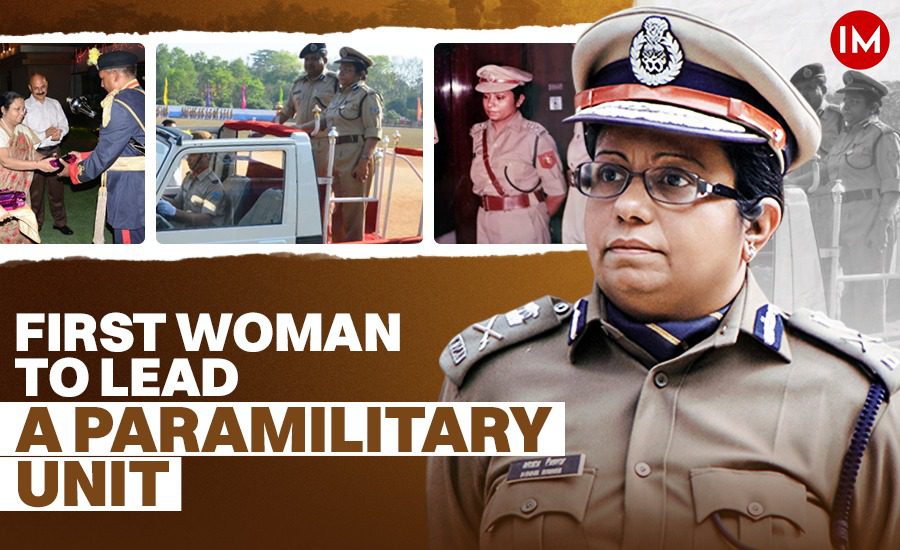
When Asha Sinha joined the Indian Police Service in 1982, there were barely a handful of women in uniformed leadership. Over the next four decades, she would not only serve Bihar, Maharashtra and Jharkhand with distinction, but also script history as the first woman to head any paramilitary force unit in India — leading the Central Industrial Security Force unit at Mazagon Dock Shipbuilders Limited, Mumbai.
A 1982-batch IPS officer of the Jharkhand cadre, she later went on to head both Intelligence (Special Branch) and CID (Crime Branch) in Jharkhand — assignments that tested her leadership in times of insurgency, elections and evolving crime patterns.
In an exclusive conversation with Indian Masterminds, Ms. Sinha reflects on leadership, gender, policing, institutional change and the evolution of law enforcement over 42 years.
Q1. Your IPS journey began in 1982. How would you describe your early years and your historic role as the first woman Commandant of a paramilitary unit?
My journey in the IPS began in 1982 and gave me the opportunity to serve in Bihar, Maharashtra, Jharkhand and also on central deputation with the CISF.
Being the first woman Commandant of a paramilitary force unit — the CISF at Mazagon Docks, Mumbai — was both a challenge and a deeply enriching experience. However, it never weighed on my mind that I was a woman leading an all-male force.
IPS training prepares every officer, regardless of gender, to lead from the front and function as a team. I simply did my job. The question of insubordination or being taken lightly never arose because leadership is earned through competence and integrity.
During my tenure, we strengthened high-level security, freed the dockyard from the grip of mafia gangs, drastically reduced theft, and resolved long-pending labour issues.
The greatest test came during the 1993 Mumbai serial blasts. Despite a diverse and large workforce and tense circumstances, we ensured the safety and security of both personnel and installations.
For any police leader, trust is earned through impartial administration, care for the staff under command, and achieving organizational goals through teamwork.
Q2. What was it like being a woman IPS officer in the early 1980s?
I joined the IPS in 1982, ten years after Kiran Bedi. At that time, there were not more than 15 women IPS officers in the country.
Though we cleared the same rigorous UPSC examination and underwent the same demanding training, the institutional mindset towards women officers was not very favourable 43 years ago.
Almost all of us faced initial challenges in our first field postings as SDPOs. Acceptance took time. But once our capabilities were recognised, there was no looking back.
Today, the scenario has transformed. In 2024 alone, 54 women IPS officers passed out from the National Police Academy. Women officers are handling tough assignments across policing and administration nationwide.
Q3. Does gender matter in police leadership?
When you are heading a district or department as an IPS officer, gender does not matter. You are fully trained and legally empowered to lead.
Statutory powers enhance your authority and leadership capabilities. Ultimately, leadership depends on professionalism, integrity and decision-making — not gender.
Q4. Do women officers face additional pressures compared to their male counterparts?
The level of hard work and commitment required in the IPS is tremendous for both men and women.
However, women often have to work doubly hard in a 24×7 high-pressure environment — to prove to themselves and sometimes to gain acceptance within the police, political administration and the public.
Balancing official commitments with responsibilities at home — young children, ageing parents and household management — requires extraordinary discipline and resilience.
Q5. Did you observe any state-wise differences in the treatment of women officers?
Initially, acceptance took time everywhere. But once capabilities were proven, there was no looking back.
From my experience, there was no major state-wise difference in treatment. However, the work culture may vary between states or central government organizations.
Q6. How did you manage work-life balance in such a demanding career?
Like any other career woman, I balanced my high-pressure 24×7 career with family responsibilities through a strong support system — family members, relatives and hired help.
Each officer must work out their own support structure depending on their personal circumstances.
Q7. You headed Intelligence (Special Branch) and CID in Jharkhand. What were the challenges?
I consider myself fortunate to have headed both Intelligence (Special Branch) and later CID (Crime Branch) in Jharkhand.
I took charge of the Special Branch soon after a Special Branch Inspector was killed by Naxalites. This was followed by State Assembly and Lok Sabha elections amid serious Naxal threats and heavy VVIP movement.
Ensuring peaceful elections through timely and accurate intelligence inputs was both challenging and exhilarating. Policing is dynamic — every day brings new problems that require immediate action.
Q8. How has the crime landscape changed over 42 years?
When I joined the service, there were no mobile phones, computers, social media or even STD facilities.
The nature of crime has changed drastically. Today’s officers must continuously upgrade their skills to stay ahead of criminals, especially in cyber and technology-driven crimes.
Q9. Are women officers today reaching top leadership roles like DGP?
Today, women officers are being given key and challenging assignments. Many states such as Uttarakhand, Maharashtra, Manipur and Jharkhand, as well as some CAPFs, have had women DGPs.
However, becoming a DGP depends on empanelment and government decisions. Not every IPS officer — male or female — can aspire to that position, as it is ultimately a policy decision from a panel of competent officers.
Q10. What personal principles guided your career?
I followed a few simple rules:
- Be sincere in your duties.
- Professional response matters. Gender does not.
- There is no good or bad posting — every assignment is an opportunity.
I never lobbied for any post, yet I was entrusted with crucial assignments. My value system was always my inner compass.
Q11. What legacy do you believe you leave behind?
Throughout my career, I promoted diversity and inclusion within the police force. I advocated equal opportunities irrespective of gender.
In a fair and unbiased environment, everyone feels valued and empowered to contribute their best.Even a decade after retirement, being remembered and honoured for my work is deeply gratifying. I am proud to have been part of this incredible journey as an IPS officer.