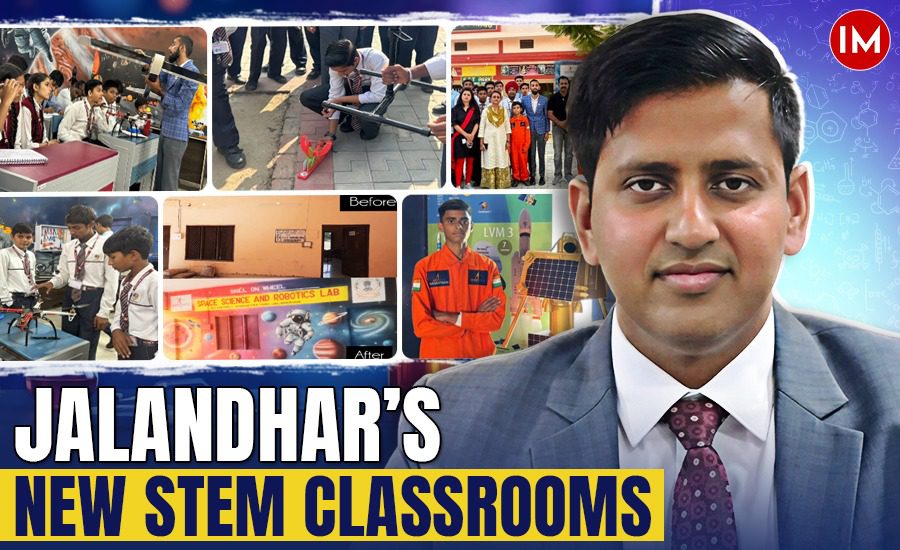
When conversations around school education often centre on infrastructure gaps and learning deficits, Jalandhar district has quietly introduced a model that reframes what government schooling can offer. Through Skill-on-Wheel, a district-led initiative conceptualised under the leadership of IAS Himanshu Aggarwal (2014 batch, Punjab Cadre), Deputy Commissioner of Jalandhar, government school students are being introduced to space science, robotics, drone technology, and design engineering—disciplines usually associated with elite institutions.
Designed as a targeted intervention, Skill-on-Wheel aims to close the widening gap between conventional classroom teaching and the rapidly evolving demands of science and technology education. Supported through a grant from the Department of Administrative Reforms and Public Grievances (DARPG) under the State Collaboration Initiative, the project focuses on building technology-enabled learning environments within government schools, ensuring that exposure to advanced STEM tools is no longer limited by socio-economic background.
FROM CONVENTIONAL CLASSROOMS TO INNOVATION LABS
The first phase of Skill-on-Wheel has already translated policy intent into tangible infrastructure. Two fully equipped Space and Innovation Labs are now operational at the School of Eminence, Phillaur, and the School of Eminence, Adampur. These labs are not add-ons to existing facilities; they represent a complete redesign of what a government school laboratory can look like.
Existing classrooms were upgraded through extensive civil and electrical works. Enhanced lighting, stable power systems, modular furniture, dedicated workstations, and digital connectivity were integrated to create spaces comparable to modern STEM and innovation labs. The idea was simple yet ambitious: remove the physical and technological constraints that often limit experiential learning in public schools.
What distinguishes these labs from standard computer labs is their emphasis on high-end engineering, design, and applied science tools. Students are not restricted to screen-based learning. Instead, they work with robotics kits, drone and aeromodelling modules, space science and astronomy equipment, rocket science kits, 3D printers, CAD modelling software, coding platforms, simulation systems, and smart-class facilities. For many students, this marks their first direct interaction with technologies that define contemporary scientific research and industry practice.
CURRICULUM BUILT AROUND EXPERIENCE, NOT ROTE LEARNING
The labs currently offer structured courses in Space Science and Technology, Robotics and Coding, Flying Drones and RC Aircrafts, 3D Printing and CAD Modelling, and Entrepreneurship and Innovation. The curriculum is deliberately designed to prioritise learning by doing. Students are encouraged to experiment, make errors, troubleshoot, and improve their designs—processes that mirror real-world engineering and scientific workflows.
Trained facilitators conduct sessions aligned with National Skills Qualifications Framework (NSQF) standards, ensuring consistency, quality, and the possibility of replication across other districts. Rather than treating STEM education as an abstract academic pursuit, the programme links concepts directly to applications, helping students understand how classroom learning translates into practical problem-solving.
The labs also function as spaces where aspiration is actively shaped. Working with drones, robots, and space-related tools introduces students to career pathways in aerospace, electronics, automation, and emerging technology sectors—fields that often remain outside the horizon of government school students. Building a drone or programming a robot becomes more than an activity; it becomes an introduction to how innovation-driven careers are built.
A SCALABLE, OUTCOME-FOCUSED MODEL
What strengthens Skill-on-Wheel as a governance initiative is its clear emphasis on outcomes rather than optics. The project does not rely on anecdotal success stories alone. Instead, it incorporates measurable indicators to assess learning impact and value for public expenditure.
As part of its institutional framework, the participating schools have been registered under the Space Tutor Programme of the Indian Space Research Organisation (ISRO), directly linking students to nationally recognised learning ecosystems. Annual assessments are conducted by an independent agency partnered with the district administration, ensuring objectivity in evaluation.
Impact is measured through multiple parameters: the number of hours students spend in lab-based sessions, the volume and quality of projects completed, and participation levels of government school students in national and state-level science competitions. These indicators provide a clear picture of engagement, skill acquisition, and external validation of learning outcomes.
EXPANSION ACROSS THE DISTRICT
Encouraged by the initial response and early indicators, Jalandhar district is now scaling the initiative. Seven additional Space and Innovation Labs across government schools are currently under development, significantly expanding the project’s reach. This phase signals a shift from pilot experimentation to district-wide institutionalisation.
By embedding advanced STEM infrastructure within the government school system, Skill-on-Wheel positions Jalandhar as a reference point for future-ready education in Punjab. The initiative demonstrates that with administrative intent, inter-departmental collaboration, and outcome-based monitoring, public education systems can move beyond minimum benchmarks toward globally relevant learning environments.
LEADERSHIP AND VISION
IAS Himanshu Aggarwal, has anchored the initiative in both administrative precision and educational purpose. Speaking about the project’s evaluation framework and broader goals, he underlined the importance of accountability and measurable impact.
“We have registered the schools under the Space Tutor Programme of ISRO. Annual assessments are held by an independent agency whom we had partnered with for these labs. Outcome is measured through the number of hours which these students take these sessions, projects being completed by students and participation of the government school students in national and statewide science competitions,” Mr Aggarwal shared with Indian Masterminds.
As Skill-on-Wheel continues to expand, it offers a practical template for districts seeking to align school education with the skills required for tomorrow’s economy—grounded in public funding, transparent metrics, and a belief that advanced learning should not be a privilege, but a public good.