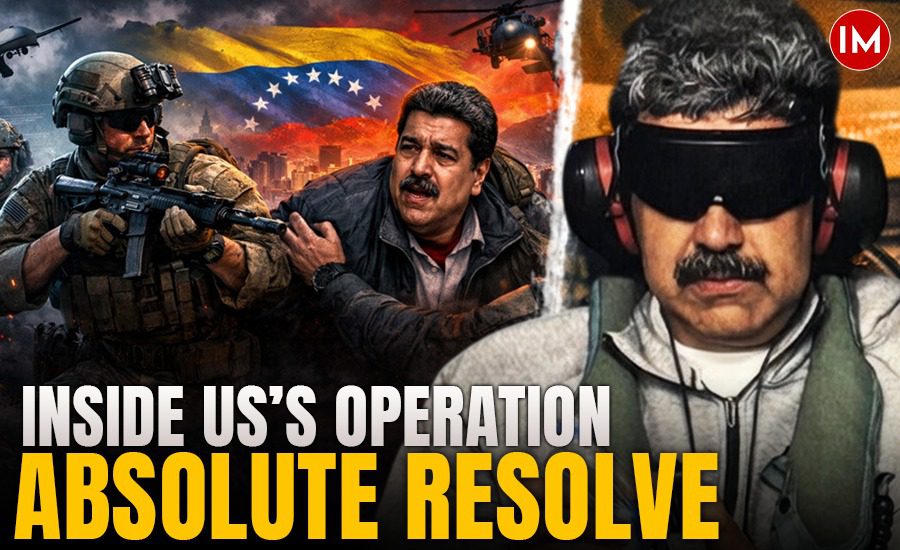
There are moments in modern warfare when even before the battle noise fades, the method adopted matters more than the message. Operation Absolute Resolve the audacious U.S. operation that resulted in the capture of Venezuelan strongman, Nicolás Maduro was one such moment.
From my soldier’s lens, this was not theatre. It was precision applied with intent.
Yet, as with all decisive military actions, the tactical brilliance raises deeper strategic questions. Was this a necessary act of counter–narco-terrorism, or a dangerous precedent in global statecraft? And more importantly, what lessons does it hold for countries like India watching from the strategic sidelines?
To understand the operation, one must first understand the rot it targeted.
Venezuela’s downward spiral did not begin overnight. The roots trace back to Hugo Chávez’s ideological pivot, which systematically distanced Caracas from the United States while drawing it closer to Russia, China, and Iran. Nicolás Maduro inherited not just a presidency, but a deeply compromised state apparatus. Despite sitting atop the world’s largest proven oil reserves, Venezuela collapsed under corruption, mismanagement, and institutional decay.
Oil production fell from nearly three million barrels per day to a fraction of that. Hyperinflation devoured salaries. Food and medicine became luxuries. Over eight million Venezuelans fled—one of the largest refugee crises in modern history. A state once rich in resources became poor in governance.
But from Washington’s perspective- the alleged fusion of state power with organised crime was the real red line.
Maduro’s regime was accused of running the infamous Cartel of the Suns, using Venezuela as a launchpad for cocaine trafficking into the United States. Criminal networks such as Tren de Aragua evolved from street gangs into transnational narco-terror outfits. When the U.S. Justice Department placed a multi-million-dollar bounty on Maduro’s head, it was not symbolic. It was a declaration that the Venezuelan state itself had crossed into criminality.
Diplomacy, predictably, ran out of road finally.
Years of negotiations collapsed amid allegations of rigged elections and broken promises. Sanctions tightened, maritime interdictions increased, and U.S. naval deployments off the Caribbean coast sent unmistakable signals. When political tools failed, military planners were already working through contingencies.
From a professional standpoint, what followed was a textbook special operations mission-
“For in the 21st century, wars are no longer declared, they are executed.”
Months of intelligence preparation preceded the strike. Human sources, signals intelligence, and surveillance mapped Maduro’s movements and security routines including the physical layout of his fortified compound. Mock-ups were constructed. Rehearsals were exhaustive.
Stealth aircraft neutralised radar coverage. Electronic warfare blinded response systems. Special operations teams inserted rapidly, exploited shock and surprise, and extracted the primary target without a single American casualty. Within hours, Maduro was off Venezuelan soil.
A demonstration of how when an execution window opens it needs a decisive closure.
In military parlance, this was not about spectacle but about control of time, space, and escalation.
Maduro now faces prosecution in the United States on charges ranging from narcotics trafficking to arms violations. Washington has framed the operation as counter-terrorism, not regime change. But the vacuum left behind in Caracas tells a more complicated story.
This is where history urges restraint. Yet victory in a raid does not equal victory in strategy.
Military force can remove a man. It cannot, by itself, repair institutions. Iraq, Libya, and Afghanistan remain cautionary tales where tactical success outpaced political planning. Precision operations win battles; governance wins peace.
Critics have already branded the operation an imperial over-reach, a Cold War reflex dressed in counter-narcotics language. Supporters argue the opposite that allowing a narco-state aligned with hostile powers to persist was strategically irresponsible.
The truth however, as always, sits uncomfortably in between.
For India, the episode is instructive.
New Delhi’s response and measured concern, calls for dialogue, and emphasis on civilian stability reflects its long-standing preference for strategic autonomy. India understands both sides of this equation. But it also knows that legitimacy matters as much as lethality.
The real lesson here is not about America or Venezuela. It is about the evolving character of power of proxy wars and hybrid warfare.
Modern conflicts are no longer declared. They are executed quietly, surgically, and often without legislative theatre. Intelligence fusion, special forces and narrative controls now move in lockstep. Precision has replaced mass. Surprise has replaced spectacle.
Wars are easy to start. Nation States are hard to rebuild.
Venezuela’s future will hinge not on who captured Maduro, but on whether governance replaces graft, institutions replace intimidation, and legitimacy replaces fear.
History will only judge this operation not by how cleanly it was executed, but by whether Venezuela emerges as a more stable, legitimate, and governable state than before.
Remember exercise of power and perfect precision must answer to the precise purpose and moral to the peace it enables always.
(The author is a war veteran with first hand experience in Kashmir.)