More than 1000 mm of rainfall lashed the city, while the larger catchment recorded a staggering 1369 mm. The Vishwamitri River swelled ominously, rising to nearly 23 feet amid 100–150 percent excess rainfall—levels that in previous years would have triggered widespread flooding. Yet this time, something was different.
Vadodara did not drown.
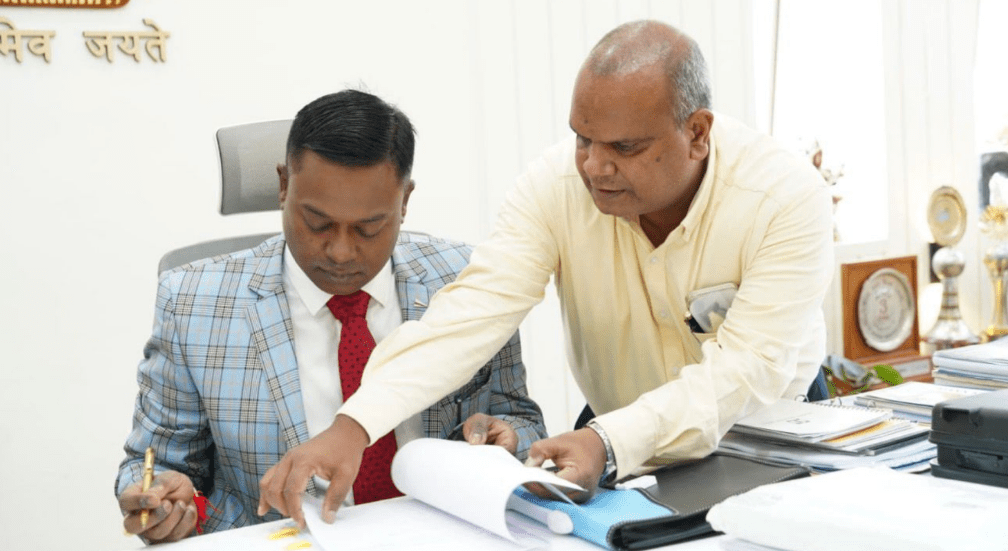
At the helm of this transformation was Arun Mahesh Babu, IAS (2013 batch, Gujarat cadre), serving as the Municipal Commissioner of Vadodara. Under his leadership, the Vadodara Municipal Corporation (VMC) executed one of the most comprehensive urban flood-management overhauls in recent memory—turning a city once vulnerable to monsoon fury into a model of climate resilience.
REBUILDING THE RIVER, RESTORING CAPACITY
The turning point came after the 2024 floods, when the administration decided incremental fixes would no longer suffice. What followed was a scientific and engineering-driven intervention beginning with the Vishwamitri itself.
Over 100 days, nearly 18.85 lakh cubic meters of silt were removed from the river through large-scale resectioning and desilting. The river channel was widened and deepened to restore its natural carrying capacity.
The results were dramatic. For a similar discharge, the peak water level dropped by almost eight feet compared to previous years.
“Flood management cannot be reactive. We treated the river as a hydraulic system that needed restoration, not temporary relief,” says Babu. “Once we restored its carrying capacity scientifically, the river responded.”
Simultaneously, Ajwa, Pratappura, and the newly created Dena buffer lake were deepened and expanded. These reservoirs absorbed heavy inflows, acting as shock absorbers during peak rainfall. By increasing water-holding capacity, the city reduced downstream pressure at critical moments.
RULE-BASED RESERVOIR MANAGEMENT
One of the most critical operational decisions lay in how water was released.
Instead of ad-hoc discharge practices, VMC adopted hydrology-based rule curves for reservoir operations. Pre-monsoon drawdown protocols were implemented to create buffer storage before heavy rainfall began. Releases were staggered and calibrated to match downstream carrying capacity.
Updated stage–discharge curves and real-time hydraulic assessments ensured that reservoir operations reflected actual river behavior rather than outdated assumptions.
“We formalized science into decision-making,” Babu explains. “Releases were not just about reducing reservoir levels; they were synchronized with what the downstream channel could safely carry.”
This rule-based discipline ensured that even when the Vishwamitri touched 23 feet, the situation remained under control.
STORMWATER NETWORK REVAMP
While rivers draw attention, urban flooding often begins in clogged drains and overwhelmed stormwater channels. Recognizing this, VMC undertook a citywide drainage overhaul.
Nearly 180 kilometers of critical stormwater channels were widened and cleaned. Proper outlets were created for 11 major lakes, integrating them into the city’s drainage grid and preventing water stagnation. Culverts were cleared, and structural audits were conducted ahead of the monsoon.
This integrated approach drastically reduced waterlogging in historically vulnerable neighborhoods.
“A river alone does not flood a city. A disconnected drainage network does,” says Babu. “We ensured every lake, drain, and outfall became part of one cohesive system.”
DATA, EARLY WARNINGS, AND RAPID RESPONSE
Science did not end with engineering works. It extended into real-time monitoring and predictive planning.
Vadodara deployed a robust Early Warning System (EWS) integrating automatic rain gauges, river sensors, and reservoir telemetry. Real-time rainfall and water-level monitoring enabled rapid decisions—whether deploying pumps, clearing culverts, or issuing public advisories.
Predictive flood mapping strengthened preparedness, while coordinated field deployment minimized disruption.
The system is now evolving into a full City Climate Command and Control framework, integrating hyper-local alerts and extreme-event simulations.
“Data reduces panic,” Babu notes. “When you can see the system responding in real time, decisions become precise rather than reactive.”
ECOLOGICAL SENSITIVITY AMID HEAVY MACHINERY
The Vishwamitri is not just a river; it is home to over 440 crocodiles and diverse wildlife. Large-scale desilting along such a river posed ecological challenges.
Yet, despite months of heavy machinery operations, there were zero human-wildlife conflicts. Continuous monitoring, coordinated rescue support, and daily ecological oversight ensured the safety of 442 crocodiles and other species.
Environmental safeguards were embedded into contractor responsibilities, making ecological care a formal protocol rather than an afterthought.
“Urban resilience cannot come at the cost of ecology,” Babu emphasizes. “If anything, restoring rivers strengthens biodiversity.”
RAINWATER HARVESTING AND DECENTRALIZED STORAGE
Flood resilience was paired with water sustainability.
VMC constructed nearly 450 rainwater harvesting wells out of 526 planned across public institutions and low-lying areas. Each high-capacity well can percolate up to 24,000 liters per hour, improving groundwater recharge and reducing surface runoff.
Buffer lakes were rejuvenated, new lake outlets were constructed, and dredged materials were repurposed for roads, embankments, parks, and civic infrastructure—turning waste into resource.
These measures reduced pressure on storm drains and strengthened long-term water security.
INSTITUTIONALIZING RESILIENCE
Perhaps the most significant achievement lies not in surviving one extreme monsoon—but in embedding resilience into governance.
Hydrology-based rule curves, staggered reservoir releases, pre-monsoon drawdown protocols, and downstream capacity assessments have now been formalized into permanent Standard Operating Procedures jointly owned by VMC, the Vadodara Collectorate, and State Disaster Management authorities.
Annual desilting targets, structural audits, and fixed maintenance calendars are now budgeted programs supported by modern surveying tools.
Climate resilience has been mainstreamed into urban planning, development control regulations, capital budgeting, stormwater policies, green construction norms, and sustainable drainage frameworks. Every new road, housing scheme, or corridor is now designed to contribute to resilience rather than burden the system.
“The goal was never just to prevent one flood,” says Babu. “We are building a governance framework where science, ecology, and operational discipline become routine—not extraordinary.”
A MODEL FOR CLIMATE-RESILIENT CITIES
The numbers speak for themselves. With over 1000 mm of rainfall in the city and 1369 mm in the catchment, Vadodara experienced no major flooding in 2025—a dramatic improvement from 2024.
More importantly, the city has transitioned from reactive flood response to predictive, integrated water management.
Under the leadership of Arun Mahesh Babu, IAS (2013 batch, Gujarat cadre), Vadodara has demonstrated that scientific river management, coordinated reservoir operations, data-driven governance, ecological safeguards, and community-centered infrastructure can together transform a city’s flood performance.
Vadodara’s story is not merely about avoiding disaster. It is about reimagining how Indian cities can coexist with rivers in an era of climate extremes.
As Babu reflects, “Climate events may intensify, but preparedness can intensify too. Resilience is a choice—and we chose to prepare.”