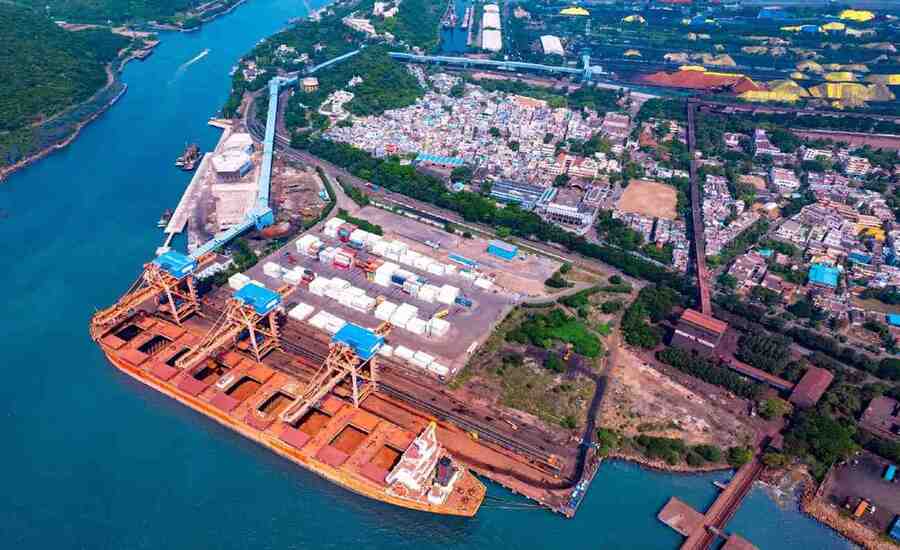
Visakhapatnam: India is enhancing its maritime defence infrastructure with a modern high-capacity dry dock in Visakhapatnam that will support construction of 10,000-tonne Project-77 nuclear-powered attack submarines (SSNs) alongside the new S5 class nuclear ballistic missile submarines (SSBNs).
This development marks a significant step in India’s pursuit of undersea warfare capability and strategic deterrence.
The focus of this expansion is the Project-77 nuclear attack submarine programme, a key initiative in the Indian Navy’s transformation into a true blue-water navy. These submarines are expected to be large, stealthy and capable of long-range patrol and combat missions.
Details of Visakhapatnam Dry Dock
The newly completed dry dock in Visakhapatnam became operational in 2025 and is designed specifically to handle construction and assembly of large submarine hulls.
- The facility supports simultaneous construction of multiple submarines, boosting industrial throughput.
- It will house both Project-77 SSNs and the larger S5 ballistic missile submarines, enabling integrated production on a common platform.
Such capacity is strategic for India, as it eliminates infrastructure bottlenecks in submarine production and aligns with future fleet expansion goals.
What Are Project-77 SSNs?
‘Project-77’ refers to a class of nuclear-powered attack submarines that will feature next-generation propulsion and stealth technologies.
What are the Characteristics of Project 77 SSNS
- Displacement: ~10,000 tonnes — placing Project-77 SSNs above earlier nuclear submarine classes in size and capability.
- Power: They will use nuclear reactors — enabling long endurance and extended range for deep-sea missions.
- Mission Role: Designed for hunter-killer operations — tracking enemy submarines, escorting carrier groups, and conducting maritime strike missions.
These submarines contrast with S5 SSBNs, which are focused on carrying nuclear ballistic missiles and forming India’s sea-based nuclear deterrent.
Parallel Build Strategy with S5 SSBN Programme
India’s S5 class SSBNs — the next evolution of the nuclear ballistic fleet — are already under construction at the Ship Building Centre (SBC) in Visakhapatnam. These are projected to be even larger than earlier submarines, displacing over 13,000 tonnes to carry long-range ballistic missiles.
The new dry dock serves both programmes side by side, ensuring India strategically expands both deterrence (SSBN) and tactical power projection (SSN) capabilities.
What is the Importance of Visakhapatnam Dry Dock
The dual construction capability provided by the Visakhapatnam dry dock aligns with India’s broader Maritime Capability Perspective Plan, which emphasizes:
- Blue-water operations across the Indian Ocean and Indo-Pacific.
- Enhanced undersea surveillance and naval deterrence.
- Support for carrier battle groups and deep-sea strike missions.
With China’s expanding submarine presence and wider Indo-Pacific tensions, Project-77 SSNs will be crucial for India’s naval balance and regional deterrence strategy.
Defense Industry and Indigenous Capabilities
The shipbuilding project marks a key milestone in India’s push for self-reliant defence manufacturing (Aatmanirbhar Bharat). The submarine infrastructure in Visakhapatnam is designed to reduce dependency on foreign yards and strengthen India’s industrial base.
This includes:
- Collaboration between the Warship Design Bureau, DRDO, BARC, and Indian shipyards.
- Engagement of private sector firms like Larsen & Toubro for hull fabrication and complex assembly work.