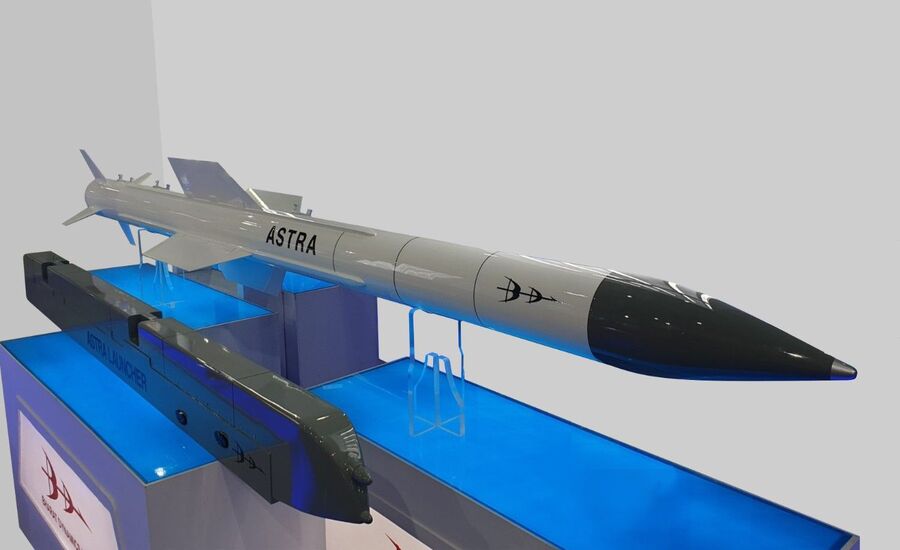
New Delhi: The Astra MK-2 missile trial is drawing major attention as the Defence Research and Development Organisation (DRDO) prepares for a crucial test to demonstrate the missile’s strike capability beyond 200 kilometres.
This development marks a significant leap in India’s indigenous Beyond-Visual-Range Air-to-Air Missile (BVRAAM) technology. India is enhancing its aerial combat edge by extending the range of the Astra series to rival some of the longest-range missiles in its class.
Background of Astra MK-2 Missile
The Astra missile programme is India’s flagship indigenous air-to-air missile development project, initiated decades ago to reduce dependence on imported weapon systems.
Read also: DRDO Surya Laser Weapon Explained: Range, Technology, Capabilities, and Strategic Impact
The original Astra Mk-1 has already been integrated into the Indian Air Force (IAF) fleet, providing long-range engagement capability with a range of around 160 km. The Mk-2 variant builds on this legacy with major enhancements.
India’s evolving air threat environment — from advanced neighbouring air forces and high-speed aerial threats — has driven DRDO to push the range envelope and improve tracking and guidance systems. The goal is to give IAF pilots the ability to engage hostile aircraft well before they come into visual range.
What’s New in the Astra MK-2 Missile
DRDO is preparing for a flight test of the upgraded Astra MK-2 missile in early 2026 to show it can engage targets beyond 200 km. This improved range is a leap forward from earlier Mk-2 projections and is made possible through an advanced rocket motor and optimized propulsion systems.
Current reports suggest that with further refinements, the effective range may extend up to around 240 km, making it one of the longest-range BVRAAMs among weapons of its kind.
Enhanced Guidance and Tracking
The Astra MK-2 features an indigenous Active Electronically Scanned Array (AESA) radar seeker and two-way data link connectivity. These upgrades help maintain target lock even in high-electronic-jam environments and allow mid-course updates from the launch aircraft.
Propulsion and Manoeuvrability
A new smokeless dual-pulse solid rocket motor has been incorporated to reduce infrared signature, improve manoeuvrability, and extend flight endurance. Enhanced thrust vector control contributes to superior target engagement performance, especially against agile or stealthy aircraft.
What is the Significance of Astra MK-2 Missile
A missile capable of reaching beyond 200 km gives the IAF a decisive first-strike advantage in beyond-visual-range aerial scenarios. This is crucial against potential adversaries equipped with similar high-range air-to-air weapons.
Supporting Indigenous Platforms
The Astra MK-2 is not only expected to be deployed on current platforms like the Sukhoi Su-30MKI but also future Indian combat jets such as the HAL Tejas Mk-1A and the planned Advanced Medium Combat Aircraft (AMCA).
Countering Regional Missile Threats
Expanding strike range in air-to-air missiles is a direct response to regional aerial threats, including long-range missiles in neighbouring arsenals. By delivering solid performance at over 200 km, the Astra MK-2 increases the IAF’s deterrence capacity across strategic frontiers like the Indian Ocean Region and the Himalayas.
Astra MK-2 Induction
Bharat Dynamics Limited (BDL) — India’s primary missile manufacturer — has already fulfilled orders for the Astra Mk-1, and production lines are being readied for the Mk-2. Initial contracts may eventually exceed 1,000 units, fostering growth in domestic defence manufacturing.
Trail to Astra Mk-3 and Beyond
Strategic thinkers predict that success with the Mk-2 will pave the way for the next-generation Astra Mk-3, which aims for ranges well beyond 250 km with ramjet propulsion systems. This continues India’s roadmap toward achieving air dominance with indigenous missile systems.
What is the Implications of Astra MK-2 Missile
India’s push for extended range BVRAAMs aligns with its broader national policy of Atmanirbhar Bharat in Defence, reducing reliance on foreign systems such as the MBDA Meteor while strengthening its role as a technologically advanced defence manufacturer.
This trial is not merely a test but a strategic statement that India aims to compete with leading global air arms and shape aerial warfare dynamics in the South Asian region and beyond.
Read also: DRDO’s Microwave Weapon Explained: Technology, Range, and Strategic Impact on India’s Defence