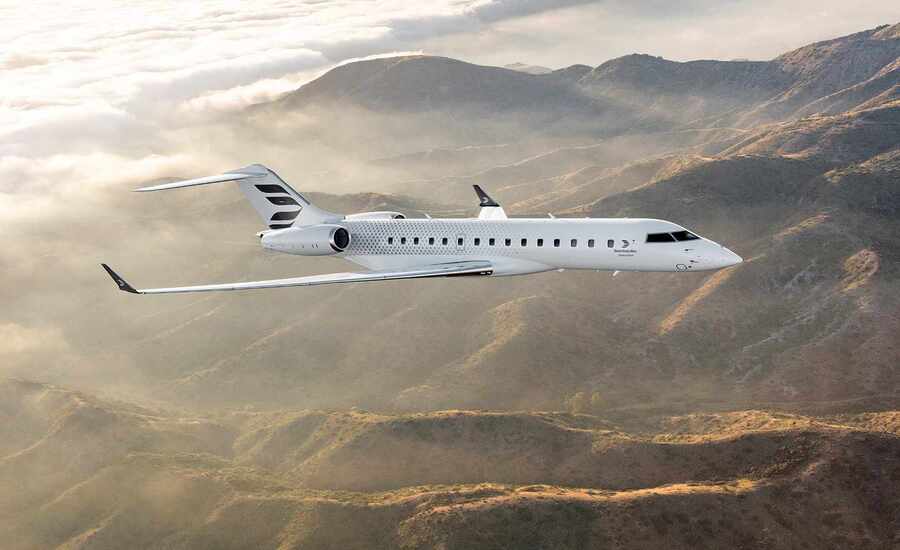
New Delhi: India has taken a significant leap toward strengthening its aerial intelligence and battlefield awareness with the Defence Research and Development Organisation (DRDO) officially selecting the Bombardier Global 6500 ultra-long-range business jet as the platform for the IAF Intelligence, Surveillance, Target Acquisition, and Reconnaissance (ISTAR) programme.
Valued at around ₹10,000 crore, this initiative aims to bolster India’s surveillance reach along strategic borders, modernising airborne reconnaissance with cutting-edge indigenous technology.
Background of IAF ISTAR Programme
The ISTAR programme is designed to provide the IAF with a next-generation aerial reconnaissance capability, integrating intelligence gathering with real-time surveillance, target tracking, and battlefield data fusion.
ISTAR — an acronym standing for Intelligence, Surveillance, Target Acquisition, and Reconnaissance — plays a crucial role in modern combat operations by combining sensor data into actionable insights for commanders.
Approved by the Defence Acquisition Council (DAC) in mid-2025, the ₹10,000 crore project envisions acquiring three advanced aircraft to serve as airborne nerve centres.
These platforms will detect and monitor threats over vast distances, relay critical information to combat units, and enhance overall battlefield situational awareness.
Why Bombardier Global 6500 Was Chosen for IAF ISTAR Programme
The Bombardier Global 6500, originally designed as a civilian ultra-long-range business jet, has been chosen as the ISTAR platform due to its exceptional endurance, range, and adaptability for military applications.
The jet offers an unrefuelled range of approximately 6,600 nautical miles (over 12,000 km) — enabling extended mission durations without frequent returns to base.
Platform Capabilities and Retrofit Potential
Endurance and Altitude: Cruising at altitudes up to 51,000 feet, the Global 6500 offers superior sensor coverage and reduced vulnerability to surface threats, enabling stable surveillance in contested environments.
Large Cabin Volume: The aircraft’s spacious interior, originally intended for civilian comfort, is being retrofitted to house advanced radar arrays, communication suites, and ergonomic workstations for mission crews, facilitating collaborative operations lasting 10–12 hours or more.
Speed and Reliability: Powered by twin Rolls-Royce Pearl engines, the platform can cruise at speeds near Mach 0.90 (approximately 950 km/h), blending rapid deployment capability with operational persistence.
Indigenous Integration: DRDO’s Sensor Suite
What sets India’s ISTAR effort apart is the integration of home-grown sensor and electronic systems developed by the DRDO’s Centre for Airborne Systems (CABS). These include:
Synthetic Aperture Radar (SAR): High-resolution terrain mapping that penetrates weather systems and foliage.
Electronic Intelligence (ELINT) Systems: Tools to intercept and analyse adversary communications and emissions.
Moving Target Indication (MTI) Radars: For real-time tracking of vehicles, troop movements, and potentially low-observable assets.
Together, these sensors will create a unified battlespace picture that enhances target acquisition accuracy and supports decision-making at strategic and tactical levels.
Operational Impact and Strategic Utility of IAF ISTAR Programme
Enhanced Border Surveillance
The ISTAR aircraft will play a vital role in monitoring India’s extensive borders, particularly along the Line of Control (LoC) with Pakistan and the Line of Actual Control (LAC) with China.
Their ability to loiter in contested airspace and detect enemy movements early will strengthen defensive posturing and tactical response.
Force Multiplier in Conflict Scenarios
In the event of active confrontations, these ISTAR jets will serve as force multipliers by providing real-time coordinates and detailed battlefield data to combat units. This accelerates decision-making, improves target accuracy, and reduces collateral risks during engagements.
Integration with Networked Defence Assets
The ISTAR platforms will work alongside existing Indian defence systems — including Rafale fighter jets, Apache helicopters, and remotely piloted Heron drones — forming a multi-layered intelligence and strike network.