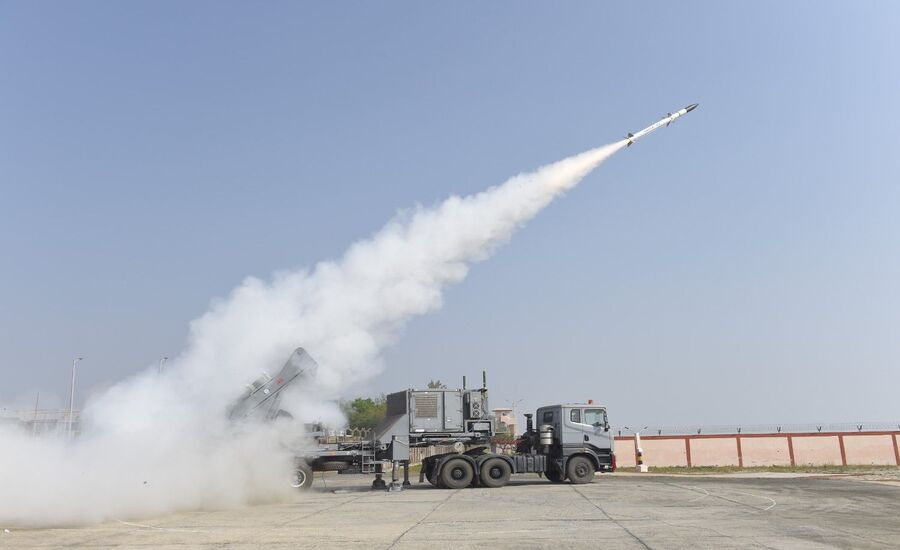
New Delhi: The Defence Research and Development Organisation (DRDO) has successfully completed the User Evaluation Trials (UET) of the Next-Generation Akash (Akash-NG) air defence missile system, marking a pivotal milestone in India’s defence self-reliance journey and significantly bolstering its layered air defence architecture.
Strategic Significance of the Akash-NG Missile Trials
India’s indigenous surface-to-air missile (SAM) systems have been key pillars of national defence, especially in protecting critical assets from aerial threats including fighter aircraft, unmanned aerial vehicles (UAVs), cruise missiles, and more.
Read also: India’s Hypersonic Leap: LRAShM Missile Enters Serial Production, Eyes 1,500 km Range
The Akash-NG — developed under the aegis of DRDO with extensive participation from Indian industry partners — builds on this legacy, bringing enhanced mobility, reduced weight, superior precision, and advanced engagement capabilities compared to earlier variants of the Akash family.
Akash-NG Missile Trials Validate Operational Readiness
During the recent user evaluation trials, Akash-NG demonstrated high precision and effectiveness, successfully intercepting aerial targets across diverse profile scenarios:
- Near-boundary, low-altitude threats
- Long-range, high-altitude targets
- Engagements at varying distances and altitudes across multiple operational envelopes
Defense analysts note that such diverse engagement conditions are designed to mirror real-world battlefield dynamics, ensuring confidence in the system’s ability to respond against evolving aerial threats.
Technology & Indigenous Features
A notable feature of the Akash-NG system is the emphasis on indigenous design and development:
Indigenous Radio Frequency (RF) Seeker – Enhances target detection and tracking capabilities.
Dual-Pulse Solid Rocket Motor – Improves missile propulsion and energy management.
Homegrown Radars & Command-Control Systems – Entire fire control suite developed jointly with Indian industry.
This level of self-sufficiency underscores India’s Atmanirbhar Bharat initiative in defence technology, which seeks to reduce dependency on foreign systems and build robust, domestic technological ecosystems.
Pathway to Induction and Operational Deployment After Akash-NG Missile Trials
With trials completed successfully, the Ministry of Defence has confirmed that Akash-NG is now ready for formal induction.
.@DRDO_India successfully completed User Evaluation Trials of the Next Generation Akash (Akash-NG) missile system, paving the way for its induction into the Indian Armed Forces. The system demonstrated high precision against diverse aerial threats, including high-speed,… pic.twitter.com/3DCcgtdph8
— Ministry of Defence, Government of India (@SpokespersonMoD) December 23, 2025
Senior defence officials from DRDO and user representatives from the Indian Air Force (IAF) were present during the evaluations, adding to the confidence in transitioning the missile system from trials to operational units.
The system’s anticipated integration into the defence forces is expected to significantly enhance India’s air defence preparedness, particularly in a security environment marked by rapid advancements in aerial technology across global theatres.