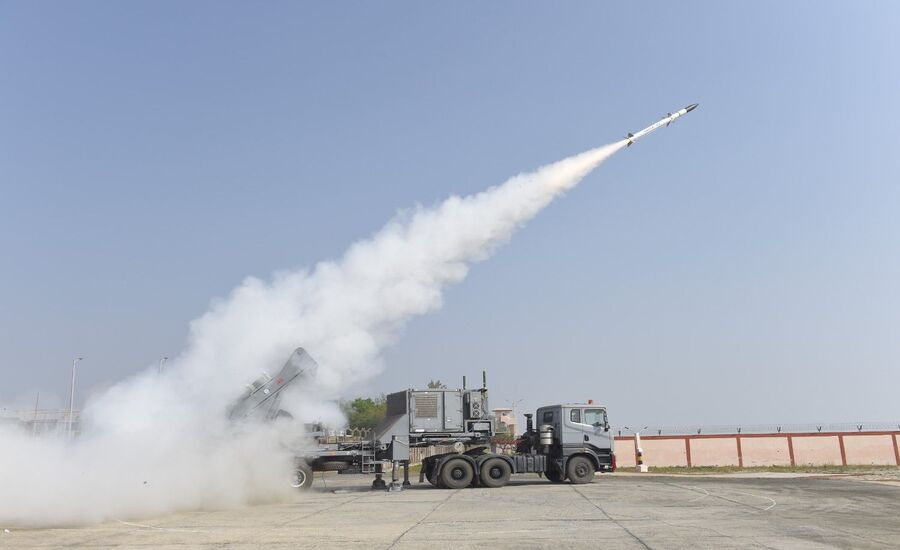
New Delhi: Defence Research and Development Organisation (DRDO) has successfully extended the operational range of the Akash-NG missile to 50 kilometres, marking a significant leap in India’s indigenous air defence capabilities.
This extension comes after rigorous testing and validation of the missile’s advanced dual-pulse solid rocket motor, which has enhanced its speed, manoeuvrability and ability to intercept modern aerial threats, including high-speed drones.
What is the Importance of the Akash-NG Missile
The Akash-NG (Next-Generation) surface-to-air missile is India’s advanced homegrown air defence system developed by DRDO to counter rapidly evolving aerial threats such as stealth aircraft, high-speed unmanned drones, cruise missiles and low observability targets.
With this range extension, the Akash-NG now fills a critical gap in the medium-range defence envelope (up to 50 km) — bridging existing capabilities between short-range systems and long-range strategic interceptors used by the Indian Armed Forces.
Dual-Pulse Motor: The Technological Game Changer
At the heart of this breakthrough is the successful validation of the dual-pulse solid rocket motor, a propulsion system that delivers thrust in two distinct stages during the missile’s flight.
- Improved Energy Management: The first thrust pulse accelerates the missile after launch, while the second pulse sustains speed during the terminal or “endgame” phase.
- Enhanced Manoeuvrability: This two-stage thrust enhances the missile’s ability to chase agile targets and maintain stable velocity throughout flight.
- Greater Endurance: The design allows the system to conserve energy and engage targets effectively at extended distances.
This motor design represents an upgrade over older single-stage or ramjet propulsion systems, giving India’s air defence forces a distinct technological edge against evolving threats.
Successful Intercept Against High-Speed Banshee Drone
The improved reach and performance of the Akash-NG were confirmed through user evaluation trials jointly conducted with the Indian Air Force (IAF). During these tests, the system successfully intercepted a high-speed Banshee target drone at the full 50 km range — a rigorous benchmark used to simulate challenging aerial threats that military defence systems often face in real combat.
This confirms not only the extended range of the missile but also the effectiveness of its indigenous active radio frequency (RF) seeker in tracking and engaging low-observable, fast-moving targets.
Akash-NG Missile Range: Enhanced Tactical Utility and Defence Network Integration
With the 50 km range now validated, the Akash-NG can integrate more effectively within India’s layered air defence strategy, complementing:
- Short-range point defence assets
- Long-range interceptor systems
- Ground-based radars and command networks
This extended engagement envelope allows ground forces to neutralise threats far before they approach critical infrastructure or troop concentrations, significantly increasing battlefield survivability.
Indigenous Capabilities and Operational Benefits
The Akash-NG demonstrates multiple operational advantages that make it a transformational missile system for India’s defence architecture:
- Canisterised Launch System: Provides reduced logistical footprint and faster deployment time.
- Active RF Seeker: Improves tracking of low-signature targets even under electronic countermeasures.
- Multiple Target Engagement: Ability to track and engage several threats simultaneously.
- Enhanced Mobility: Lighter launch vehicles improve tactical flexibility in diverse terrains.
These enhancements are expected to place the Akash-NG among the most capable medium-range surface-to-air systems developed indigenously.
Akash-NG Missile Range Extension: What This Means for Indian Defence
The successful validation and range extension of Akash-NG is a major milestone in India’s pursuit of strategic autonomy in defence technologies. With threats from drones, cruise missiles and advanced aircraft on the rise, this capability will play a central role in safeguarding national airspace and strengthening the operational readiness of the Indian Armed Forces.
As the system moves towards production and induction, it will also enhance India’s export potential in defence hardware — especially to nations seeking cost-effective but technologically advanced air defence options.
Read also: India’s Home-Grown Astra MK-2 Missile Aims Beyond 200 km in Landmark DRDO Trial