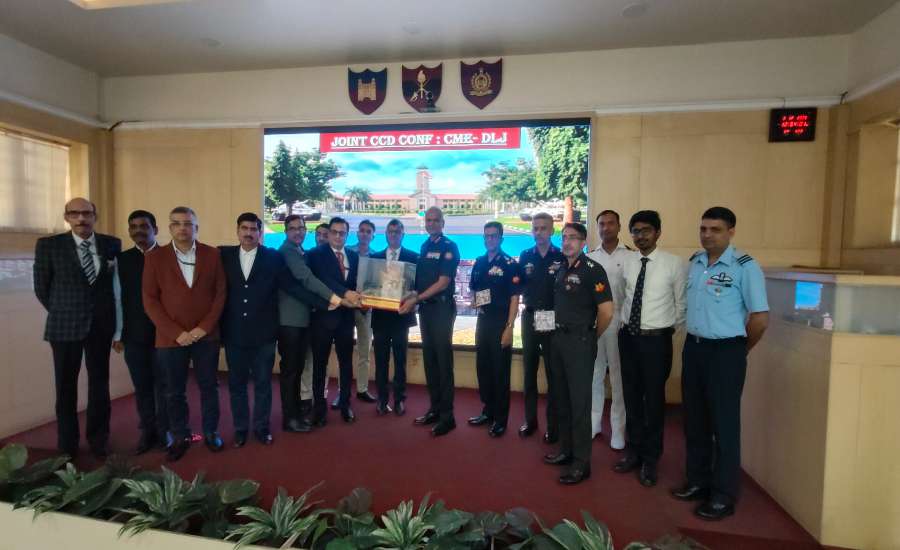
Mumbai: In a significant stride toward enhancing battlefield stealth and deception capabilities, the Defence Laboratory, Jodhpur (DLJ) — under the aegis of DRDO — has formally handed over its newly developed “Camouflage Pattern Generation Software Sigma 4.0 (CPGSS4.0)” along with a full-scale multispectral signature tank mock-up to the College of Military Engineering (CME), Pune.
Background of Sigma 4.0
The Defence Laboratory, Jodhpur (DLJ) was established in 1959 to address the unique demands of desert and general terrain warfare, with a focus on materials, electronics, camouflage, and other defence-relevant research.
Read also: From Guns to Smart Guns: Indian Army Evaluates Oerlikon Skyshield for Modern Drone & Missile Threats
Over decades, DLJ has been instrumental in developing technologies such as lightweight radar-absorbing materials, chaff payloads for electronic countermeasures, and various signature management systems.
In more recent years, research at DLJ has increasingly focused on advanced camouflage solutions — particularly multispectral camouflage. Unlike traditional camouflage that only hides visual detection, multispectral camouflage aims to thwart detection across a broader electromagnetic spectrum, including infrared, thermal, and radar bands.
Such multispectral capabilities are critical in modern warfare, where sensors and detection systems operate across different wavelengths — from optical imaging to infrared surveillance to radar scanning.
What Is Sigma 4.0? — The Camouflage Pattern Generation Software
At the core of this handover is the newly developed software: Camouflage Pattern Generation Software Sigma 4.0 (CPGSS4.0). While official technical specifics shared so far are limited, the concept aligns with advanced digital camouflage-pattern generation methods now used globally.
- Camouflage generation using computer algorithms — rather than manual design — enables dynamic, terrain-specific pattern creation, incorporating background colours, textures and randomness to better blend equipment and vehicles with their surroundings.
- Academic and industrial camouflage research — including fractal-texture based digital camouflage methods — demonstrates that software-based generation can significantly improve adaptability, randomness, and effectiveness compared to traditional static paint or pattern schemes.
- By adopting such an approach, CPGSS4.0 likely enables Indian forces to generate camouflage patterns tailored to specific terrains (desert, forest, urban, etc.), lighting, and detection threats — helping vehicles and assets remain concealed across visual, infrared, and possibly radar/thermal spectrums.
- This adaptability is especially crucial for India, given its varied geography — from deserts and plains to mountains, jungles and deserts — demanding different camouflage solutions depending on region and threat environment.
Sigma 4.0: The Multispectral Signature Tank Mock-up — Training For Real-World Deception
The ceremonial handover, conducted in the presence of senior DRDO and Army officials, marks a crucial step in equipping India’s tri-service forces with advanced camouflage and signature management technologies.
According to DRDO’s official announcement, CPGSS 4.0 was launched by Lieutenant General AK Ramesh, SM, Commandant CME, alongside DLJ Director V. S. Shenoi — signalling its imminent availability for use across the Indian Army, Navy, and Air Force. A full-scale multispectral signature tank mock-up will serve as a training tool for service personnel in camouflage and deception techniques.
Defence Laboratory, Jodhpur(DLJ), DRDO handed over Camouflage Pattern Generation Software Sigma 4.0 (CPGSS4.0) and A full scale Multispectral Signature Tank Mock-up to CME, Pune today.
— DRDO (@DRDO_India) December 3, 2025
CPGSS4.0 was launched today by Lt Gen AK Ramesh, SM, Comdt CME in the presence of Sh VS… pic.twitter.com/iRpPHYkgeJ
This development underscores India’s growing emphasis on indigenous research and development to safeguard critical military assets from detection across multiple sensor spectrums.
Alongside the software, DLJ has handed over a full-scale multispectral signature tank mock-up. This mock-up is not a working battle tank but a training/demonstration rig designed to simulate real tank signature characteristics (visual, infrared, thermal, radar) under different camouflage configurations.
The main purpose of such a mock-up is to prepare personnel — camouflage specialists, signal-intelligence units, and engineers — in applying multispectral camouflage, deploying deception techniques, and evaluating effectiveness under controlled testing conditions.
Given advances in detection technologies — including thermal imaging, infrared sensors, and radar-based surveillance — such training is critical to ensure that camouflage schemes remain effective across all likely detection modalities. Multispectral camouflage aims exactly to counter such detection — not just in visible light but also infrared, thermal and radar domains.
The tank mock-up thus becomes a live testing ground: personnel can test camouflage patterns generated by Sigma 4.0 software, fine-tune deployment strategies, and learn how best to conceal tanks or other large assets under diverse threat environments.
Strategic Importance of Sigma 4.0 for Tri-Service Use
That the handover was made to the College of Military Engineering (CME), Pune — rather than directly to a single service branch — signals DRDO’s intention for tri-service applicability.
According to the DRDO announcement, Sigma 4.0 will be “available for use by Tri-Services.”
Significance
- Army can camouflage and manage signatures of tanks, armoured vehicles, artillery units, and bunkers in terrain-specific operations.
- The Navy may leverage multispectral camouflage for coastal installations, shore-based radar/weapon systems, amphibious equipment, or even land-support assets in littoral zones.
- The Air Force could potentially use similar signature-management techniques for ground-based radar shelters, missile launchers, or support vehicles — reducing detectability from adversary surveillance.
By enabling all three services to access a common camouflage-generation toolkit and training mock-up, DRDO ensures a unified, interoperable stealth and deception approach — vital in modern multidomain operations.
Broader Context: Why Camouflage and Signature Management is Important now for India
Modern warfare and surveillance have evolved far beyond simple visual detection. Adversaries now employ multispectral sensors — infrared, thermal, radar, even millimetre-wave — along with high-resolution satellite imagery, drones, and electronic-intelligence platforms.
As a result, traditional paint-based camouflage is often inadequate. Even well-camouflaged tanks or vehicles may be detectable through thermal signatures, heat emissions, or radar reflections.
Multispectral camouflage — which aims to conceal across multiple detection bands — helps mitigate this risk. By blending temperature signatures, modifying surface reflectivity, and using materials or coatings that reduce radar visibility, multispectral camouflage can significantly delay or prevent detection.
For a country like India, with a wide variety of terrains, extreme weather conditions, and a need for strategic flexibility, indigenous development and deployment of such technologies is crucial. Relying on foreign camouflage or stealth solutions may not suffice, especially given evolving threat perceptions and surveillance capabilities.
Hence, the induction of Sigma 4.0 and the multispectral tank mock-up represents more than just a technical adoption — it is a step toward self-reliance, operational readiness, and future-ready defence preparedness.
Future Implications of Sigma 4.0
Faster camouflage adaptation: With Sigma 4.0, camouflage patterns can be generated quickly for different terrains — enabling forces to adapt to changing deployment environments.
Comprehensive stealth across spectrums: Multispectral camouflage reduces detectability not just visually, but thermally and radar-wise — critical against modern sensor threats.
Training & doctrine development: The mock-up allows training personnel in real-world signature management and camouflage deployment, paving the way for doctrine and SOPs (standard operating procedures) around deception operations.
Tri-service integration: A unified system for Army, Navy and Air Force promotes coordination, interoperability and shared learning — especially relevant for joint operations.
Indigenous innovation & Atmanirbhar Bharat: Encourages domestic R&D and reduces dependence on foreign technologies — aligning with national strategic goals.
Key Challenges & Considerations
As with any new technology, several challenges and considerations remain:
- Real-world effectiveness vs testing conditions: While mock-ups and controlled tests are valuable, actual battlefield conditions — weather, terrain complexity, wear & tear — may impact camouflage effectiveness.
- Maintenance and lifecycle: Camouflage coatings or materials often degrade over time, especially under harsh conditions. Sustaining multispectral effectiveness may require regular maintenance or replacement.
- Cost-benefit analysis: Advanced multispectral materials, painting/coating processes, and retrofitting existing equipment could be costly — decision-makers must balance stealth needs with budget constraints.
- Training and deployment complexity: Personnel must be thoroughly trained to apply camouflage correctly; improper application could reduce effectiveness or even increase detectability.