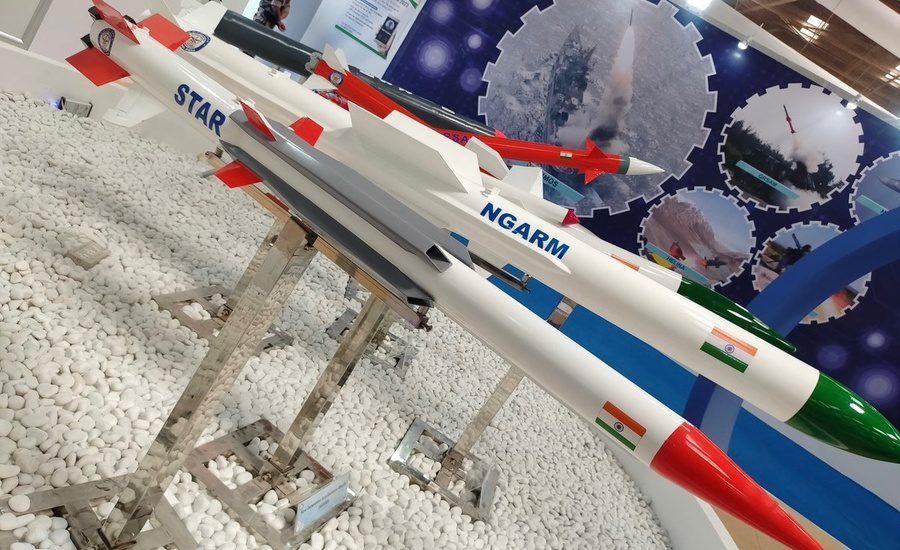
New Delhi: Defence Research and Development Organisation (DRDO) has achieved a significant breakthrough in the STAR (Supersonic TARget) missile programme, officially advancing it into Phase-III development.
Originally designed as a high-speed supersonic target missile for training and testing air defence systems, the STAR platform is now being evaluated for combat-oriented roles such as anti-AWACS (Airborne Warning and Control System) and anti-radiation missions — a transformation that could bolster India’s aerial warfare capabilities against high-value adversary assets.
Background of DRDO STAR Supersonic Missile Phase-III
The STAR missile was conceived as an indigenous, high-speed target system capable of simulating real-world aerial threats like modern cruise and anti-ship missiles to train Indian Armed Forces across the Air Force, Navy, and Army.
Designed to mimic hostile flight profiles at supersonic speeds, STAR enhances the realism of live interception drills for air defence units — replacing costly foreign systems and supporting India’s Atmanirbhar Bharat (self-reliant India) initiative.
In Phase-III, engineers at the DRDO are conducting full system integration and advanced validation tests that bring together propulsion, guidance, and control systems into complete prototypes. These tests include combat-style trials at varied altitudes and speeds to ensure robustness under real-world conditions.
Advanced Capabilities and Specifications DRDO STAR Supersonic Missile
At its core, STAR uses a two-stage propulsion system consisting of a solid booster for initial launch and a Liquid Fuel Ramjet (LFRJ) for sustained supersonic flight.
This configuration enables STAR to reach speeds beyond Mach 2, allowing it to closely replicate the performance of contemporary threats encountered in modern combat scenarios.
Key Capabilities of DRDO STAR Supersonic Missile
- Supersonic speeds exceeding Mach 2
- Flight profiles ranging from low-altitude sea skimming to high-altitude passes
- Operational range of 55–175 km
- Flight duration up to approximately 10 minutes
- High manoeuvrability to stress test radar and interceptor systems
- Dual-Variant Deployment: Air-Launched & Ground-Launched Systems
Air-Launched STAR
The air-launched variant is under evaluation for integration with fighter jets such as the HAL-manufactured LCA Tejas and potentially other front-line platforms.
This version is designed for high-threat air-to-air and air-to-ground simulations, including scenarios involving enemy AWACS and radar emitters. By enabling pilots to train against supersonic threats with realistic dynamics, it strengthens combat readiness for missions such as suppression of enemy air defences (SEAD).
Ground-Launched STAR
Complementing the air-launched variant, the ground-launched STAR is engineered for flexible deployments from mobile launchers. Mounted on tactical vehicles, this configuration facilitates rapid setup across diverse operational theatres, from coastal regions to forward land borders, allowing the Navy and Army to conduct joint exercises without needing fixed infrastructure.
Anti-AWACS & Combat Potential
While STAR’s original mission was training, DRDO is now actively exploring modifications to equip it with seeker technologies and warhead systems that could allow it to engage airborne emitters like AWACS and other high-value defence assets.
These advanced variants would fill a critical capability gap in India’s arsenal by enabling cost-effective operations against enemy command-and-control platforms and radar systems at standoff ranges.
If successful, a combat-ready STAR could act as an indigenous anti-AWACS weapon — a role historically addressed by expensive imported systems or dependent on allied integrations.
This would represent a strategic leap in India’s ability to secure airspace against airborne surveillance and electronic warfare assets.
What’s Next: Path to Operational Deployment
With Phase-III focusing on finalising prototype systems and completing advanced flight trials, DRDO could move STAR into limited production and user trials by late 2026 or early 2027. Analysts suggest that once integrated with frontline squadrons and ground units, STAR may become a key component of training frameworks and, later, if modified, into combat missile inventories.
Challenges remain — including miniaturising seekers for reliable target acquisition and ensuring robust performance in electromagnetic threat environments — but DRDO’s past success with sophisticated missile systems inspires confidence in successful outcomes.