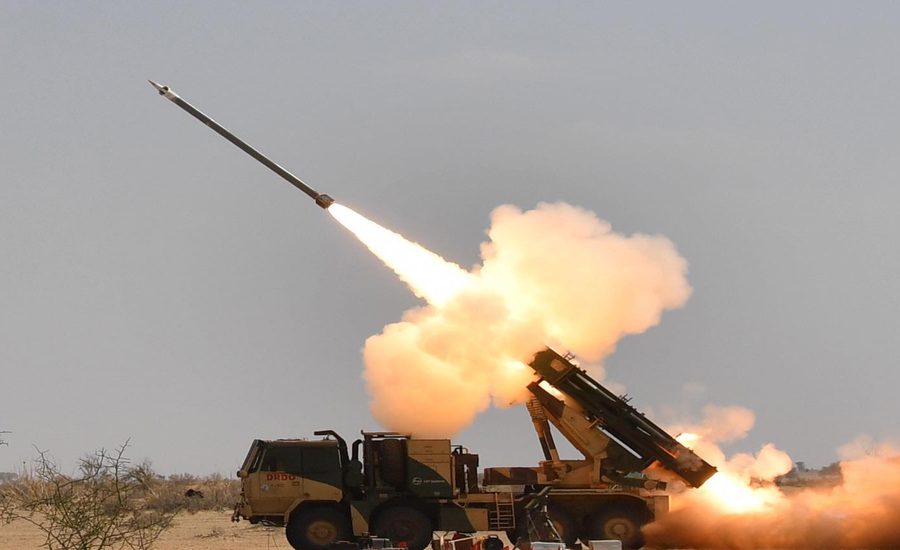
Paris / New Delhi – The French Army has intensified its assessment of India’s indigenous Pinaka multi-barrel rocket launcher (MBRL) system developed by the Defence Research and Development Organisation (DRDO), evaluating it as a potential stop-gap solution to fill critical artillery capability gaps in its own forces.
French military officials are reported to be closely monitoring the development of the Pinaka Mk3, a next-generation guided variant designed to achieve extended strike ranges of approximately 120–130 km with high precision — a significant leap over earlier versions.
Renewed French Interest in Pinaka Mk3 Rocket Amid Artillery Capability Gaps
France’s interest in the Pinaka system is rooted in operational exigencies. The French Army is facing a pressing need to replace its Lance-Roquettes Unitaire (LRU) systems — European derivatives of older M270 MLRS platforms that have been gradually rendered obsolete due to wear, attrition, and stock depletion.
The ongoing conflict in Ukraine has further strained artillery stocks across several NATO forces, including France, pushing Paris to explore interim solutions while indigenous European long-range artillery projects like Thundart and Foudre advance toward deployment.
As a result, French defence planners are assessing whether the Pinaka Mk3’s performance, cost profile, and deployment flexibility can help bridge the operational gap ahead of fully homegrown replacements.
What Is the Pinaka Mk3 Rocket and How It Has Evolved
The Pinaka MBRL system, originally developed in the 1980s by DRDO’s Armament Research and Development Establishment (ARDE), has become one of India’s most important artillery platforms. It fired its first rockets during the 1999 Kargil conflict and has since become a backbone of Indian Army artillery units.
Over decades, the Pinaka has evolved from unguided, area-saturation rockets to more precisely guided variants. Current operational versions deliver ranges of up to 75–90 km with advanced Inertial Navigation System (INS) and Global Navigation Satellite System (GNSS) guidance.
The Pinaka Mk3 project marks a strategic jump, aiming for a 120–130 km strike range while maintaining precision through enhanced guidance kits and improved propulsion systems.
Meanwhile, DRDO is progressing towards validating these new long-range variants, with trials expected to intensify early next year.
Why Does France is Interested in Pinaka Mk3 Rocket
France’s interest has reportedly progressed beyond casual observation to formal evaluations. High-level visits and demonstrations in 2024 and 2025 allowed French delegations to witness Pinaka’s capabilities firsthand.
Brigadier General Stephane Richou noted that the French Army is evaluating the system’s performance against its requirements for a mobile, rapid-fire artillery platform.
General Pierre Schill, France’s Army Chief, has also publicly signaled interest in long-range Indian systems as a credible interim acquisition prior to the induction of domestic systems like Thundart and Foudre by 2026 and beyond.
Analysts believe that this cross-continental evaluation underscores growing defence cooperation between New Delhi and Paris, driven by tactical needs as well as shared strategic perspectives.
Why Pinaka Is Gaining Global Attention
Several factors elevate the Pinaka Mk3’s attractiveness in global defence markets:
Proven Combat Experience
Pinaka’s performance during high-altitude engagements such as the Kargil conflict has demonstrated its operational reliability and battlefield effectiveness.
Precision and Extended Range
Modern guided variants offer precision strike capabilities with a Circular Error Probable (CEP) as low as 10 meters — a crucial requirement for modern warfare where minimizing collateral damage is key.
Cost-Effectiveness
Compared to Western alternatives like the HIMARS rocket artillery systems, Pinaka provides a compelling cost-performance ratio, making it attractive to nations seeking to modernize artillery without prohibitive expenditure.
Export Potential
Interest from nations beyond India — including Southeast Asian and European states — reflects the system’s rising global footprint, potentially positioning India as a significant artillery exporter.
What is Implications of Pinaka Mk3 Rocket for Indo-French Defence Cooperation
If Paris opts for Pinaka as an interim capability, this could mark one of the most significant defence procurement moves by a major Western power for an Indian military platform. It would deepen defence ties between India and France and reinforce India’s credentials as a competitive defence technology supplier on the global stage.
Such cooperation could lead to broader co-development initiatives, joint research programs, and integration of Indian technologies in European defence ecosystems — a major strategic development in global defence diplomacy.
Way Forward
With DRDO accelerating trials of the Pinaka Mk3 and French military assessments advancing, the coming months could be pivotal. An official procurement or memorandum of understanding between Paris and New Delhi would signal a paradigm shift in both defence export dynamics and long-range artillery development.
For now, France’s close tracking of Pinaka’s progress highlights an emerging trend: European powers seeking innovative, cost-effective artillery solutions beyond traditional Western suppliers — and India’s strides in defence technology making it a partner of choice.
Read also: Akash-NG Missile Trials: DRDO Confirms High-Precision Intercepts and Combat Readiness