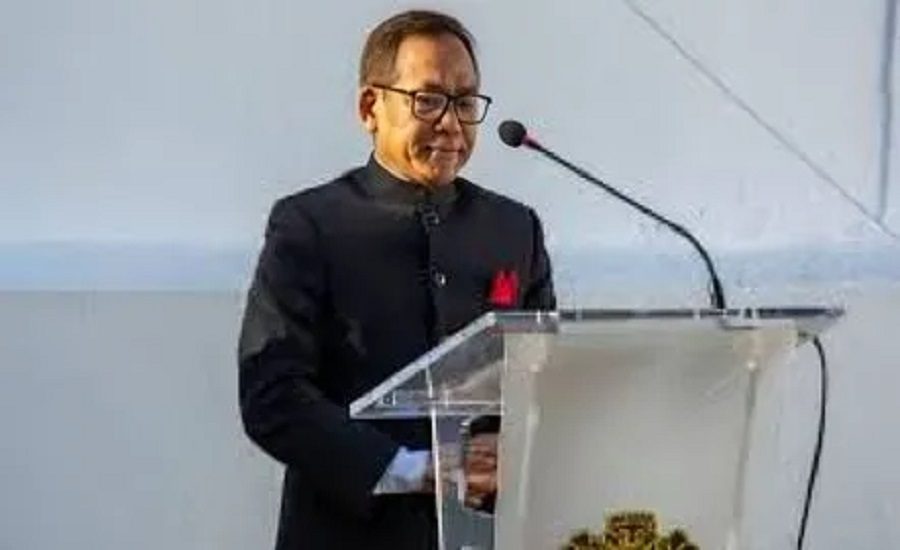
New Delhi: The Ministry of External Affairs (MEA) on Monday announced the appointment of 2007 batch Indian Foreign Service (IFS) officer Mahendra Singh (M.S.) Patiyal as the next Ambassador of India to the Democratic Republic of Timor-Leste. The official announcement was made on December 15, 2025, through a formal statement issued by the MEA.
According to the statement, “M.S. Patiyal (YOA: 2007), presently posted at the Embassy of India, Tunis, has been appointed as the next Ambassador of India to the Democratic Republic of Timor-Leste.” He is expected to take up his new assignment shortly.
Diplomatic Career and Professional Background
Mahendra Singh Patiyal joined the Indian Foreign Service in 2007 and has since held a range of diplomatic and administrative positions at both the MEA headquarters in New Delhi and Indian missions abroad.
Prior to his current appointment, he served as Counsellor (Political) and Head of Chancery at the Embassy of India in Tunis, Tunisia. In this role, he handled key administrative responsibilities and actively engaged in outreach initiatives, including hosting orientation programmes for Tunisian candidates selected under the Indian Technical and Economic Cooperation (ITEC) scheme.
At the MEA headquarters, Patiyal has contributed to policy formulation and the implementation of India’s foreign relations. His diplomatic experience includes safeguarding India’s national interests, strengthening bilateral ties, reporting on political developments, and participating in international negotiations.
His appointment as Ambassador marks a significant milestone in his diplomatic career, as he prepares to lead India’s mission in Timor-Leste.
India–Timor-Leste Relations: A Strong Diplomatic Foundation
India and Timor-Leste share warm and friendly relations rooted in shared values such as democracy, pluralism, and diversity. India was among the earliest countries to establish diplomatic relations with Timor-Leste following its independence.
India was represented at Timor-Leste’s Independence Day celebrations in May 2002 by a high-level delegation led by the then Minister of State for External Affairs, Omar Abdullah. A formal Memorandum of Understanding (MoU) establishing diplomatic relations was signed on January 24, 2003.
Support for India at the United Nations
Timor-Leste has been a consistent supporter of India on the global stage. It formally backed India’s bid for permanent membership of the United Nations Security Council (UNSC) in 2003, announced by then Prime Minister Mari Alkatiri at the United Nations General Assembly (UNGA).
The country also supported India’s candidature for non-permanent membership of the UNSC during 2011–12 and 2021–22, and has co-sponsored the UNGA Resolution on International Yoga Day.
Establishment of Resident Missions in 2024
A major milestone in bilateral relations was achieved following Prime Minister Narendra Modi’s announcement at the ASEAN-India Summit on September 7, 2023, that India would open a resident mission in Timor-Leste.
Accordingly, the Indian Embassy was established in Dili on September 5, 2024. Soon after, the Government of Timor-Leste also opened its resident mission in New Delhi in October 2024, further strengthening diplomatic engagement.
Development Cooperation and Capacity Building
Since the establishment of diplomatic relations, India and Timor-Leste have cooperated closely at bilateral, regional, and international levels. India has extended economic, technical, and capacity-building assistance to Timor-Leste through initiatives in the health sector, training programmes, and projects funded under the India–UN Development Partnership Fund and the IBSA Fund.
About Timor-Leste: The Young Nation in Southeast Asia
Timor-Leste, also known as East Timor, is an island nation in Southeast Asia located in the eastern part of Indonesia’s Lesser Sunda Islands. It comprises the eastern half of the island of Timor, the islands of Atauro and Jaco, and the exclave of Oecusse.
Timor-Leste gained full international recognition as an independent nation on May 20, 2002, making it one of the first countries formed in the 21st century.
A Long and Complex History
Portuguese influence in East Timor began in the 16th century, and the country formally gained independence from Portuguese rule in 1975. However, years of conflict followed, including violence by pro-Indonesian militias, which necessitated the deployment of a UN peacekeeping force.
After a UN-supervised referendum in 1999, Indonesia relinquished control, paving the way for full independence. The capital and largest city of Timor-Leste is Dili.
Population, Language, and Governance
Timor-Leste has a population of approximately 1.4 million, with nearly 97.5 percent identifying as Christian, predominantly Roman Catholic. Tetum and Portuguese are the official languages, while Indonesian and English are used as working languages.
The country is a republic with a unicameral National Parliament, and a significant portion of its population resides in rural areas.
Significance of the Appointment
With the Indian Embassy in Dili recently established, M.S. Patiyal’s appointment comes at a crucial juncture in India–Timor-Leste relations. His leadership is expected to further strengthen diplomatic engagement, development cooperation, and people-to-people ties between the two nations.