New Delhi: India and the European Union (EU) on Tuesday formally concluded a historic Free Trade Agreement (FTA), described by Prime Minister Narendra Modi as the largest and most ambitious trade pact ever negotiated by either side. The agreement is set to deepen economic ties, expand market access, enhance investments, and strengthen cooperation across strategic sectors.
Historic Occasion Marks First EU Leaders as Chief Guests at Republic Day
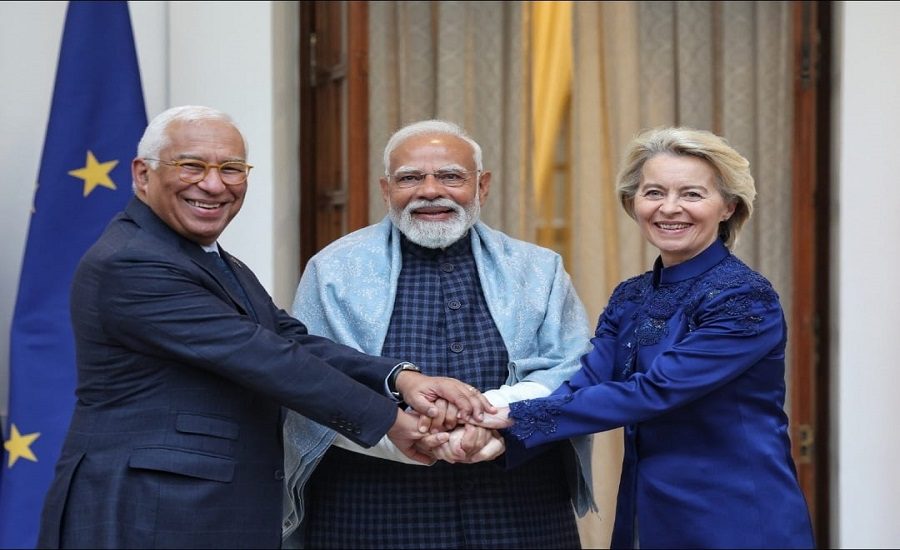
Welcoming European Council President Antonio Costa and European Commission President Ursula von der Leyen on their inaugural official visit to India, Prime Minister Modi called the occasion “historic.” For the first time, EU leaders were the Chief Guests at India’s Republic Day celebrations.
“This summit marks a decisive new chapter in relations between the world’s two largest democratic groupings,” the Prime Minister stated during the India–EU Joint Press Statement in New Delhi.
Read also: India and Oman Sign Landmark Free Trade Agreement to Boost Bilateral Trade and Strategic Partnership
India–EU Trade and People-to-People Ties at a Glance
Highlighting the scale of the bilateral partnership, the Prime Minister noted that India–EU trade has reached €180 billion. Over 800,000 Indians live and work in EU countries, actively contributing to their economies. Cooperation has expanded in strategic technologies, clean energy, digital governance, and development partnerships, reflecting a steady deepening of ties over recent years.
FTA: A “Shared Blueprint for Prosperity”
Describing the newly concluded FTA as a “shared blueprint for prosperity,” Prime Minister Modi said the deal would provide Indian farmers and small industries easier access to European markets. It would also create new opportunities in manufacturing, deepen collaboration in the services sector, boost bilateral investments, and promote innovation partnerships.
“This is not just a trade agreement; it is a foundation for shared growth and resilience,” the Prime Minister added, noting the symbolic coincidence that the deal was finalized on the 27th day of the month, aligning with the EU’s 27-member composition.
Mobility Framework and Science & Technology Cooperation
Alongside the FTA, India and the EU agreed to develop a new mobility framework, providing greater opportunities for Indian students, workers, and professionals in Europe. Both sides also committed to strengthening long-standing cooperation in science and technology, paving the way for innovation-driven collaborations.
Strategic Security and Defence Partnership
In a significant strategic move, the leaders formally launched a Security and Defence Partnership to enhance collaboration in counter-terrorism, maritime security, and cybersecurity. The partnership is aimed at reinforcing a rules-based international order, expanding cooperation in the Indo-Pacific, and fostering co-development and co-production opportunities for Indian and European defence companies.
Five-Year Strategic Agenda for Comprehensive Cooperation
Building on the summit outcomes, India and the EU unveiled an ambitious five-year strategic agenda. The plan seeks to provide clear direction in a complex global environment by promoting shared prosperity, accelerating innovation, strengthening security cooperation, and deepening people-to-people ties.
Prime Minister Modi described the India–EU partnership as a “partnership for global good,” announcing plans to expand trilateral initiatives spanning the Indo-Pacific to the Caribbean. These initiatives will focus on sustainable agriculture, clean energy, and women’s empowerment. The leaders also reaffirmed their commitment to developing the India–Middle East–Europe Economic Corridor (IMEC) as a key driver of global trade and sustainable development.
Shared Vision on Global Issues
The summit included detailed discussions on pressing international developments, including the situations in Ukraine, West Asia, and the Indo-Pacific. Both sides emphasized their shared commitment to multilateralism, international norms, and the urgent need for reforms in global institutions to address contemporary global challenges.
A Defining Moment in India–EU Relations
Describing the summit as a defining moment, Prime Minister Modi stated that history would view this as the point where India–EU relations entered a new era. He extended his gratitude to President Costa and President von der Leyen for their friendship towards India and their commitment to a shared future between India and the European Union.
Read also: What Is the India–EU Free Trade Deal? Key Benefits, Sectors Covered and Strategic Impact Explained