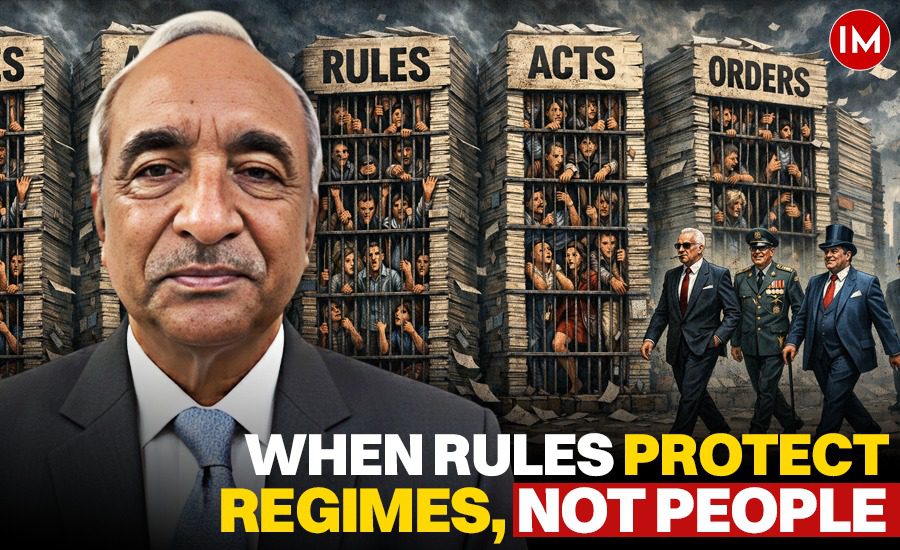
The rules-based order is an instrument, not an end. It exists to serve human beings, not the other way around. When it protects people, it deserves defence. When it shields oppressors under the cover of sovereignty, it betrays its own foundational purpose, writes former IAS officer V.S. Pandey.
The current USA/Israel vs Iran war has yet again raised the tension between the “rules-based international order” and the fundamental right of people to choose their own governments. It represents one of the most profound and unresolved dilemmas in contemporary international relations. The United Nations Charter, drafted in the aftermath of World War II, attempted to balance these competing imperatives — but the balance has never been fully achieved, and the fault lines have only deepened over time.
The UN Charter does not use the phrase “rules-based international order” anywhere at all. This is a crucial starting point. That phrase is largely a post-Cold War Western diplomatic construction, used most prominently by the United States, the European Union, and their allies to describe a constellation of international norms, institutions, and legal frameworks. The Charter itself is rooted in two foundational but frequently conflicting principles: the sovereign equality of states (Article 2) and the self-determination of peoples (Article 1 and Article 55).
Also read: Wisdom–Ethics–AI and Future of Law: From Intelligence to Judgement
Article 2(1) declares that the organization is “based on the principle of the sovereign equality of all its Members.” Article 2(7) prohibits the UN from intervening “in matters which are essentially within the domestic jurisdiction of any state.” Yet Articles 1(2) and 55 affirm the development of “friendly relations among nations based on respect for the principle of equal rights and self-determination of peoples.”
These are contradictory. Sovereign equality protects governments — including the most repressive ones. Self-determination protects people. The Charter contains both, and the friction between them has never been legislated away.
The right of the people to determine their own political destiny is not merely a philosophical aspiration — it is codified in hard international law. The International Covenant on Civil and Political Rights (ICCPR, 1966), Article 1, states unambiguously: “All peoples have the right of self-determination. By virtue of that right they freely determine their political status and freely pursue their economic, social and cultural development.”
The Universal Declaration of Human Rights (UDHR, 1948), Article 21, goes further: “The will of the people shall be the basis of the authority of government.” This is a direct assertion that governmental legitimacy derives from popular consent — not from military conquest, theological decree, or ideological imposition.
A government that rules purely through terror, that derives its authority from religious coercion rather than popular mandate, and that systematically denies its citizens the ability to participate in political life is, by this standard, illegitimate under the very framework the international order claims to uphold. The rules-based order, if it is to be internally consistent, cannot simultaneously champion human rights instruments and treat the sovereignty of theocratic or terror-based regimes as sacrosanct.
And yet, this is precisely what is happening in practice today. The doctrine of state sovereignty — elevated to near-absolute status in the post-Westphalian order and reinforced by the UN Charter’s Article 2(7) — has frequently been weaponized by authoritarian regimes to insulate themselves from accountability as has been done by Iran, North Korea and many others on our planet. Pakistan, an epicentre of terrorism, also carries out its nefarious activities in the name of protecting its sovereignty and in the name of its religion. The logic advanced is: “Our internal governance is our internal affair. External criticism or intervention constitutes a violation of our sovereignty.”
This argument was similarly made by apartheid South Africa, by Pol Pot’s Cambodia, by Saddam Hussein’s Iraq, the Iranian theocratic regime and is made today by numerous governments that combine theological absolutism with systematic repression. The rules-based order, as conventionally invoked, has too often been complicit in this evasion — treating the formal sovereignty of states as more important than the substantive freedom of the people who live within them.
The Responsibility to Protect (R2P) doctrine, adopted unanimously at the 2005 UN World Summit, was an attempt to break this impasse. It established that sovereignty is not a right but a responsibility — that states have a duty to protect their populations, and that when they manifestly fail to do so, the international community has both the right and the obligation to intervene. This was a genuine philosophical advance. But R2P has been applied selectively and inconsistently, used when geopolitical interests align and ignored when they do not.
The specific case of theocratic governance — where religious authority is conflated with state power and political legitimacy is claimed to derive from divine mandate rather than popular consent — poses a particular challenge. Such systems are, by their internal logic, immune to democratic accountability. If a government’s authority flows from God, it cannot be questioned by mere citizens. Elections, if held at all, become performative rituals rather than genuine exercises of popular sovereignty.
Several states in the contemporary world operate on precisely this basis. The people living under such systems are not merely governed badly — they are governed in ways that structurally deny them any agency over their own political lives. To treat the sovereignty of such regimes as more important than the right of their populations to self-determination is to invert the moral hierarchy that the UN’s own founding documents establish.
The Charter’s preamble speaks of “fundamental human rights, in the dignity and worth of the human person.” Dignity and worth cannot coexist with governance systems that treat citizens as subjects of divine law rather than as free persons with inherent political rights.
So, is the rules-based order more sacrosanct than the right of people to choose their governments? The answer, examined honestly, must be a resounding No — and the UN Charter itself does not claim otherwise.
The rules-based order is an instrument, not an end. It exists to serve human beings, not the other way around. When it protects people, it deserves defense. When it shields oppressors under the cover of sovereignty, it betrays its own foundational purpose. The right of peoples to self-determination — to governments that derive their just powers from the consent of the governed — is not merely one norm among many. It is the moral foundation upon which the legitimacy of any international order ultimately rests.
The challenge for the international community is not to choose between order and freedom, but to build an order that genuinely serves freedom — one that stops treating the territorial control of a regime as equivalent to the legitimate sovereignty of a people.
(Vijay Shankar Pandey is a former secretary of the Government of India.)
Also read: The War Before the War: What Iran Teaches Us About India’s Next Conflict