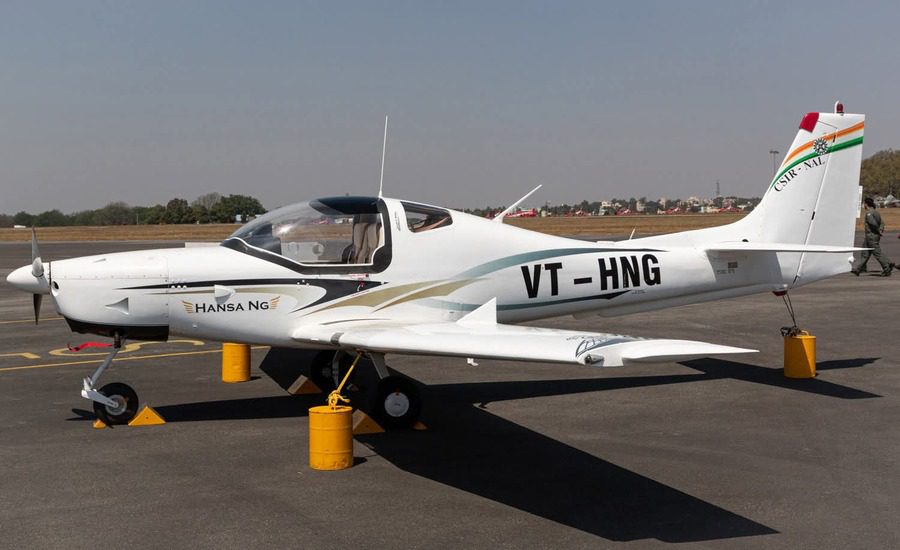
New Delhi: India has taken a significant leap in indigenous aviation technology with the launch of its first locally developed pilot trainer aircraft, the Hansa-3 (Next Generation). The aircraft was unveiled by Union Minister Dr. Jitendra Singh, marking a new chapter in India’s aerospace self-reliance and a critical step towards reducing dependence on imported flight training systems.
Developed by the CSIR–National Aerospace Laboratories (NAL), Bangalore, the Hansa-3(NG) is designed to serve as an efficient and cost-effective platform for both Private Pilot License (PPL) and Commercial Pilot License (CPL) training within India.
Background of Hansa-3(NG)
India’s aerospace industry has long relied on foreign-manufactured aircraft for pilot training, which limited both production autonomy and cost efficiency. Recognising this gap, the government and CSIR-NAL initiated a mission to design and develop a next-generation light trainer aircraft tailored to Indian aviation schools and regulatory environments.
The Hansa series dates back to the early 1990s, when the first-generation Hansa-3 was conceptualized and produced. Over the years, the aircraft underwent extensive upgrades to meet evolving flight training requirements, culminating in the Hansa-3(NG) — a more advanced, lighter, and efficient version suited for the modern pilot training ecosystem.
Manufacturing and Industrial Collaboration
The production version of the Hansa-3(NG) was unveiled at CSIR-NAL, Bangalore, and the manufacturing responsibilities have been undertaken by Pioneer Clean Amps Pvt. Ltd., a Mumbai-based company. The company has established a state-of-the-art ₹150 crore production facility in Kuppam, Andhra Pradesh, dedicated to producing 100 aircraft annually.
This large-scale manufacturing capability represents a major milestone in India’s Make in India and Atmanirbhar Bharat (self-reliant India) initiatives, enabling the domestic aerospace sector to scale up and meet both national and international training demands.
Technological Advancements and Key Features of Hansa-3(NG)
The Hansa-3(NG) stands out for its all-composite airframe, a departure from traditional metal-based designs. The use of composite materials not only enhances strength and corrosion resistance but also significantly reduces overall aircraft weight, improving fuel efficiency and performance.
Other important features include:
- Glass Cockpit with Advanced Avionics: Offers modern navigation and display systems suitable for CPL-level training.
- Low Operating Cost: Simplified maintenance design, reducing lifecycle costs for training academies.
- High Safety Standards: Equipped with improved stall and spin characteristics for safer pilot handling.
- Environment-Friendly Design: The composite structure contributes to lower emissions and energy-efficient performance.
These innovations make Hansa-3(NG) one of the most advanced trainer aircraft in its class, aligning with international standards set by leading aviation authorities.
Strategic Importance of Hansa-3(NG) for India’s Pilot Training Ecosystem
India’s aviation industry is witnessing rapid growth, with an estimated requirement of over 1,000 new pilots annually. Flight training organizations (FTOs) in India have historically relied on foreign-made aircraft such as Cessna or Piper, which come with high procurement and maintenance costs.
The introduction of the Hansa-3(NG) provides a cost-effective indigenous alternative, allowing FTOs to train pilots locally with reduced expenditure and easier access to spares and maintenance. This will not only benefit domestic aviation schools but also create export opportunities across Asia and Africa, where affordable training aircraft are in high demand.
Government’s Vision for Self-Reliant Aerospace
Union Minister Dr. Jitendra Singh emphasized during the launch that the project embodies India’s broader vision of self-reliance in high-technology sectors. He lauded the role of CSIR-NAL and Pioneer Clean Amps in creating a sustainable, scalable model for indigenous aircraft manufacturing.
He added that the initiative aligns perfectly with Prime Minister Narendra Modi’s Atmanirbhar Bharat mission, promoting domestic innovation, manufacturing, and employment generation in the aerospace sector.
CSIR-NAL’s Commitment and Future Plans
In April 2025, CSIR-NAL formalized a long-term manufacturing agreement with Pioneer Clean Amps to scale production and meet the growing demand for pilot trainers. This collaboration ensures consistent quality standards, technological upgrades, and the possibility of expanding production for export markets.
The institution also aims to integrate electric propulsion and AI-assisted flight data systems in future versions of the Hansa series, further strengthening India’s position as a leader in sustainable aviation technologies.
Impact of Hansa-3(NG) on the Indian Aerospace Industry
The successful rollout of the Hansa-3(NG) will create a ripple effect across the Indian aerospace ecosystem.
It is expected to:
- Generate hundreds of skilled jobs in manufacturing, maintenance, and R&D.
- Strengthen supply chain networks for aviation-grade composite materials and avionics.
- Encourage private sector participation in aerospace innovation.
- Position India as a regional hub for pilot training aircraft exports.
With the Hansa-3(NG), India not only reduces dependence on imported training platforms but also opens avenues for international partnerships and technology collaborations.