New Delhi: In a major development in international defence cooperation, France’s aerospace giant Safran has agreed to transfer 100% of the critical technology for a fighter-jet engine — including the highly sensitive “hot section” — to India. This marks a dramatic shift in global arms-technology sharing norms, historically dominated by countries like the U.S. and Russia who tightly guard such secrets.
Safran Jet Engine Tech Transfer Agreement
Under the agreement signed in late November 2025, Safran will co-develop a brand-new engine in collaboration with India’s DRDO (Defence Research and Development Organisation) — building a complete propulsion system under Indian intellectual-property rights (IPR).
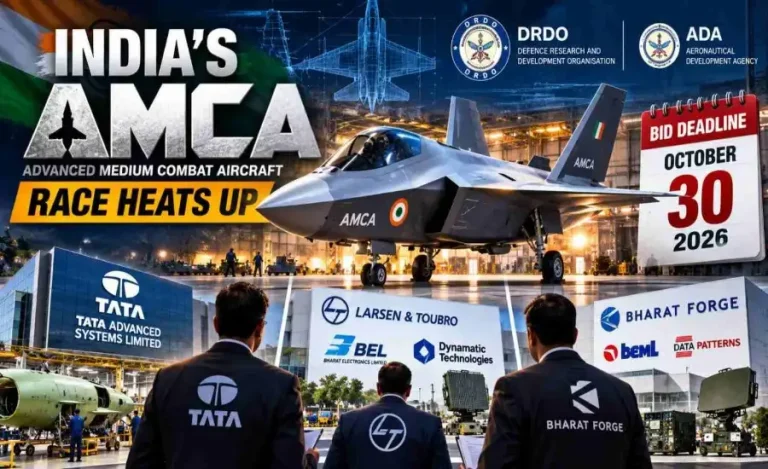
The engine, designed for the indigenous Advanced Medium Combat Aircraft (AMCA), will deliver 120–140 kN thrust, making it suitable for powering fifth-generation stealth fighters planned by India.
Safran’s CEO, Olivier Andries, emphasized this is far beyond licensed production or simple assembly — it is a “full technology transfer,” letting India handle design, development, and future innovations independently.
Importance of Hot Section in Jet Engines
The “hot section” refers to the core components of a jet engine — turbines, combustion chamber, and high-temperature alloys — that endure extreme heat, pressure, and mechanical stress. Mastering this technology is a major engineering hurdle and traditionally a guarded secret among advanced aerospace nations.
Key features Safran Jet Engine Tech Transfer
- Single-crystal blade technology — crucial for withstanding extreme thermal and mechanical loads.
- Complete engine architecture design; from materials to turbine geometry and integration.
- Manufacturing know-how; India will build the engine domestically, including all critical parts — establishing a fully local supply chain.
According to official timelines, initial prototypes will likely be ready by 2028. Full certification and serial production — potentially starting around 2035 — will follow, aligning with the planned development roadmap of AMCA.
Importance of Safran Jet Engine Tech Transfer for India’s Defence & Aerospace Industry
1. Realizing “Make in India” for Fighter Engines: For decades, India’s military aircraft — including jets like Tejas, transport planes and helicopters — have relied heavily on foreign engines. The failure of the indigenous engine programme Kaveri was a major setback.
With this deal, India will become one of the few nations capable of designing, developing, producing and maintaining advanced jet engines — dramatically reducing dependence on foreign supply chains and recurring maintenance/overhaul imports.
2. Boost to Aerospace Ecosystem & Job Creation: The engines will be manufactured in India, with Indian industry — including private players like Tata Advanced Systems, Larsen & Toubro (L&T), and Adani Defence — expected to play major roles in production and supply-chain participation.
Experts describe this as a “game-changer” for India’s aerospace ambitions — from engine manufacturing to advanced materials, precision engineering and maintenance ecosystems.
3. Strategic Autonomy & Export Possibilities: With full IPR and domestic production capabilities, India can now plan for future fighter-engine exports — something previously unimaginable. This strategic autonomy strengthens India’s defense credentials globally.
Key Implications for AMCA — India’s Fifth-Gen Stealth Fighter Programme
- The upcoming AMCA — intended to be comparable with global stealth fighters — will now likely be powered by this indigenous engine (after early prototypes that may use foreign engines). This ensures that AMCA will remain fully domestically powered in its production variants.
- This reduces long-term costs, ensures easier sustainment and maintenance inside India, and removes dependence on foreign supply-chains and geopolitics for propulsion systems. It also makes AMCA a stronger candidate for export markets.
Key Challenges Ahead and What Needs to Be Done
While the agreement marks a giant leap forward, realizing the full potential will require:
- Rigorous engineering, testing and certification over the coming years — building a brand-new engine is a demanding task.
- Developing supply-chain maturity for high-spec materials, precision manufacturing, and ongoing maintenance infrastructure.
- Coordinated collaboration among Indian stakeholders — DRDO, private aerospace firms, infrastructure, and skilled workforce.
But experts remain optimistic that with sustained political will and industrial backing, the long-term gains will outweigh short-term challenges.
Strategic Significance: A Turning Point for India as an Aerospace Power
This agreement doesn’t just serve the AMCA programme — it signals India’s arrival among a select club of nations capable of producing advanced jet engines. It could reshape India’s defence posture, reduce dependence on imports, catalyse private-sector aerospace growth, and potentially open export markets in Asia and beyond.
In essence, the 100% tech-transfer of the jet-engine hot section is not merely a defence contract — it’s a strategic investment in India’s long-term sovereignty, technological self-reliance, and global standing in aerospace.