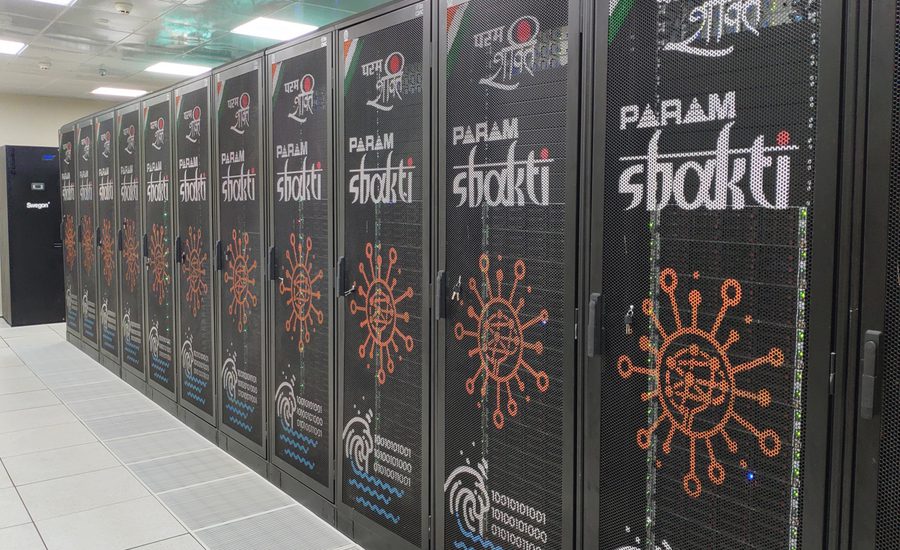
Chennai: In a major technological and strategic milestone for India’s defence, science, and research ecosystems, the Ministry of Electronics & Information Technology (MeitY) has inaugurated PARAM SHAKTI — a homegrown supercomputing facility delivering 3.1 petaflops of computing power at the IIT Madras.
The launch reinforces India’s push for self-reliance in high-performance computing under the National Supercomputing Mission (NSM) and promises to accelerate innovation across defence, climate science, aerospace, materials research, and beyond.
What is PARAM SHAKTI Supercomputer ?
PARAM SHAKTI is a cutting-edge 3.1 petaflop supercomputer — capable of executing over 3.1 quadrillion calculations per second — making it one of the most powerful academic supercomputers in India.
The system is entirely developed and manufactured within India by the Centre for Development of Advanced Computing (C-DAC) using its indigenous PARAM RUDRA server series and open-source software stacks, including AlmaLinux.
Positioned as a key computational resource under the National Supercomputing Mission (NSM), PARAM SHAKTI represents a significant leap in India’s technological capabilities, moving the nation closer to technological self-reliance in advanced digital infrastructure.
What is the Importance of PARAM SHAKTI Supercomputer
While PARAM SHAKTI will support a broad spectrum of academic research, its implications for India’s defence and strategic capabilities are particularly noteworthy.
Enhancing Defence R&D and Simulation
High-performance computing (HPC) is integral to modern defence research, enabling complex simulations that were once prohibitively time-consuming or costly. With up to 3.1 petaflops of performance, PARAM SHAKTI will allow Indian researchers and defence organisations to model:
Hypersonic and advanced flight aerodynamics
- Structural analysis of defence systems
- Swarm UAV dynamics and control algorithms
- Materials design for lightweight armour and high-strength composites
Such capabilities support ongoing indigenous defence efforts — such as the HAL Tejas Mark-2, AMCA (Advanced Medium Combat Aircraft), and other future platforms — by enabling rapid design iteration and optimisation.
What are the Impacts of PARAM SHAKTI Supercomputer
PARAM SHAKTI is not limited to defence applications.
The facility will power research across critical domains, helping tackle:
- Climate and weather modelling with higher resolution for monsoon and cyclone prediction
- Drug discovery and molecular simulations to speed development cycles
- Advanced manufacturing and materials science
- Nuclear science and energy research
- Combustion and propulsion system studies
- Data-intensive AI and machine learning workflows
By reducing simulation times from months to hours, PARAM SHAKTI accelerates innovation and allows India to compete globally in frontier scientific fields.
Built for India — with Indian Expertise
One of PARAM SHAKTI’s most defining features is its indigenous design and assembly. According to faculty and officials, the core server infrastructure was designed, developed, and built within India, marking a departure from reliance on imported components for high-end computing.
This achievement also reflects the maturity of India’s domestic supercomputing ecosystem — built over decades under the PARAM series of systems, which began in the late 1980s with the original PARAM 8000.
What is The National Supercomputing Mission (NSM)
PARAM SHAKTI is part of the National Supercomputing Mission (NSM) — a landmark initiative jointly implemented by MeitY and the Department of Science & Technology (DST) since 2015.
The NSM aims to connect Indian academic and research institutions with a grid of 70+ high-performance computing facilities through the National Knowledge Network (NKN).
Under the mission:
- 37 supercomputers are already installed nationwide.
- Several more powerful facilities — including a planned 20 petaflop indigenous supercomputer — are under development.
By developing computer infrastructure domestically, the NSM strengthens India’s technological backbone and reduces strategic dependence on foreign suppliers.
Collaboration and Future Growth of PARAM SHAKTI Supercomputer
At the inauguration ceremony on January 3, 2026, MeitY Secretary Shri S. Krishnan highlighted the importance of interdisciplinary research and collaboration among faculty, researchers, and industry partners in maximising PARAM SHAKTI’s impact.
The event was attended by senior officials from MeitY, C-DAC, and IIT Madras, underscoring the cooperative effort behind this milestone.