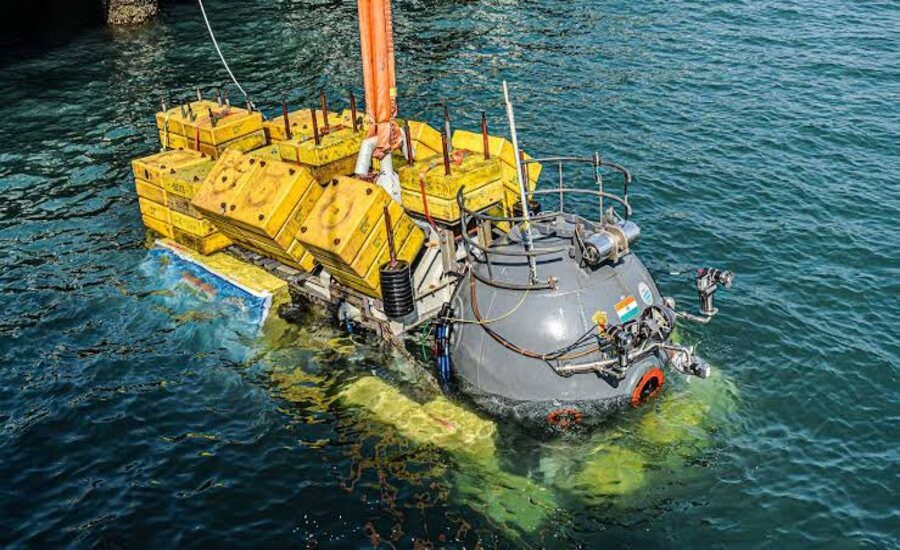
New Delhi: India has taken a decisive leap in its pursuit of ultra-deep ocean exploration with significant progress in the development and testing of Matsya-6000, the nation’s first human-operated deep-sea submersible.
Union Minister Jitendra Singh spotlighted the initiative as a landmark moment that places India among the select group of nations advancing both deep-sea and human space exploration capabilities. The updates were revealed during the Indian International Science Festival (IISF) 2025, marking a major stride under India’s ambitious Deep Ocean Mission.
Background: The Vision Behind Matsya-6000 Deep-Sea Submersible
Matsya-6000 represents India’s first indigenously designed and engineered human submersible capable of reaching extreme ocean depths.
The project is spearheaded by the National Institute of Ocean Technology (NIOT) under the Ministry of Earth Sciences, as part of the flagship Samudrayaan Programme—India’s equivalent of a manned mission into the deep sea.
The submersible is planned for phased development:
- 500 metres by 2026
- 6,000 metres (ultra-deep) by 2027
Achieving these operational depths would position India among the very few countries—such as the U.S., Russia, France, China, and Japan—that possess indigenous human deep-ocean diving technologies.
Design and Capabilities of Matsya-6000 Deep-Sea Submersible
The submersible’s engineering focuses on safety, manoeuvrability, and scientific value. Key features include:
● Titanium Alloy Pressure Hull
- Spherical design
- Diameter: 2.1 metres
- Capacity: Three crew members
● Advanced Buoyancy and Control Systems
- Main ballast system for controlled diving
- Multiple thrusters for precise manoeuvring
- Robust battery bank for power endurance
- Syntactic foam to maintain buoyancy
- Distributed power and control network for redundancy and safety
These technologies were developed after extensive research, modelling and iterative safety assessments.
Testing Milestones: Wet Trials, Harbour Trials & More
Wet Trials (Jan–Feb 2025): Initial integrated tests ensured the system’s readiness across a 500-metre operational range. These trials assessed stability, buoyancy behaviour, system responsiveness, and emergency readiness.
Harbour Trials: Conducted at the Larsen & Toubro (L&T) Shipbuilding facility, Kattupalli Port near Chennai, harbour evaluations tested:
- Power coordination
- Control system accuracy
- Structural integrity
- Vessel handling under simulated sea conditions
Both unmanned and manned missions were undertaken.
Underwater Communication Tests: High-fidelity tests ensured reliability of communication channels—an essential safety requirement for ultra-deep expeditions.
Scientific Payload Validation: Matsya-6000 successfully tested its oceanographic sensor suite, designed to perform:
- Deep-sea sampling
- Environmental parameter measurements
- Imaging and mapping operations
These systems are crucial for marine biology, geology, mineral exploration, and climate science research.
Operational Trials and Future Goals of Matsya-6000 Deep-Sea Submersible
Although controlled tests have validated stability, real-world deep-sea trials—especially beyond 500 metres—remain the next milestone.
Key upcoming phases include:
- Full-scale dives from 500 metres to 6,000 metres
- Integration of mission-specific scientific payloads
- Endurance testing for multi-hour operations
The government aims for full operational readiness before end-2025, enabling scientists to study unexplored ocean territories.
Strategic Significance of Matsya-6000 Deep-Sea Submersible for India
Matsya-6000 extends India’s technological footprint into deep-ocean exploration, with implications across:
- Blue Economy Development
- Critical Mineral Resource Mapping
- Climate and Ocean Dynamics Research
- Defence and Strategic Surveillance Capabilities
The initiative runs parallel to India’s space ambitions, reinforcing the country’s long-term vision of excelling in both space and ocean sciences.
Read also: Indian Navy Signs Pact With Crimson Energy to Build AI-Powered Deepdarshak Maritime Analytics System