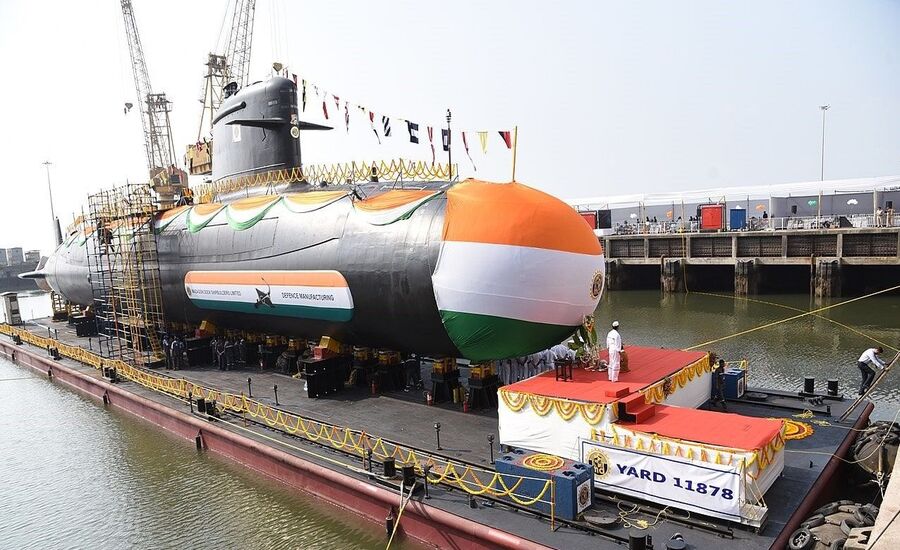
New Delhi: The Indian Navy is on the verge of a landmark expansion of its underwater strategic capabilities with the imminent commissioning of INS Aridhaman, its third indigenously built nuclear-powered ballistic missile submarine (SSBN).
According to recent statements from the Chief of Naval Staff, the submarine is now in the final stages of sea trials and is expected to be formally inducted soon. This milestone marks not just another addition to the fleet — but a major enhancement of India’s sea-based nuclear deterrence and strategic reach.
Background of INS Aridhaman
The submarine programme under the Advanced Technology Vessel (ATV) project was conceived to give India a credible sea-based leg of its nuclear triad — land, air, and sea. The first successful result of that project was INS Arihant (S2), India’s first indigenous nuclear-powered ballistic missile submarine.
Following Arihant, the second vessel in the class — INS Arighaat (S3) — was commissioned in August 2024 after extensive trials.
These submarines laid the foundation for a credible underwater deterrence posture, reducing reliance on external platforms and enhancing domestic strategic autonomy.
INS Aridhaman: What Makes It Special
Larger Displacement & Enhanced Payload: INS Aridhaman has a displacement of around 7,000 tonnes — significantly larger than the 6,000-tonne displacement of its predecessors.
More Missile Tubes, Higher Strike Potential: The submarine features eight vertical launch system (VLS) tubes (compared to four on Arihant and Arighaat).
Flexible Missile Loadout: Aridhaman is capable of carrying up to 24 short-range SLBMs (e.g., K-15 Sagarika, ~750 km range) or a mix of longer-range missiles such as K-4 (~3,500 km) — and potentially future long-range missiles.
Advanced Reactor & Stealth Features: Powered by a more advanced light-water reactor (CLWR), Aridhaman benefits from lower acoustic signatures, improved endurance, and enhanced stealth — making it harder to detect during prolonged submerged patrols.
In essence, INS Aridhaman is a more potent, stealthier, and longer-range submarine compared to earlier generation SSBNs.
Strategic Implications: Strengthening India’s Sea-based Deterrence
- With the commissioning of Aridhaman, India would effectively have three operational SSBNs in the class — Arihant, Arighaat, and Aridhaman — significantly strengthening its sea-based nuclear deterrence.
- A larger fleet of SSBNs operating with extended-range SLBMs increases survivability and credibility of a second-strike capability, a cornerstone of India’s nuclear doctrine under “no-first-use.”
- The induction of Aridhaman signals to regional rivals and global powers alike that India is serious about securing its maritime interests and deterrence posture. Analysts view this step as a meaningful boost to India’s strategic depth, especially in the Indian Ocean region.
- Beyond deterrence, the submarine’s stealth and strike capabilities give India flexible options for power projection, strategic patrols, and rapid response, altering the underwater strategic balance.
Operational Readiness: Current Status of Trials & Commissioning Timeline
- Navy leadership has confirmed that INS Aridhaman is in the final stages of sea- and system-trials, including reactor and weapons integration checks.
- The formal commissioning is expected very soon, likely in early 2026, if all trials are completed successfully.
- Once inducted, it will join the operational SSBN fleet alongside Arihant and Arighaat, expanding the effective underwater deployment and strategic deterrence footprint of the Indian Navy.
What Lies Ahead: Challenges and Future Prospects
While the Aridhaman submarine is a major milestone, challenges remain. High-end submarine technologies — particularly in stealth, sensor systems, and advanced reactors — still require constant upgrades.
The navy and government appear to be pushing ahead: a fourth SSBN (codenamed S4) is reportedly under development, even as Aridhaman prepares for induction.
Strategic Role in Future Naval Doctrine
With the Indo-Pacific witnessing growing naval competition and maritime security challenges, having a robust SSBN fleet gives India strategic flexibility. Aridhaman — with its enhanced payload, endurance, and stealth — may play a central role in future deterrence patrols, undersea surveillance, and as a silent sentinel of the ocean.
That said, sustaining a credible undersea deterrent will require maintenance, periodic technological upgrades, secure reactor management, and trained crew — all of which demand long-term commitment.
Read also: Project 75I: India to Boost Submarine Force with Advanced Indigenous AIP-Equipped Submarines