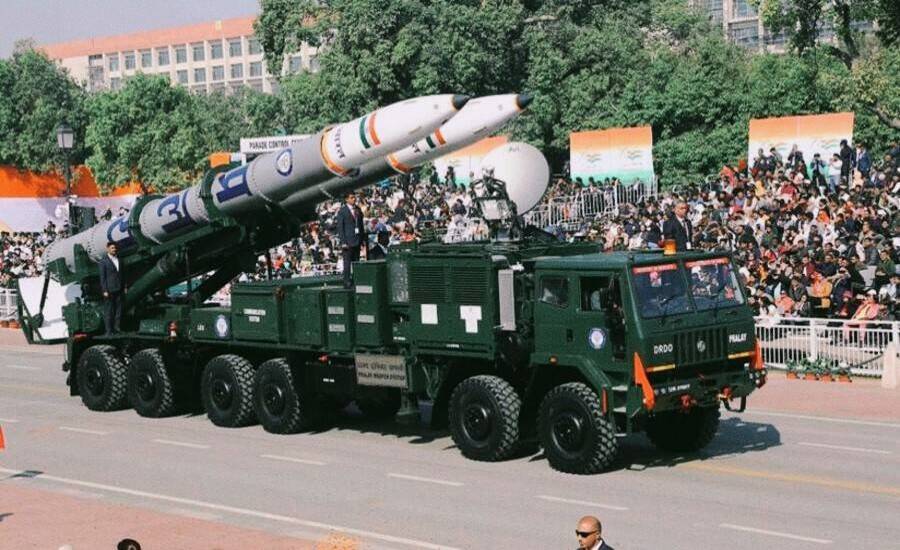
New Delhi: In a major leap for India’s defence capabilities, the Defence Research & Development Organisation (DRDO) on December 31, 2025, successfully conducted a salvo launch of two Pralay quasi-ballistic missiles from the Integrated Test Range (ITR), Chandipur, off the Odisha coast.
The test, part of user evaluation trials, underlines India’s growing tactical strength and precision strike capacity in conventional warfare.
Salvo Launch Marks New Era in Indian Missile Capability
The twin salvo launch involved firing two Pralay missiles in rapid succession from the same mobile launcher platform, demonstrating not only the reliability of the missile system but also its enhanced readiness for battlefield deployment.
#DRDO has successfully conducted salvo launch of two #Pralay missiles in quick succession from the same launcher off the coast of #Odisha at about 1030 hrs on December 31, 2025.
— Defence Production India (@DefProdnIndia) December 31, 2025
🔹 The flight-test was conducted as part of user evaluation trials. Both the missiles followed the… pic.twitter.com/YOVhJ6Xdsw
Both missiles successfully followed their quasi-ballistic trajectories and met all predefined flight objectives, as confirmed by telemetry data, tracking radars and optical sensors.
Defence Minister Rajnath Singh congratulated DRDO scientists and industry partners for this technological milestone, highlighting the imminent operational induction of the system into the Indian Armed Forces.
What Is a Pralay Quasi Ballistic Missile System? – The ‘Apocalypse’-Named Missile Explained
“Pralay” — derived from the Sanskrit word for apocalypse or “widespread destruction” — is an indigenous quasi-ballistic, surface-to-surface tactical missile developed by DRDO. It bridges a crucial capability gap between short-range battlefield systems and longer-range strategic missiles.
Unlike traditional ballistic missiles that follow predictable trajectories, quasi-ballistic missiles like Pralay can maneuver mid-flight, making them significantly harder for enemy air defence systems to intercept.
What are the Features of Pralay Missile
Here are the key features of Pralay Missile system;
Range, Payload & Propulsion
Pralay missile range: Approximately 150–500 km, making it a potent theatre-level weapon capable of deep penetration into adversary territory.
Pralay missile payload: Able to carry conventional warheads ranging from 350 to 1,000 kg, including high-explosive fragmentation, penetration, submunitions or runway denial warheads.
Propulsion: Solid-propellant rocket motor with canisterised launch capability, ensuring quick reaction time and high mobility on the battlefield.
Pralay Missile Accuracy and Guidance: Pralay’s advanced navigation and guidance systems boast a Circular Error Probable (CEP) of less than 10 meters, enabling pinpoint strikes on strategic enemy targets such as radar installations, command and control hubs, airfields and logistic centres.
Mobility, Deployment and Launch Readiness: The Pralay missile system is fully road-mobile, typically mounted on an 8×8 transporter-erector-launcher (TEL) vehicle. Its canisterised design allows rapid deployment, with the missile ready for launch within minutes of command.
This mobility ensures operational flexibility across diverse terrains, from the mountainous northern frontiers bordering China to the plains along Pakistan’s border, reinforcing India’s conventional deterrence posture.
What is the Importance of Pralay Quasi Ballistic Missile for India
Pralay fills a key capability niche in India’s missile inventory — offering a potent non-nuclear conventional deterrent that complements longer-range strategic systems (like Agni variants) and short-range assets (like BrahMos).
Its precision strike ability and manoeuvrable trajectory make it particularly valuable in high-intensity conflict scenarios, where rapid and accurate responses are critical and escalation thresholds must be carefully managed.
Experts believe this missile enhances force multiplication and provides the Indian military with more credible tactical options.
Comparisons of Pralay with other Quasi Ballistic Missile
Analysts note that Pralay is conceptually similar to Russia’s Iskander-M quasi-ballistic missile, renowned for its battlefield performance and difficulty of interception.
Such systems are increasingly relevant in modern warfare that prioritises precision, speed, and survivability against advanced air defence networks.
The missile’s range covers key strategic depths across potential theatres of operation — from coverage of military infrastructure deep within Pakistan to countering missile threats along India’s northern borders.
Pralay Quasi Ballistic Missile Induction Timeline
With successful user evaluation tests now completed, DRDO and the Indian Defence Establishment are expected to move towards full operational induction and production scaling. Pralay’s inclusion in the army’s arsenal will significantly enhance India’s tactical strike and deterrence capabilities in the prevailing geopolitical environment.