New Delhi: According to recent media reports, India is reportedly considering procurement of a limited number of RD-191 semi-cryogenic rocket engines from Russia. This development — if it goes through — may mark a significant strategic collaboration between the Indian space establishment and the Russian space industry, enhancing India’s space launch capabilities at a time when its own semi-cryogenic engine program is nearing maturity.
What is RD-191 Semi Cryogenic Rocket Engine? — Background and Technical Profile
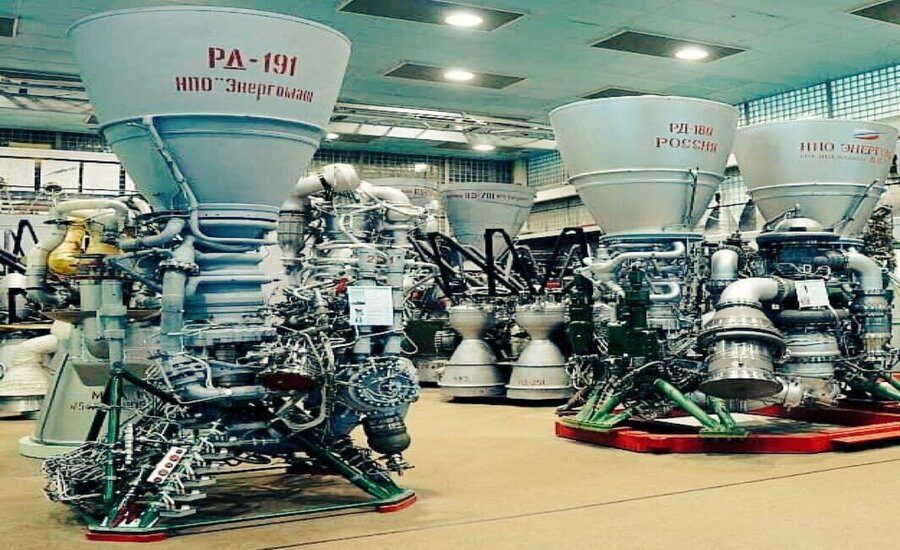
The RD-191 Semi Cryogenic Rocket Engine is a high-performance liquid-propellant rocket engine developed by NPO Energomash in Russia. It descends from the powerful multi-chamber engine family that includes RD-170 (four-chamber) and RD-180 (dual-chamber).
The RD-191 simplifies the design into a single-combustion-chamber engine, optimized for modern launch needs.
Key features of RD-191 Semi Cryogenic Rocket Engine
- Propellant type: RP-1 (a refined kerosene) fuel, and Liquid Oxygen (LOX) oxidiser — a classic semi-cryogenic combination.
- Cycle: Uses an oxygen-rich staged combustion cycle, which allows for very efficient fuel usage and high performance compared to simpler open-cycle engines.
- Thrust: At sea level ~ 196 tonnes-force (≈ 1,920 kN), in vacuum ~ 212.6 tonnes-force (≈ 2,090 kN).
- Specific Impulse (Isp): ~ 310.7–311.2 seconds at sea level; ~ 337–337.5 seconds in vacuum.
- Thrust-to-weight ratio: High (roughly 89:1 under certain configurations), making RD-191 efficient for first-stage or booster applications.
- Throttle & control: The engine can throttle down (to about 27–30%) and also briefly increase thrust (up to around 105%) — useful for precise control or in-flight adjustments. It also incorporates nozzle gimbaling (about ±8°), allowing steering and attitude control of the rocket during flight.
- The engine was originally developed to power the first stage of the Russian Angara family of launch vehicles, which are meant to replace older heavy- and medium-lift rockets.
- Variants of RD-191 (or related engines derived from its design lineage) have been used beyond Russia: for example, as the RD-181 in the American Antares launch vehicle, and as the slightly lower-thrust RD-151 for the South Korean KSLV-1.
Why India Is Interested: Strategic Rationale & Advantages
1. Enhanced Lift Capability for Heavy Satellites / GTO Missions: India’s primary heavy-lift launcher, LVM3 (also marketed earlier as GSLV Mk3), currently uses a combination of solid and cryogenic stages.
🚨 BREAKING: Russia Grants 100% Tech Transfer of RD-191M Engines to India 🚀
— INDIAN (@hindus47) December 3, 2025
Just in: Russia has agreed to hand over full technology transfer of its RD-191M semi-cryogenic rocket engines to ISRO.
This upgrade will power future GSLV Mk3/LVM3 missions boosting India’s GTO payload… pic.twitter.com/qq3TpwucfA
However, as requirements grow — for heavier satellites, bonded multi-satellite launches, or direct-to-GTO (Geostationary Transfer Orbit) missions — there is a clear need for more powerful first- or second-stage engines.
Acquisition of RD-191 (or a variant) could significantly boost lift capacity, enabling heavier payloads to GTO or allowing greater flexibility in mission design.
Further, recent reporting suggests that Moscow has approved full technology transfer of an upgraded variant, RD-191M, to the Indian space agency for potential integration on LVM3. This could allow not just import, but eventual domestic production — a key advantage for long-term capacity building.
2. Proven, Reliable Technology — De-risking Future Launches: RD-191 is not a conceptual or experimental engine — it is a proven, flight-qualified design, with operational history on Angara rockets since their maiden launches in 2014.
In contrast, developing a high-performance semi-cryogenic engine indigenously is a major technological challenge, requiring years of development, testing and validation. By obtaining RD-191, India could leapfrog some of those hurdles, achieving near-term enhanced capabilities while its own engine development efforts — for example, through ISRO — continue.
3. Complementing — Not Replacing — Indigenous Engine Projects: It’s important to note that India already has domestic efforts underway to build its own semi-cryogenic engine. As recently as March 2025, ISRO announced a successful hot-test of a semi-cryogenic engine’s powerhead designed for future Indian rockets.
Thus, RD-191 acquisition appears likely to be a strategic bridging solution — enabling immediate performance gains while indigenous systems mature. The potential full technology transfer for RD-191M also suggests that, eventually, such engines could be built in India — combining the best of proven foreign design with local manufacturing.
Key Challenges, Considerations & Geopolitical Context
While the RD-191 deal has many apparent advantages, several challenges and strategic trade-offs need consideration:
• Dependence on Foreign Technology vs. Self-Reliance: One of the core objectives of India’s space program has long been self-reliance — building from scratch engines, launchers, satellites, etc. Relying on imported engines, even under technology-transfer, may slow down truly indigenous development or create dependencies. This could undermine long-term technological independence, particularly if key supply chains remain foreign.
• Integration Complexity and Adaptation: Integrating RD-191 (or RD-191M) with existing Indian rocket architectures — e.g., LVM3 — would entail substantial work: mechanical adaptation, avionics, propellant supply, safety and testing infrastructure, quality control, etc. The differences between the Russian design lineage and Indian launcher design standards may present non-trivial engineering hurdles.
• Strategic Geopolitics — Export Controls & International Pressure: While Russia reportedly cleared RD-191M technology transfer to India (as per recent media), global geopolitical dynamics — including sanctions, changing defence relations, scrutiny over dual-use technologies — may complicate the process. Overreliance on Russian engines might also expose India to supply disruptions caused by global political developments.
• Opportunity Cost: Indigenous Engine Development: If resources (financial, human, institutional) shift toward adapting foreign engines, the indigenous semi-cryogenic program might get de-prioritized or delayed. This could affect long-term sustainability of independent launch capabilities.
Importance of RD-191 Semi Cryogenic Rocket Engine for India’s Space Ambitions
If India does acquire — and eventually domestically produce — RD-191 or RD-191M engines, the implications could be far-reaching:
- Enhanced GTO Launch Capability: With a powerful semi-cryogenic first-stage engine, India could launch heavier communication, navigation, earth observation or scientific satellites directly to GTO, increasing the competitiveness of Indian launch services internationally.
- Faster Ramp-up of Launch Cadence: Proven engine technology could reduce lead times for rocket development, allowing India to accelerate satellite deployment or expand commercial launch offerings.
- Technological Upgradation & Industrial Base Growth: With technology transfer, Indian industry could gain capacities for advanced engine manufacturing, quality control, and long-term maintenance — building a foundation for future, more advanced rockets.
- Bridge to Indigenous Future: While the domestic engine program continues (e.g., semi-cryogenic engines under ISRO), imported engines provide a safety net — preventing capability gaps during transition.
Why Russia Is Offering RD-191 to India
After the Ukraine conflict, exports of Russian rocket engines to many Western customers have dwindled or ceased. Opening supply lines to India provides a strategic economic and diplomatic outlet for Russia’s space industry and preserves relevance for its engine manufacturing base.
By offering technology transfer (as opposed to just sales), Russia may be seeking long-term partners, extending influence through collaboration and dependency, and keeping industrial demand for Russian designs alive even as Western markets close.