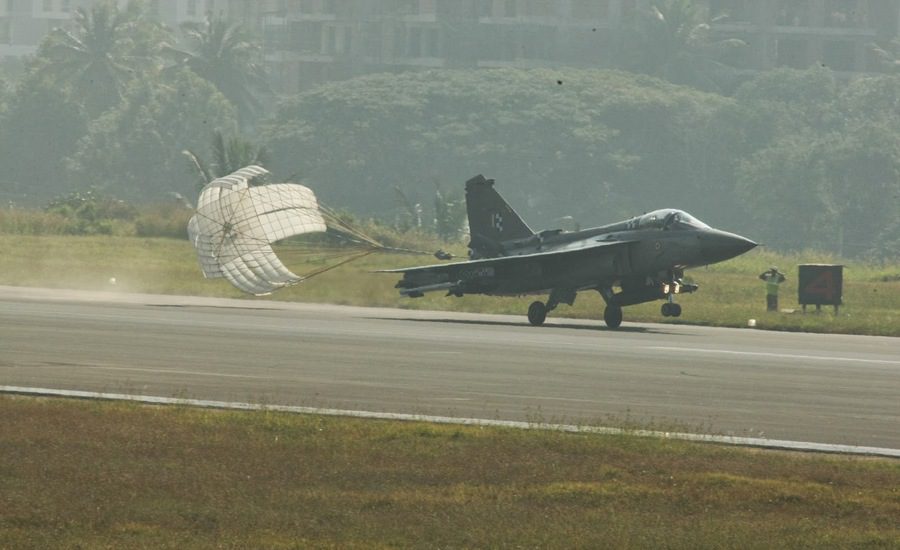
New Delhi: In a major stride toward enhancing operational safety and strengthening indigenous defence capabilities, India has successfully developed and inducted a Hybrid Brake Parachute for the Light Combat Aircraft (LCA) TEJAS.
Designed and manufactured domestically by Gliders India Ltd (GIL) in collaboration with the Aerial Delivery Research and Development Establishment (ADRDE) under the Defence Research and Development Organisation (DRDO), this advanced braking system significantly improves TEJAS’s landing performance, especially during high-speed recoveries and emergency scenarios.
Hybrid Brake Parachute for TEJAS: Revolutionising Aircraft Landing Safety
Landing a high-performance fighter like TEJAS — especially on short runways or under adverse weather conditions — presents unique safety challenges. Traditional wheel braking alone often struggles to bring such jets to a safe stop under demanding conditions.
The newly developed Hybrid Brake Parachute addresses this critical need by providing rapid deceleration and enhanced pilot survivability.
Weighing just 10 kg, this lightweight parachute system features a Uni-Cross main canopy with a span of 5.75 metres and a total area of 17 square metres — offering efficient deceleration while maintaining structural resilience.
Major Advantages of Hybrid Brake Parachute for TEJAS
Multi-stage Deployment: Includes pilot and auxiliary parachutes that ensure dependable deceleration, even during rapid or abrupt landing sequences.
High Deployability: Operates at speeds up to 285 km/h under normal conditions and up to 340 km/h in emergencies, enabling adaptability to varying mission requirements.
Efficient Design: Its compact and lightweight architecture simplifies installation, reduces aircraft turnaround time, and places fewer maintenance demands on ground crews.
Operational Benefits of Hybrid Brake Parachute for TEJAS for the IAF
Here are the operational benefits of hybrid brake parachute for TEJAS;
Enhanced Safety and Mission Readiness
With the Hybrid Brake Parachute integrated into TEJAS, pilots receive a crucial additional safety layer — especially useful during high-speed recoveries, short runway operations, or unplanned landings.
The new system reinforces survivability in high-pressure scenarios where traditional brake systems may be inadequate.
Improved Deceleration and Reduced Landing Distance
By shortening the aircraft’s landing roll, the innovation enhances operational flexibility on short or unprepared airstrips, such as those found at forward operating bases or expeditionary airfields.
Faster Turnaround and Reduced Maintenance
Ground crews benefit from easier installation and lower maintenance requirements, enabling quicker aircraft readiness cycles — a key factor in sustained operational deployments.
Strategic Reinforcement of Indigenous Aviation Technologies
This milestone underscores India’s broader commitment to “Atmanirbhar Bharat” (self-reliant India) and the “Make in India” initiative, which prioritize domestic innovation in defence manufacturing. By reducing dependency on imported safety systems, the country is bolstering its aerospace ecosystem and fortifying defence supply chains.
Gliders India Ltd, with its prior experience developing brake parachutes for other fighter platforms like the Sukhoi Su-30MKI, has adeptly tailored its expertise to meet TEJAS-specific requirements using advanced materials like nylon and Kevlar.
CEMILAC-certified to stringent military aviation standards, the Hybrid Brake Parachute meets rigorous safety and performance benchmarks.
Future Integration and Fleet Implications of Hybrid Brake Parachute for TEJAS
As Hindustan Aeronautics Limited (HAL) continues production of the TEJAS fleet — particularly the MK-1A and future variants — integration of the Hybrid Brake Parachute is expected to become standard, further elevating the aircraft’s operational envelope.
With projected IAF holdings of over 120 TEJAS jets, this safety upgrade not only enhances pilot and aircraft survivability but also reinforces confidence in India’s home-grown defence aviation programs amid evolving regional security landscapes.
Technical Specifications of Hybrid Brake Parachute for TEJAS
| Parameters | Details |
| Weight | 10 kg |
| Main Canopy Configuration | Uni-Cross, 5.75 m span, 17 sq m |
| Deployment Speed | 285 km/h (normal), 340 km/h (emergency) |
| Mechanism | Multi-stage (pilot + auxiliary) |
| Primary Purpose | High-speed landing deceleration and safety |
Strategic Significance and Regional Impact
The induction of this Hybrid Brake Parachute aligns with India’s strategic goal to reduce foreign dependency and strengthen in-country expertise in defence technologies.
As aerial threats grow more sophisticated and operational demands increase, such innovations deepen India’s defence industrial base while improving frontline readiness against potential regional contingencies.
Read also: Indian Navy Signs Pact With Crimson Energy to Build AI-Powered Deepdarshak Maritime Analytics System