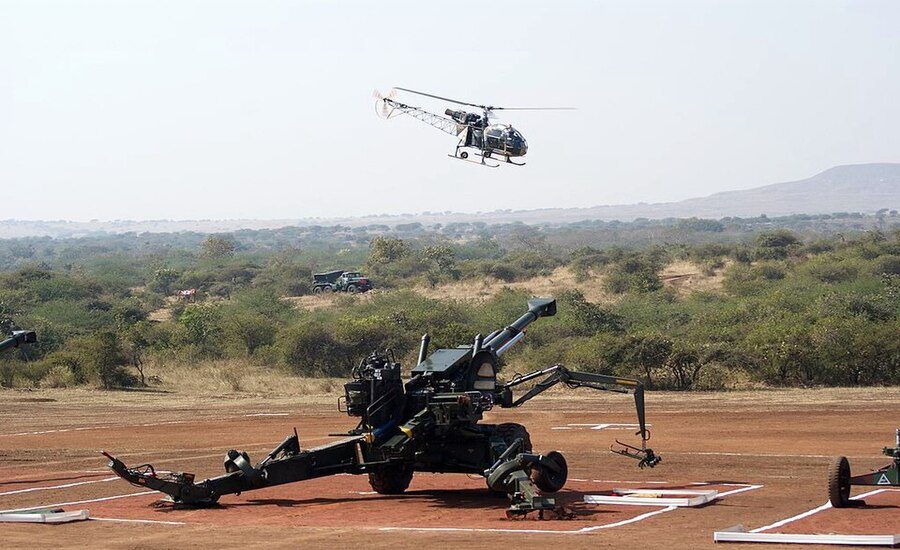
New Delhi: The Indian Army Dhanush howitzer order marks a major step in strengthening India’s indigenous defence capabilities. The Indian Army is preparing to place an order for 300 Dhanush howitzers, an advanced artillery system developed and manufactured in India.
According to defence officials, the procurement will help raise 15 new artillery regiments, significantly improving the Army’s long-range firepower and operational readiness. The move also highlights India’s growing focus on self-reliance in defence production under the “Make in India” initiative, reducing dependence on imported weapon systems while boosting domestic defence manufacturing.
Details of Dhanush Howitzer Procurement
The Indian Army is expected to soon place an order for 300 indigenous Dhanush howitzer guns, with approval likely from a high-level meeting of the Ministry of Defence. These artillery systems will be used to create 15 additional regiments, enhancing the Army’s artillery strength.
This will be the second major procurement of Dhanush artillery guns after an earlier order of 114 guns. Several regiments equipped with the system have already been inducted into service, while more are scheduled for deployment.
The decision reflects India’s continued push to strengthen indigenous military capabilities and improve battlefield preparedness, particularly in sensitive border areas.
What is the Dhanush Howitzer?
The Dhanush is a 155 mm, 45-calibre long-range towed artillery gun developed in India. It is produced by Advanced Weapons and Equipment India Limited, formerly part of the Ordnance Factory Board.
The system is based on the technology transfer obtained from the Bofors FH-77B guns acquired by India in the 1980s but has been upgraded with modern electronics and improved firing capabilities.
It is considered one of the key success stories of India’s indigenous defence manufacturing efforts.
What are Features of Dhanush Howitzer Procurement
The Dhanush artillery system has several advanced capabilities that make it suitable for modern battlefield requirements:
- Calibre: 155 mm / 45 calibre artillery gun
- Maximum firing range: Around 38 km depending on ammunition
- Rate of fire: Up to 3 rounds in 15 seconds during burst firing
- Crew requirement: Approximately 6–8 soldiers
- Advanced features:
- Automatic gun alignment
- Inertial navigation-based sighting system
- On-board ballistic computation
- Day-and-night firing capability
- Compatibility with NATO-standard ammunition
These upgrades provide better accuracy, faster deployment and improved combat performance compared to older artillery systems.
Importance of Dhanush Howitzer Procurement
Each artillery regiment typically consists of 18 guns, meaning the new order could equip around 15 regiments of Dhanush howitzers.
This will significantly enhance the Army’s ability to deliver long-range precision fire support, which is essential in modern warfare.
The new regiments are expected to support operations in difficult terrains such as:
- High-altitude border regions
- Mountain warfare environments
- Strategic sectors requiring long-range artillery coverage
The deployment will also help replace older artillery systems currently in service.
Boost to ‘Make in India’ Defence Manufacturing
The Dhanush project represents one of the first indigenous long-range artillery systems produced in India.
Key benefits include:
- Around 80% indigenous content, reducing import dependency
- Easier maintenance due to locally available spare parts
- Strengthening India’s domestic defence industry
The programme aligns with India’s broader push for defence self-reliance (Atmanirbhar Bharat) and domestic production of critical military systems.
Strategic Importance
The procurement comes at a time when India is actively modernising its artillery capabilities.
Modern artillery systems play a crucial role in:
- Battlefield dominance
- Long-range strike capability
- Rapid response during conflicts
- Strengthening deterrence along sensitive borders
By increasing the number of indigenous artillery systems, India aims to build a stronger, more self-reliant and technologically advanced military force.