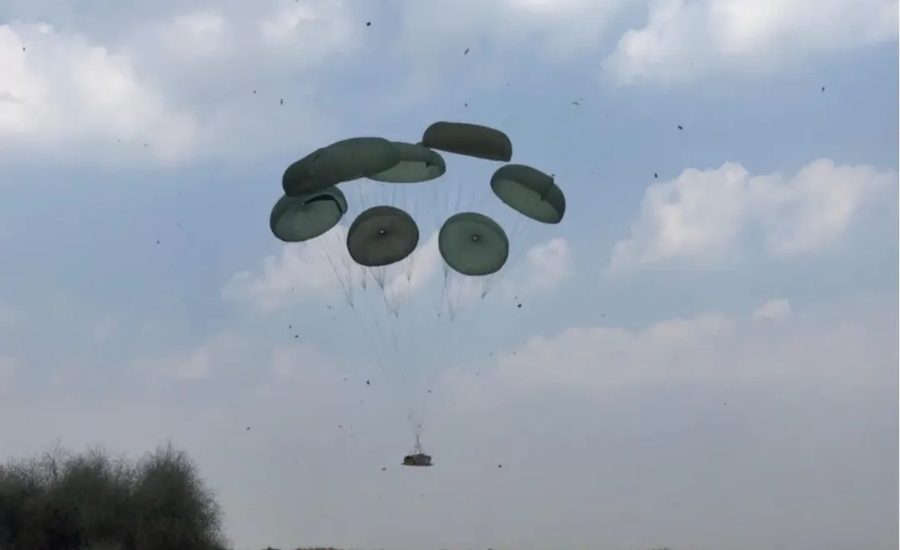
New Delhi: In a major stride for Indian defence readiness and self-reliance, the Indian Army successfully executed the airborne airdrop of a BMP infantry combat vehicle using a domestically developed 28-foot Cluster Extractor Parachute system.
This strategic milestone, achieved during trials on 17 February 2026 at the Mahajan Field Firing Ranges in Rajasthan, enhances rapid deployment capabilities for mechanised forces in inaccessible areas. The operation, involving the C-17 Globemaster III aircraft and led by the Army Airborne Training School (AATS) under the Army Training Command (ARTRAC) in Agra, underscores growing joint operational synergy with the Indian Air Force (IAF) while advancing India’s Aatmanirbhar Bharat defence vision.
Details of Indian Army BMP Airdrop
The Indian Army’s objective was to validate the capability of executing a controlled airdrop of a fully mechanised infantry combat vehicle (BMP) using an advanced parachute delivery system.
Read also: Faster, Safer, Deadlier: How Jeanuvs-CVRDE Indigenous Autoloader Enhances Indian Army Firepower
- The BMP vehicle, weighing approximately 13,000 kg, was successfully rigged on a specialised heavy-drop platform for airborne delivery.
- A 28-foot Cluster Extractor Parachute, designed and developed by the Defence Research and Development Organisation (DRDO), deployed in a controlled low-velocity descent to ensure safe ground impact.
This capability is critical for rapid force projection when relief, logistics or heavy combat assets must be delivered into regions with limited road access or emerging battlefield requirements.
How the Indian Army BMP Airdrop System Works
The indigenous system integrated several key components:
- Drogue Chute Initiation – Drag parachute starts the extraction process.
- Cluster Parachutes Deployment – Up to eight parachutes (variants include configurations up to 100 feet in diameter) manage load suspension and descent.
- Floor Lock Mechanism – Holds the platform securely inside the aircraft until optimal release conditions are established.
- Controlled Descent & Ground Impact – The platform and vehicle descend with minimal velocity to ensure safety and operational integrity.
This system is compatible with both C-17 and C-130 military transport aircraft, broadening its utility across multiple platforms in the Indian defence inventory.
Strategic Importance of the Indian Army BMP Airdrop Capability
The successful trial has strategic implications:
- Enhanced Rapid Deployment – Forces can now insert heavy mechanised assets swiftly into remote or hostile regions without relying solely on ground transport.
- Joint Operational Readiness – Signals refined coordination between the Indian Army and IAF during high-stake airborne operations.
- Boost to Indigenous Defence Manufacturing – Aligns with national self-reliance goals by leveraging DRDO-developed hardware.
According to official statements from ARTRAC, such capabilities certify improved combat mobility, and bolster India’s preparedness for rapid crisis response and border contingencies.
In Context: India’s Aerial Delivery Evolution
India’s airborne operations have a long history, tracing back to pivotal missions like the 1971 Tangail Airdrop during the Bangladesh Liberation War, which showcased early strategic airborne deployment concepts.
Modern aerial delivery systems now mix self-developed hardware with international platforms like the C-17 — marrying global aviation mobility with homegrown innovation.