In a bid to strengthen its air-defence posture against evolving aerial threats, the Indian Army has initiated a formal evaluation of the German-designed Oerlikon Skyshield short-range air-defence (SHORAD) system. The move comes amid increasing concern over low-flying aircraft, cruise missiles, precision-guided munitions, and — notably — drone swarms that have become a central feature of modern asymmetric and hybrid warfare.
Indian military planners regard this acquisition as a key step in upgrading legacy anti-aircraft artillery (like aging 40 mm or Zu-23mm systems) that may no longer be adequate to counter high-speed, low-observable and highly manoeuvrable threats.
What is Oerlikon Skyshield?
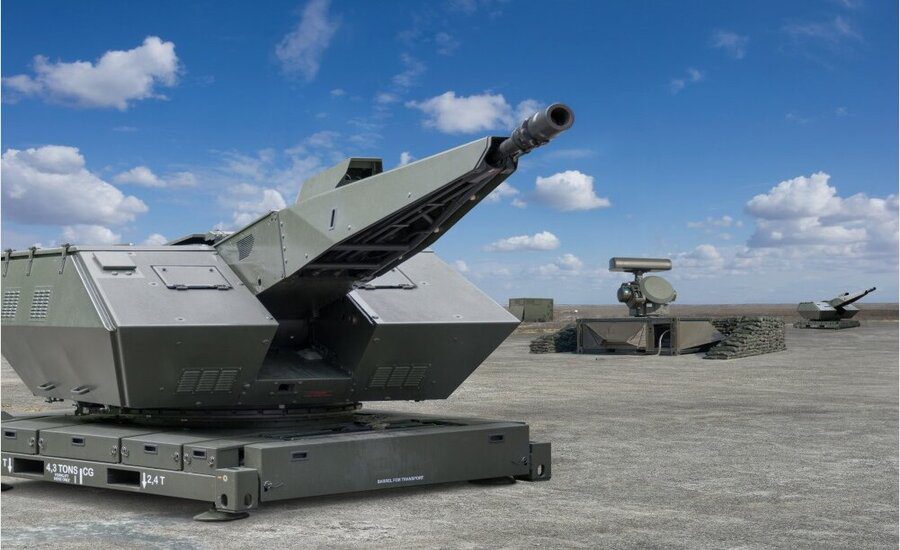
The Oerlikon Skyshield is a modular, lightweight SHORAD solution originally developed by Swiss firm Oerlikon Contraves, now part of Germany’s Rheinmetall.
It functions as a short-range ground-based air-defence system, designed to rapidly detect, track, and destroy incoming aerial threats including aircraft, helicopters, missiles, and drones.
Key Capabilities of Oerlikon Skyshield
At the heart of Skyshield are two 35 mm revolver cannons capable of firing up to 1,000 rounds per minute.
This high rate-of-fire is complemented by advanced programmable ammunition (AHEAD — Advanced Hit Efficiency And Destruction), which releases a dense cloud of tungsten sub-projectiles near the target, significantly increasing the odds of destroying small, fast-moving threats like drones or cruise missiles.
The system also integrates sophisticated radar and fire-control capabilities. A tactical acquisition radar (for example, X-TAR3D) provides long-range airspace surveillance, while the command post and fire control unit — which may be physically separated — handle target tracking and engagement. This modular architecture allows Skyshield to be networked with other air-defence assets, enabling layered air-defence coverage.
Strategic Imperatives of Oerlikon Skyshield for Indian Army
1. Countering Drone Swarms & Precision Threats: Given the proliferation of inexpensive, small, and hard-to-detect drones and loitering munitions — especially in regional conflicts — conventional anti-aircraft systems are increasingly inadequate. The Skyshield’s rapid-firing cannon and programmable ammunition are particularly suited for neutralizing drone swarms, low-flying drones, and cruise missiles, which represent a new era in aerial threats.
2. Building a Layered Air-Defence Network: Indian defence planners envision integrating Skyshield alongside existing and planned systems such as surface-to-air missiles (SAMs), man-portable air-defence systems (MANPADS), sensors and radar networks. This layered architecture enhances airspace security: long-range missile systems engage high-altitude, long-range threats; while SHORAD systems like Skyshield handle low-altitude, short-range threats.
3. Enhancing Saturation / Swarm Attack Resistance: Modern threats often involve saturation attacks — simultaneous multiple missile, drone or UAV incursions aimed at overwhelming defences. The modular, rapid-fire capability of Skyshield is designed for high “saturation resistance,” meaning it can engage multiple targets in quick succession or simultaneously.
4. Platform for Future Upgrades & Localisation: Skyshield’s open architecture allows for integration of other effectors beyond the 35 mm cannon — including missiles, electronic warfare assets, or even future high-energy lasers — offering room for upgrades as threats evolve.
Furthermore, there is growing emphasis on indigenisation under India’s “Make in India” defence push. Indian defence firms (such as Tata Advanced Systems or BEML) have been identified as prospective industry partners for manufacturing or co-producing some components of such systems in India.
Broader Context of Oerlikon Skyshield
Globally, advancing drone, missile and UAV technologies — often inexpensive and produced in large numbers — are forcing militaries to rethink traditional air-defence paradigms. Systems like Skyshield are part of a broader shift toward layered, multi-component, modular air-defence networks.
India, with its growing security challenges on multiple fronts — conventional threats, asymmetric warfare, cross-border drones / missile threats — needs a diversified air-defence portfolio. The potential integration of systems like Skyshield could complement missile-based defences and indigenous efforts such as the programme VSHORADS (Very Short Range Air Defence) or other home-grown systems.
Moreover, by working toward localisation and co-production, India could reduce dependency on imports over time, while building domestic manufacturing and maintenance capabilities for high-end defence hardware.
Road Ahead
The evaluation by the Indian Army is the first step toward potential procurement of the Skyshield system. If approved, deployment of SHORAD batteries could significantly upgrade the operational air-defence readiness of the Army — protecting vulnerable front-line assets, military installations, logistics hubs, or sensitive infrastructure.
Successful integration of Skyshield would also mark a shift toward a more networked and layered defence doctrine — combining long-range SAMs, mid-range systems, SHORADs, and potentially even directed-energy weapons in the future.
However, formal procurement would likely come with negotiations around localisation, technology transfer, and adaptation for the Indian operational environment — a process that, while promising, tends to be time-consuming.
In sum, adoption of Skyshield could represent a substantial leap in India’s ability to deter or thwart modern aerial threats — especially drones, missiles, and precision-guided munitions — making India’s air-defence grid more credible and resilient.