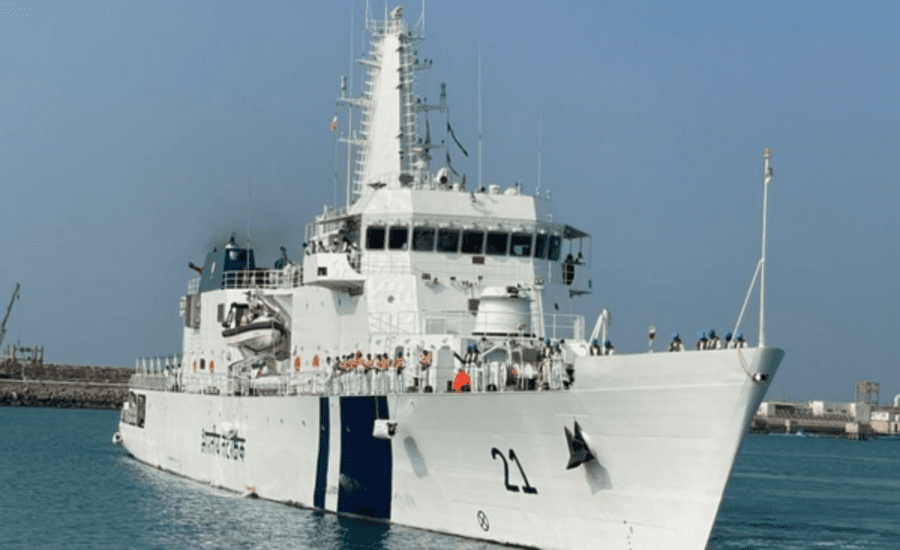
The first-ever visit of an Indian Coast Guard ship to Chabahar Port represents a major step in India’s evolving maritime diplomacy. As regional sea lanes grow in strategic importance, India is expanding its maritime engagement beyond naval deployments to include coast guard-led cooperation, which focuses on safety, environmental protection, and law enforcement at sea.
The port call of ICG Ship Sarthak highlights India’s intent to play a constructive, stabilising role in the Indian Ocean Region (IOR) and the Gulf of Oman, while strengthening bilateral ties with Iran through non-combat maritime collaboration.
Background of Indian Coast Guard Ship Sarthak
India’s maritime outreach is guided by two core doctrines:
- SAGAR (Security and Growth for All in the Region)
- MAHASAGAR Vision, which emphasizes inclusive maritime security and cooperation
Under these frameworks, the Indian Coast Guard has increasingly engaged with regional maritime forces, complementing the Indian Navy’s blue-water operations.
Port calls such as this serve three strategic purposes:
1. Building institutional trust
2. Enhancing operational interoperability
3. Supporting regional maritime governance
About Indian Coast Guard Ship Sarthak
ICG Ship Sarthak is an Offshore Patrol Vessel (OPV) designed for long-duration deployments and multi-role maritime missions.
Key Capabilities:
- Maritime surveillance and patrol
- Search and Rescue (SAR) operations
- Maritime Law Enforcement (MLE)
- Marine Pollution Response (MPR)
- International maritime cooperation
Its deployment to Chabahar underscores India’s focus on capability-based diplomacy, not symbolic presence.
Chabahar Port Call: Key Details
Location: Chabahar Port, Iran
Duration: Until December 19
Nature of Visit: Professional, operational, and community engagement
Participating Agencies: Iranian Navy and Iranian maritime authorities
This visit is the first-ever Indian Coast Guard presence at Chabahar, making it a landmark event in India–Iran maritime relations.
Operational Engagements During the Visit
1. Maritime Search and Rescue (SAR)
Joint interactions aim to improve coordination during distress situations, particularly in the Gulf of Oman and nearby sea lanes.
2. Maritime Law Enforcement (MLE)
Discussions focus on:
- Anti-smuggling efforts
- Maritime safety regulations
- Best practices in coastal security
3. Marine Pollution Response (MPR)
A live pollution response demonstration will be conducted at Chabahar Harbour, focusing on:
- Oil spill containment
- Response to Hazardous and Noxious Substances (HNS)
- Inter-agency emergency coordination
This aligns with global maritime environmental protection norms.
Community Outreach and Environmental Initiatives
The port call also includes people-centric diplomacy, reinforcing India’s soft power approach:
- Sports events and cultural interactions
- Beach walkathons for environmental awareness
- Participation of embarked National Cadet Corps (NCC) cadets
- Activities aligned with Puneet Sagar Abhiyan, India’s marine cleanliness initiative
These efforts strengthen people-to-people and youth-level engagement.
Strategic Importance of Chabahar Port (Explainer)
Chabahar is a deep-water port on the Gulf of Oman, offering India:
- Direct maritime access to Iran
- Connectivity to Afghanistan and Central Asia
- A trade route bypassing Pakistan
- Integration with the International North–South Transport Corridor (INSTC)
For India, Chabahar is a geopolitically independent gateway that supports trade, energy security, and regional stability.
Regional Context: Continuity of Maritime Engagement
The Chabahar visit follows Sarthak’s earlier port call at Kuwait, where it interacted with the Kuwaiti Coast Guard. Together, these engagements demonstrate:
- The Indian Coast Guard’s expanding regional footprint
- India’s preference for cooperative maritime security
- Growing trust with West Asian maritime partners
Strategic Implications of Indian Coast Guard Ship Sarthak to Chabahar Port for India
This port call strengthens India’s ability to:
- Secure critical sea lanes
- Support regional disaster response
- Project economic and maritime influence
- Promote a rules-based maritime order
It also reinforces India’s role as a net security provider in the Indian Ocean Region.