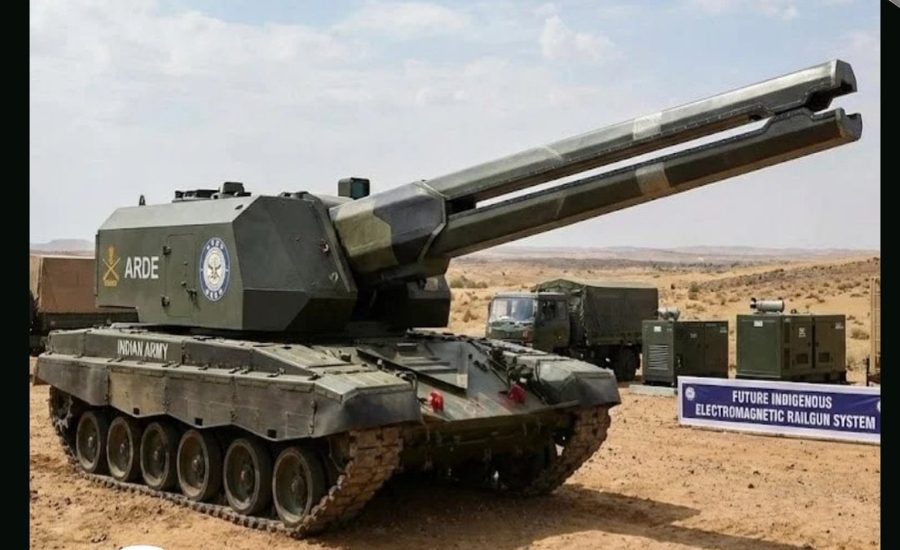
Pune: In a significant leap forward for India’s defence innovation ecosystem, the Armament Research & Development Establishment (ARDE) – a premier laboratory of the Defence Research and Development Organisation (DRDO) – has officially confirmed the development of an indigenous Electromagnetic Railgun System.
The groundbreaking technology is designed to amplify the Indian Army’s long-range strike capabilities, heralding a new era of futuristic firepower that relies on electromagnetic propulsion rather than conventional explosives.
What Is the Indigenous Electromagnetic Railgun?
An electromagnetic railgun (EMRG) is a weapon system that leverages electromagnetic forces – rather than chemical propellants – to launch projectiles at extraordinarily high velocities. Unlike conventional guns or artillery that depend on explosive charges, the railgun uses a powerful electrical pulse routed through conductive rails.
This delivers tremendous kinetic energy, enabling projectiles to reach hypersonic speeds of up to approximately 2,000 metres per second (around Mach 6).
The ARDE project’s railgun is currently engineered to launch a 50-kilogram projectile to distances nearing 200 kilometres, significantly outpacing the range of traditional artillery systems fielded by the Indian Army.
What is the Importance of Indigenous Electromagnetic Railgun
Here is the key importance of indigenous Electromagnetic railgun;
Extending Battlefield Reach
The extended range – roughly 200 km – provides Indian forces with unprecedented standoff capability, allowing them to strike deep into contested zones from safer distances.
This enhances deterrence and deep-strike precision in counter-force scenarios across India’s complex security environment, including along the Line of Control (LoC) and the Line of Actual Control (LAC).
Kinetic Impact Over Explosives
Instead of relying on explosive warheads, the railgun’s high-velocity solid metal projectile inflicts damage through pure kinetic energy.
This reduces the logistical burden and safety risks associated with transporting and storing propellants and explosives, a crucial advantage in forward operating areas.
Cost Efficiency & Logistics
Over time, firing solid metal projectiles could prove significantly more cost-effective than traditional artillery shells or missile systems.
The reduced need for complex explosive ordnance simplifies supply chains and lowers long-term operational expenses.
Technical and Development Challenges
While the promise of railgun technology is transformative, ARDE scientists acknowledge numerous engineering challenges remain:
High-Power Energy Storage: Developing capacitor banks capable of storing and delivering the massive electrical energy needed for repeated firings is a critical hurdle.
Rail Durability: Rails experience extreme heat, friction, and plasma effects during each shot. Enhancing rail materials to withstand these stresses is a complex materials-science challenge.
Power Generation: Deploying a combat-ready railgun demands compact, high-density energy sources appropriate for battlefield conditions, possibly integrating next-generation onboard generators or vehicle-mounted power systems.
Infrastructure development such as Pune’s Centre for Electromagnetic Launch Technology (CEMaLT) plays a pivotal role in scaling energy outputs from earlier experimental benchmarks (~10 MJ) toward the ~100 MJ levels considered necessary for operational deployment.
India’s Place in the Global Railgun Race
By advancing its own railgun system, India joins a select group of nations – including the United States, China, and Japan – actively pursuing electromagnetic launch technologies.
These systems represent futuristic warfare capabilities that could reshape strategic doctrines by prioritising speed, range, and precision over payload explosive force.
Integration into Self-Reliant Defence Priorities
The railgun development aligns squarely with India’s Atmanirbhar Bharat initiative in defence research and manufacturing. Recent high-level visits – including by Defence Minister Rajnath Singh to ARDE and DRDO research facilities – have underscored the importance of indigenous innovation across advanced technologies such as railguns, robotics, and propulsion systems.
This railgun initiative complements India’s broader arsenal of indigenous systems such as:
- Pinaka Multi-Barrel Rocket Launchers
- ATAGS 155 mm howitzers
- Light Tank ‘Zorawar’
- AKASH-NG Missile Systems
Ongoing integration with platforms like the Artillery Combat Command and Control System (ACCCS) strengthens networked battlefield awareness and fire coordination, further magnifying the impact of next-generation weapons.
Timeline of Indigenous Electromagnetic Railgun
ARDE officials project that the electromagnetic railgun could move from research prototype to Indian Army induction within the next decade, contingent on successful endurance testing, ruggedisation, and battlefield integration.
The platform’s potential extends beyond land warfare. Research into mounting such systems on naval vessels or mobile truck-based platforms could expand India’s strategic options across multi-domain operations.
Read also: Project Dhvani Explained: Inside DRDO’s Project Dhvani and Its Mach-7+ Strike Capability