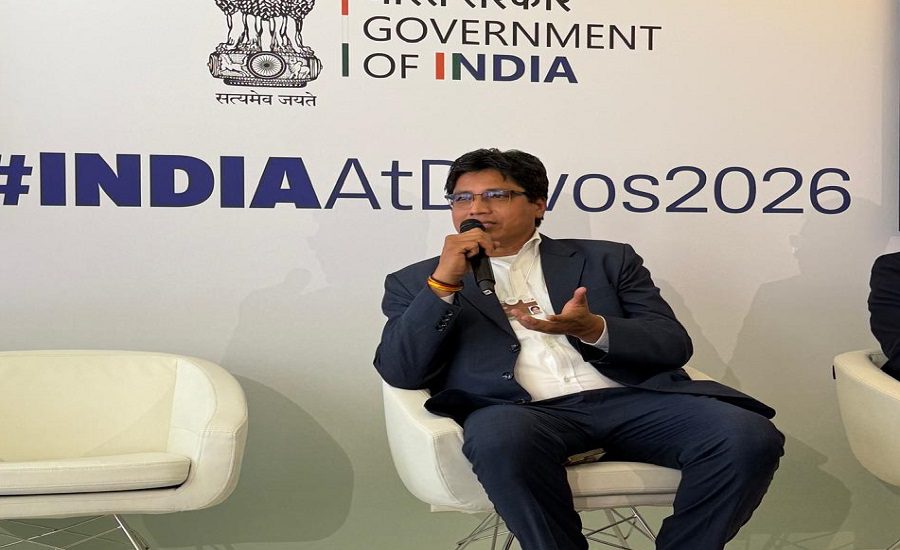
Davos/New Delhi: India’s growing leadership in distributed and decentralised solar energy solutions took centre stage at the World Economic Forum (WEF) Davos 2026, where Indian Renewable Energy Development Agency Limited (IREDA) Chairman and Managing Director, Mr. Pradip Kumar Das, participated in a high-level panel discussion titled “Scaling Solar Where It Matters: India’s Lessons on Rooftop, Agriculture and Decentralized Energy for the Global South.”
The session was preceded by a keynote address from Union Minister for New and Renewable Energy, Mr. Pralhad Joshi, highlighting India’s progress and ambition in the renewable energy sector.
Distributed Solar Key for Emerging Economies
During the discussion, Mr. Pradip Kumar Das underlined that decentralised renewable energy systems are becoming increasingly important for emerging and developing economies. He noted that distributed solar solutions:
- Improve overall energy efficiency
- Help reduce government subsidies
- Lower Aggregate Technical & Commercial (AT&C) losses
- Reduce power costs and improve affordability
According to Das, these benefits make decentralised energy a strong tool for inclusive and sustainable development.
Read also: IREDA’s IGGEFIL Sanctions $22.5 Million International Loan for 100 MW Solar Project in Zambia
Managing Risks in New Renewable Energy Segments
Responding to concerns about risks in new and emerging renewable energy segments, Das explained that such risks can be effectively managed through robust project design and strong risk management practices.
He highlighted IREDA’s solid financial performance, stating that:
- IREDA has financed projects worth around Rs 1.81 lakh crore since inception
- Over more than 38 years of operations, cumulative write-offs have been limited to just Rs 149 crore
This track record, he said, reflects the strength of IREDA’s appraisal, monitoring, and risk mitigation frameworks.
Accelerating Rooftop Solar and Rural Clean Energy Access
Mr. Das further shared that IREDA plays a critical role in expanding access to clean energy, particularly in rural India. Under key government schemes:
- IREDA finances 70–80% of project costs
- Support is extended through the aggregator model
- Major schemes include Rooftop Solar and PM-KUSUM
These initiatives are helping accelerate agricultural solarisation and decentralised energy adoption across the country.
India’s Renewable Ecosystem a Global Model
Thanking Union Minister Pralhad Joshi for providing IREDA the platform at WEF Davos, Das said the forum enabled India to showcase its renewable energy growth backed by a mature and well-developed ecosystem.
Referring to Maharashtra’s progress in agricultural solarisation, he emphasised the importance of building an enabling ecosystem that:
- De-risks renewable energy projects
- Attracts long-term and patient global capital
- Offers scalable models for other countries in the Global South
These lessons, he noted, can help accelerate clean energy transitions worldwide.
About REC Limited
REC Limited is a Maharatna Central Public Sector Enterprise under the Ministry of Power, Government of India, and a leading Non-Banking Financial Company (NBFC) supporting India’s power and infrastructure sectors. REC plays a vital role in financing generation, transmission, distribution, and renewable energy projects, contributing significantly to India’s sustainable energy and infrastructure development goals.
Read also: PESB Recommends REC Executive Director Valli Natarajan for Director (Projects) Post at IREDA