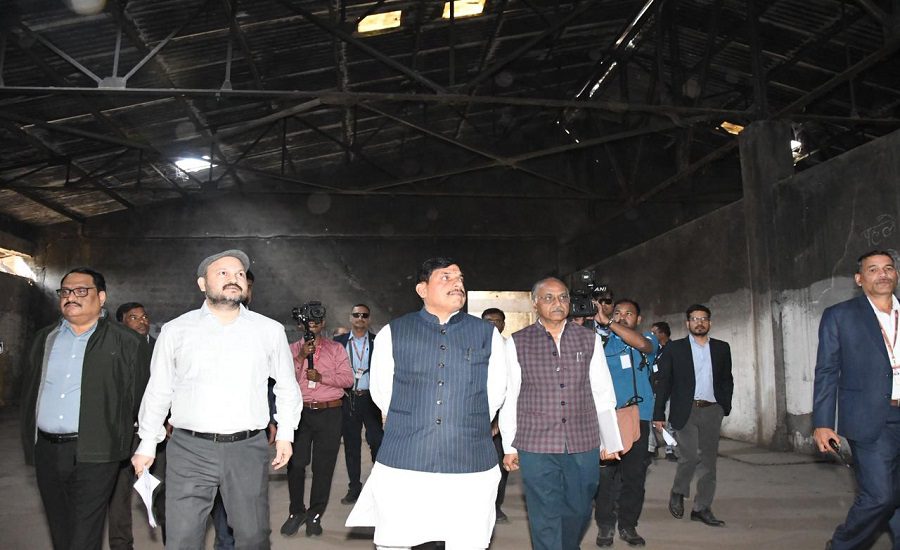
Bhopal: Chief Minister of Madhya Pradesh, Dr. Mohan Yadav, on Saturday conducted an extensive inspection of the Union Carbide Factory premises in Arif Nagar, Bhopal, emphasizing the government’s commitment to stand with the gas tragedy victims and initiate the redevelopment of the site. The factory, infamous for the catastrophic methyl isocyanate (MIC) gas leak on the night of December 2-3, 1984, had chemical waste lying unattended for nearly 40 years.
Dr. Yadav stated that under the guidance of the High Court, the government has successfully disposed of the decades-old chemical waste without causing any environmental or human harm. “Now, in consultation with all stakeholders and victims’ representatives, we will develop the Union Carbide premises and establish a memorial to honor the lives lost in the Bhopal Gas Tragedy,” he said.
Comprehensive Site Inspection and Safety Assurance
During the visit, Dr. Yadav became the first Chief Minister of Madhya Pradesh to inspect the core areas of the Union Carbide factory without a safety mask, highlighting the site’s complete decontamination. Accompanied by senior officials from the Gas Relief and Rehabilitation Department, Chief Minister’s Office Secretary Alok Kumar Singh, Public Relations Commissioner Deepak Kumar Saxena, and Bhopal Municipal Commissioner Mrs. Sanskriti Jain, the CM reviewed plans for the memorial and other redevelopment activities.
“The Bhopal gas leak was not only Madhya Pradesh’s but India’s deadliest industrial disaster. The factory was abandoned after the tragedy, with no immediate action taken by previous governments. The chemical waste remained here for decades,” Dr. Yadav said. He further emphasized that the current government has set an example for the world by safely disposing of the toxic chemicals using modern scientific methods, turning the site into a safe and clean area.
Read also: Disabled Fan’s Dream Comes True as CM Mohan Yadav Arranges Ticket for India-New Zealand Match
Redevelopment Plans and Metropolitan Development
Dr. Yadav announced that the Union Carbide factory premises will now be redeveloped in alignment with broader urban development plans. The Madhya Pradesh government aims to integrate this site into the Bhopal metropolitan area, which includes six surrounding districts, facilitating infrastructure growth, urban renewal, and social development.
“The government will ensure all development activities are carried out transparently and in consultation with stakeholders. A memorial will honor the victims while the site will contribute to the city’s growth,” he said.
Interaction with Residents and Welfare Measures
During the inspection, Dr. Yadav stopped his convoy at the request of a local woman performing a ritual, personally participating in the ceremony at a Shiva idol. He also interacted warmly with local women beneficiaries of the Ladli Bahna scheme, confirming their monthly financial assistance and addressing their concerns.
Responding to requests for immediate financial help, Dr. Yadav approved ₹50,000 each from the Chief Minister’s voluntary fund to two women, with instructions to ensure prompt transfer to their bank accounts. The Municipal Commissioner confirmed that interim assistance had already been provided and remaining amounts would be credited shortly.
Dr. Yadav also took time to interact with schoolchildren at Arif Nagar, taking selfies with them and engaging with the local community, demonstrating a hands-on approach to governance and citizen engagement.
Commitment to Gas Victims and Sustainable Development
The Chief Minister reaffirmed that the state government will continue to stand by gas victims, ensuring their welfare and addressing all concerns. With the chemical waste safely disposed of, Madhya Pradesh is now ready to turn the Union Carbide premises from a symbol of tragedy into a site of remembrance and urban development, combining historical commemoration with progress and social welfare.
Dr. Yadav’s visit reflects the government’s ongoing commitment to urban renewal, citizen welfare, and honoring the memory of one of India’s gravest industrial disasters.