In a move that could reshape India’s aerial combat capabilities over the coming years, India and Russia are reportedly finalising a deal to integrate the R-37M—one of the world’s most potent long-range air-to-air missiles—into the Su-30MKI fleet of the Indian Air Force (IAF).
This development is not just a routine upgrade: it reflects a strategic recalibration in response to evolving threats in South Asia. By arming the Su-30MKI with R-37M missiles, India aims to significantly enhance its beyond-visual-range (BVR) strike envelope — potentially deterring adversaries and restoring air-combat parity (or advantage) in a landscape of rapidly modernizing air forces.
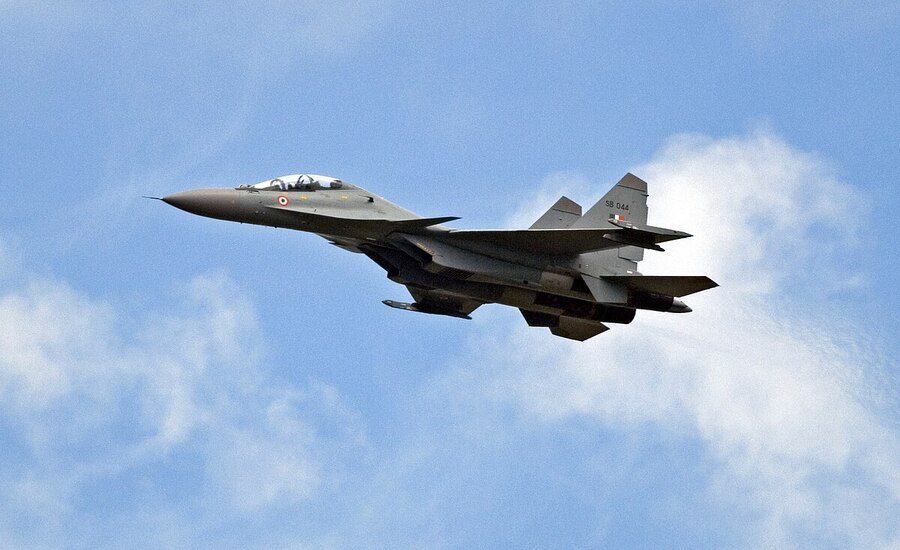
What is Su-30MKI
The Su-30MKI is a twin-jet, twin-seat, multirole air superiority fighter developed by Russia’s Sukhoi and built under licence by India’s Hindustan Aeronautics Limited (HAL).
First inducted in 2002 (Russian-made), with the first locally assembled Su-30MKI entering service in 2004.
Over the decades, the Su-30MKI has formed the backbone of the IAF’s fighter fleet due to its versatility, long range, and powerful avionics suite.
However, while the airframe and avionics have remained relevant, the evolving BVR missile threat from potential adversaries has exposed capability gaps — especially in long-range engagements.
Given the persistent security challenges in India’s neighbourhood and the increasing deployment of advanced foreign missiles by rival air forces, upgrading legacy platforms like the Su-30MKI with cutting-edge weaponry has become imperative.
The R-37M Missile: Capabilities and Significance
The R-37M (also known as export version RVV-BD) is a Russian long-range air-to-air missile — NATO codename “AA-13 Axehead.”
Key characteristics:
- Weight: ~ 510 kg, Length: over 4 m.
- Warhead: ~ 60 kg high-explosive fragmentation.
- Guidance: Inertial navigation with mid-course updates + active radar homing for terminal phase (Agat 9B-1388 seeker).
- Propulsion: Boost-sustain solid rocket motor (with jettisonable booster), enabling extremely long range.
- Speed: Hypersonic — up to Mach 5–6.
Engagement Envelope & Role
Reported range: While the export variant (RVV-BD) is often quoted around 200 km, in optimal conditions the R-37M’s maximum reach — using cruise-glide profile — could extend to 300–400 km.
Altitude and target profile: Designed to engage high-value, high-altitude, and high-value assets such as airborne early warning and control (AWACS) aircraft, aerial refuelling tankers, jammers — effectively the “C4ISTAR” nodes — while keeping the launching fighter outside the engagement envelope of enemy escort fighters.
Terminal guidance ensures high kill probability even against maneuvering targets.
In essence, the R-37M transforms an ordinary air-superiority fighter into a long-range “interdiction / anti-force multiplier” — capable of neutralising not just enemy fighters, but force-multiplying support assets far behind enemy lines.
Importance of R-37M Su-30MKI integration
Expanding Engagement Envelope: Integrating R-37M will dramatically expand the Su-30MKI’s engagement envelope far beyond what legacy missiles allowed. According to sources, India expects to take delivery of around 300 R-37M missiles for its Su-30MKI fleet.
With such a large stockpile and extended-range capability, the IAF would gain crucial tactical options, especially in conflicts where first look — first shot — first kill can decide the battle.
Deterrence: Hitting High-Value Enemy Assets
High-value support assets like AWACS, tankers, and electronic-warfare aircraft play a vital role in force multiplication. With R-37M-armed Su-30MKIs, India would be able to threaten such assets well beyond the protective umbrella of enemy fighters — potentially deterring their deployment in contested airspace.
This capability would significantly raise the cost for adversaries to rely on airborne command & control and force-knit support structures — potentially reducing their capacity for long-range precision strike, surveillance, and aerial refuelling.
Strategic Flexibility While Retaining Proven Airframes
Rather than investing only in new fighters (which are expensive, take years to build, and depend on foreign supply chains), upgrading existing Su-30MKIs allows India to squeeze more value out of proven airframes. According to reporting, this missile integration is part of a broader modernisation — involving avionics upgrades, fire-control system enhancements, sensor & radar improvements — ensuring Su-30MKI remains relevant for decades.
Given the pace of regional military modernisation (especially in China and Pakistan), such upgrades provide a cost-effective yet potent means to maintain a qualitative edge in the sky.
Key Challenges & Considerations for R-37M Su-30MKI integration
While the opportunity is clear, integrating a missile of this sophistication is not without challenges:
Structural and Avionics Integration: The size, weight, and aerodynamics of R-37M require modifications — including suitable hardpoints, pylons, and integration with radar/fire-control systems tailored for long-range BVR engagements.
Pilot Training and Tactical Doctrine: Employing 300–400 km missiles effectively demands new engagement doctrines, pilot training in long-range tracking and launch, and updated rules of engagement. Over-reliance or misuse could risk collateral damage or friendly fire.
Counter-measures by Adversaries: Once such capability becomes known, adversaries may adapt — hardening AWACS/tankers, limiting their exposure, or deploying swarm escort tactics to saturate defenses.
Logistics & Maintenance: Sustaining a large missile inventory (≈ 300 missiles) demands robust maintenance, storage, and lifecycle support infrastructure.
Geopolitical & Strategic Implications of R-37M Su-30MKI integration
Regional Deterrence — Particularly Pakistan & China: In recent years, air forces in the region — notably those of neighboring rivals — have been augmenting their BVR arsenal. The acquisition of R-37M would help restore India’s deterrence posture, especially in scenarios where adversaries aim to exploit long-range BVR missile advantage. Several reports cite recent confrontations (e.g., operations like Operation Sindoor in May 2025 as a wake-up call for India’s air defence planners.
Signal of Deeper India–Russia Defence Ties: This deal underscores a continued and evolving strategic partnership between India and Russia — not just in acquiring hardware, but in modernising legacy systems, integrating advanced weaponry, and potentially transferring technology.
A Bridge Until Indigenous Systems Mature: While India is working on its own long-range BVR missiles (e.g., future variants under development by domestic defence research agencies), the R-37M provides a bridge capability — ensuring India is not left vulnerable during the interim. This calibrated approach of “modernise existing + develop indigenous” reflects strategic prudence.
What Comes Next: Timeline & Outlook
According to available reporting, deliveries of R-37M for the Su-30MKI fleet are expected to begin within 12–18 months upon finalisation of the agreement.
The initial phase is expected to cover around 100 upgraded Su-30MKI aircraft — giving them an augmented air-to-air strike profile.
Concurrently, India may undertake structural/refit work: avionics, fire-control upgrades, testing, pilot training — a process likely to span several years before full operational deployment across the fleet.
In the longer term, this integration may pave the way for more advanced missiles (foreign or indigenous) on Su-30MKI and potentially other combat aircraft — contributing to a layered, flexible, long-range air defence/offence posture.