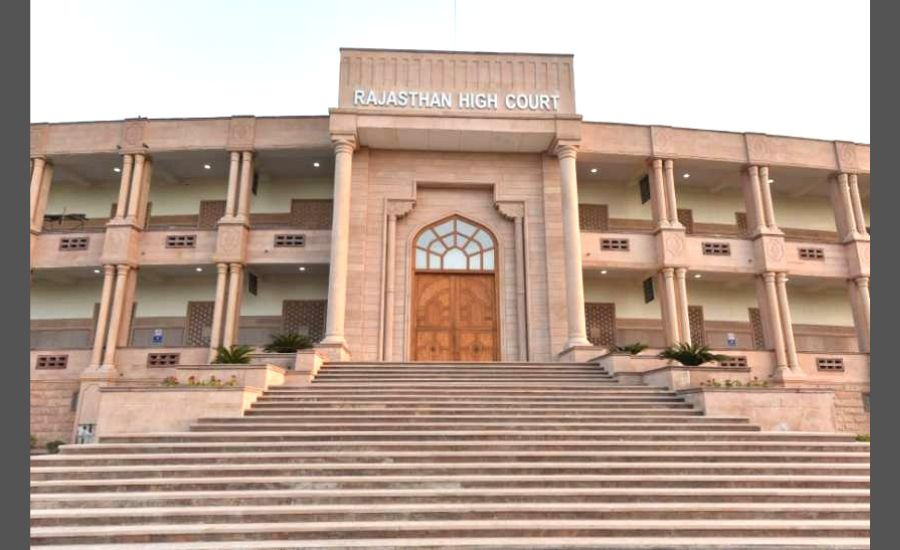
Jaipur: The Rajasthan High Court (Rajasthan HC) slammed a police Station House Officer (SHO) for “misbehaviour” with a lawyer and called the incident “most unfortunate.”
The court has ordered an inquiry and directed the state to provide soft-skills training to police officers. The matter has touched a sensitive chord — underscoring how friction between the police and legal fraternity can hamper the justice delivery system.
Background of the Case
According to the facts laid before the court: a lawyer — accompanied by his wife (also a lawyer) — visited a police station along with a rape victim, to assist her in recording her statement. Instead of ensuring due process, a man in civil clothes was recording the statement of the prosecutrix, bypassing proper formalities.
Read also: Rajasthan High Court Allows Prosecution of Retired IAS Officer in Rs 8 Crore Wheat Scam
When the lawyer raised objections to this irregularity, the SHO allegedly began misbehaving with him, even restraining him in a room. The incident was captured on camera and the video later went viral, prompting outrage.
Concerned by the severity — both in terms of procedural lapses and unbecoming behaviour — the High Court took up the matter.
High Court’s Reaction: Scathing, But Constructive
The case was heard by a division bench comprising Sanjeev Prakash Sharma (Acting Chief Justice) and Baljinder Singh Sandhu.
The bench observed that “advocates and police personnel are two limbs of the justice delivery system who must act in tandem with each other with mutual respect and cooperation.”
The Court held that while police sometimes must act firmly — especially while dealing with accused persons — such conduct cannot be expected when they are dealing with lawyers. At the same time, lawyers too are expected to treat police personnel with respect and politeness.
The incident, the Court said, reflects a “lack of coordination between the two wings of administration of justice.”
To address this systemic problem, the Court ordered that:
A formal inquiry must be conducted. The bench summoned the Commissioner of Police and the Deputy Commissioner. The Commissioner assured the court that departmental proceedings would be initiated against the SHO and other officials if needed.
The incident should reach a “logical conclusion,” and a report on the departmental action must be submitted at the next hearing.
The state police officials should be provided soft-skills training. The Court directed the Commissionerate to inform the Police Academy about this requirement so that training can be incorporated in the curriculum.
Systemic Concerns: Importance of this Rajasthan SHO Case and HC Ruling
The Court also referred to a previous judgment — Bharat Yadav v State of Rajasthan — in which a similar episode had occurred. At that time, the Court had recommended the constitution of a “Coordination Committee” at each district level to foster harmonious working relationships between police and advocates.
Shockingly, the present bench noted, the district-level Coordination Committees formed earlier had not been functioning effectively. In light of the current incident, the Court ordered that fresh committees be constituted in each district. The state was mandated to provide details of these committees at the next hearing.
This underscores a deeper structural problem: rising tensions and mistrust between the police and legal community, frequent procedural lapses in sensitive cases (such as sexual offences), lack of proper coordination, and deficits in communication and mutual respect — all of which can undermine the very purpose of justice delivery.
Immediate Fallout: Disciplinary Action and Public Outcry
Following the Court’s severe rebuke, there was swift action. According to subsequent media reports, both the SHO and a constable involved in the incident were suspended.
The public release of the video showing the misbehaviour added to the uproar, especially as the incident involved a rape victim — already among the most vulnerable. The outrage also resonated within the legal fraternity and civil-society observers, who praised the High Court for its prompt intervention.
Importance of Soft-Skills Training and Coordination
The Court’s directive for soft-skills training is significant, and potentially transformative. Here’s why:
Police–Advocate Cooperation Is Foundational: Police are often the first formal point of contact for victims, especially in sensitive offences like rape. Lawyers play a critical role in ensuring procedural and legal safeguards. Without mutual respect, coordination can break down, harming victims.
Trauma Sensitivity and Empathy: In cases involving sexual violence, victims are emotionally fragile. Insensitive behaviour from authorities can retraumatize them. Training in communication, sensitivity, empathy — all part of soft skills — can significantly improve victim experience and faith in justice systems.
Institutional Trust: Repeated episodes of police–lawyer friction erode trust. Institutional mechanisms like district-level Coordination Committees can foster regular dialogue, address grievances, and preempt conflicts.
Professionalism and Accountability: Soft skills are not just about politeness — they reflect professionalism, discipline, and accountability. In a democratic society, these are essential for justice institutions to command respect.
What’s Next: Pending Hearing, Structural Reforms, and Expectations
The matter has been listed for the next hearing on December 8, 2025, when the Commissioner must present a detailed report on departmental proceedings and on the reconstitution of district-level Coordination Committees.
The case will be closely watched, for it could set a precedent for how police-lawyer interactions are regulated across the state — and possibly beyond.
If implemented in spirit, the Court’s directives could lead to structural reforms, enhance professionalism, and improve the justice-delivery experience for vulnerable victims.
However, much will depend on follow-through: whether soft-skills training becomes part of the standard training for all police officers, whether the Coordination Committees are genuinely functional, and whether instances of police misbehaviour are treated with the seriousness they deserve.
Read also: Sanjiv Bhatt Moves Supreme Court Seeking Suspension of 20-Year Sentence in 1996 Gujarat Drug Case