Jaipur: In a major step towards technology-driven governance and fast-tracking development projects, Rajasthan has become the first state in the country to replicate the Centre’s PRAGATI model, launching its own platform named Raj-UNNATI. The initiative was formally rolled out following the Prime Minister’s call to states to adopt PRAGATI-like systems during the PRAGATI meeting held on December 31, 2025, and was subsequently reinforced at the 5th National Conference of Chief Secretaries.
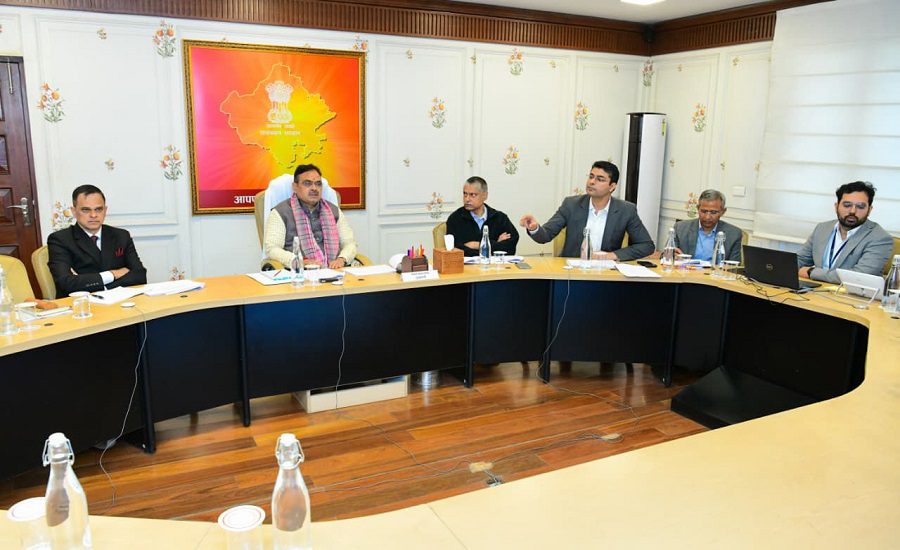
The first Raj-UNNATI meeting was chaired by Rajasthan Chief Minister Bhajanlal Sharma on January 17, 2026, marking a significant administrative reform aimed at resolving stalled projects, accelerating implementation of key schemes, and ensuring timely redressal of public grievances.
Inspired by PM Modi’s PRAGATI Platform
Raj-UNNATI is directly inspired by the PRAGATI (Pro-Active Governance and Timely Implementation) platform of the Central Government, chaired by Prime Minister Narendra Modi. PRAGATI integrates data management, geo-spatial mapping, and video conferencing to enable real-time monitoring of critical infrastructure projects and flagship schemes.
During the fifth Chief Secretaries’ Conference, the Prime Minister strongly emphasized that states must replicate the PRAGATI best practice, urging them to adopt technology-based governance mechanisms to improve efficiency, accountability, and delivery.
Rajasthan responded swiftly to this directive, becoming the first state to operationalize a PRAGATI-inspired system at the state level.
Cabinet Secretary Commends Rajasthan’s Raj-UNNATI Initiative
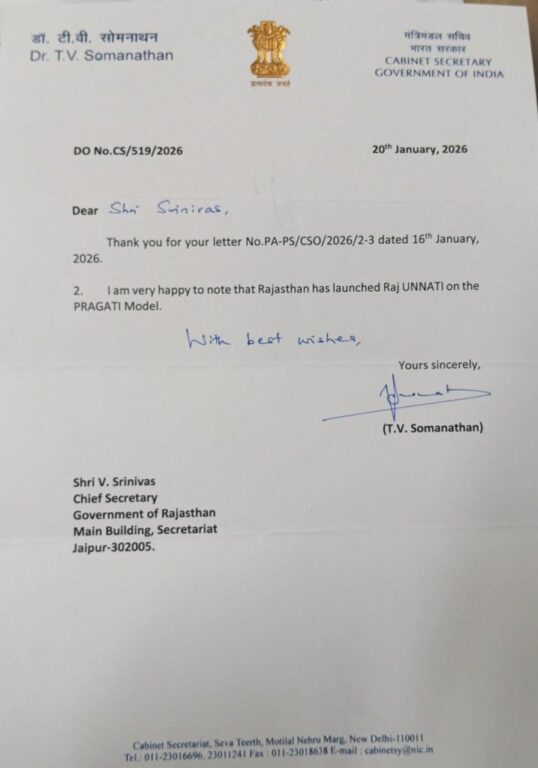
In a significant endorsement of the initiative, Cabinet Secretary to the Government of India, Dr. T.V. Somanathan, a IAS officer from the 1987 batch of the Tamil Nadu cadre, has formally praised the Rajasthan government for launching Raj-UNNATI on the PRAGATI model. In a letter addressed to the Rajasthan government, Dr. Somanathan acknowledged receipt of the state’s communication, and expressed his appreciation for the initiative. “I am very happy to note that Rajasthan has launched Raj-UNNATI on the PRAGATI Model. With best wishes,” the Cabinet Secretary stated, underlining the Centre’s approval of Rajasthan’s move to replicate the Prime Minister’s best-practice governance platform at the state level.
Objective of Raj-UNNATI
The core objective of Raj-UNNATI is to:
- Resolve long-pending issues related to important infrastructure projects and schemes
- Remove administrative bottlenecks that delay implementation
- Ensure time-bound execution of both Central and State Government projects
- Provide a structured platform for direct resolution of public grievances
Strengthen the governance model aligned with the vision of “Minimum Government, Maximum Governance”
Key Agenda of the First Raj-UNNATI Meeting
During the inaugural Raj-UNNATI meeting, discussions focused on the timely implementation of high-value projects and schemes, including:
- 7 projects belonging to 5 departments, with a combined worth of ₹1,943 crore
2 major Central Government schemes:
- PM SHRI
- PM Surya Ghar
4 public grievance cases, where direct interaction with complainants was conducted along with concerned officials to ensure effective resolution
The meeting reviewed development projects worth nearly ₹2,000 crore, with a clear focus on removing procedural and administrative hurdles.
High-Level Participation Across the State
The Raj-UNNATI meeting witnessed participation from the entire senior administrative machinery of the state, including:
- Chief Secretary, Government of Rajasthan
- Concerned Additional Chief Secretaries, Principal Secretaries, and Secretaries
- All Divisional Commissioners
- All District Collectors
- Concerned district-level officials
This ensured real-time coordination between the state leadership and field-level administration, mirroring the PRAGATI framework.
Dedicated Digital Infrastructure Through CMIS
To support Raj-UNNATI, the Rajasthan government has created a special module under the Chief Minister Information System (CMIS).
Key features include:
- A dedicated Raj-UNNATI portal for agenda-wise data upload
- Mandatory uploading of updated comments by concerned officers before the meeting
- No post-deadline uploads allowed, ensuring accountability
- Video conferencing discussions strictly based on uploaded data
- Monitoring, Tracking, and Accountability Mechanism
Decisions taken during Raj-UNNATI meetings are uploaded on the CM Directions Module of the CMIS portal. Each directive is:
- Assigned a specific timeline
- Monitored through an online tracker
- Linked with an escalation and communication matrix to ensure follow-up and compliance
Participation guidelines and a detailed sitting plan for the meetings have also been formally issued.
Alignment with National Governance Reforms
Raj-UNNATI aligns closely with the broader governance reforms discussed at the National Conference of Chief Secretaries, chaired by Prime Minister Narendra Modi. Key themes of the conference included:
- Replication of PRAGATI-like platforms at the state level
- Establishment of Data Strategy Units and Deregulation Cells
- Use of technology to modernize governance
- Limiting routine video conferences for District Collectors to allow greater field engagement
- Focus on human capital development for Viksit Bharat
Senior officials from the Prime Minister’s Office, Union Government, and NITI Aayog participated in these discussions.
A Model for Other States
With Raj-UNNATI, Rajasthan has set a precedent by translating the Prime Minister’s governance vision into a state-level institutional mechanism. The initiative demonstrates how best practices from the Centre can be effectively replicated by states to ensure faster decision-making, transparent monitoring, and citizen-centric administration.