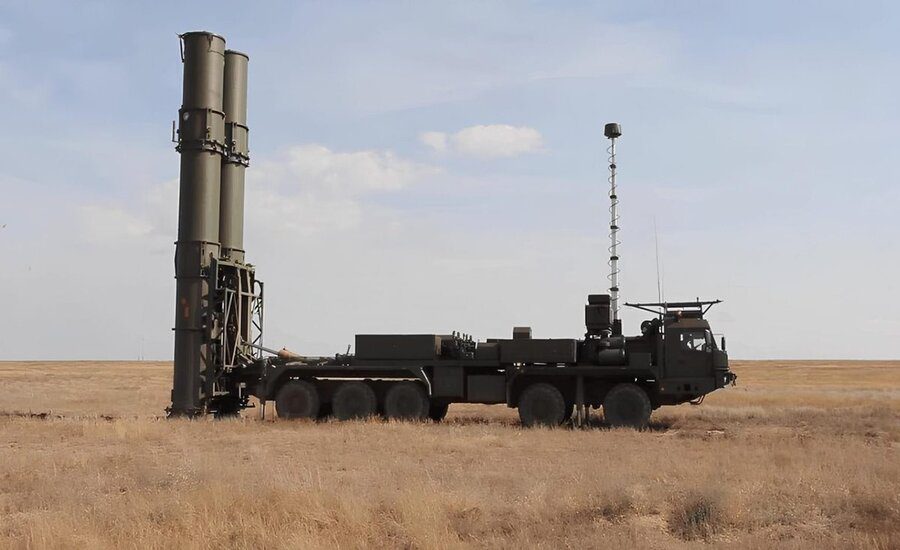
Russia has taken a major strategic leap in its air and missile defense capability with the official combat deployment of the first S-500 “Prometheus” Surface-to-Air Missile (SAM) regiment.
The announcement—made by Russia’s Defence Ministry in December 2025—signals an evolution in Moscow’s layered air defense architecture and carries significant geopolitical weight, particularly given ongoing export discussions with India.
This development not only strengthens Russia’s defense against next-generation threats such as hypersonic weapons and ballistic missiles but also potentially reshapes strategic military balances in the Indo-Pacific region if India becomes a buyer.
What Is the S-500 Prometheus Missile System?
The S-500 Prometheus is Russia’s next-generation long-range air and missile defense system, developed to intercept and neutralize an expanded threat spectrum that goes well beyond what its S-400 predecessor can handle.
Developed by Russian arms manufacturer Almaz-Antey, the S-500 combines advanced radar systems with interceptor missiles capable of engaging:
- Ballistic missiles during their terminal phase,
- Hypersonic glide vehicles,
- Aircraft and cruise missiles,
- Low-orbit satellites and reconnaissance platforms.
It extends Russia’s defense envelope into near-space, with claimed engagement altitudes reaching several thousand kilometres above the Earth’s surface—placing it at the vanguard of modern missile defense technology.
Combat Deployment of S-500 Prometheus Missile System
On December 17, 2025, Russia formally announced that the first regiment equipped with the S-500 Prometheus SAM system had entered combat duty.
Defence Minister Andrei Belousov highlighted the system’s readiness as part of Russia’s broader effort to modernize its missile defense.
This regiment is integrated into Russia’s multi-layered air defense network—working alongside existing S-400 batteries and short-range systems like Pantsir—to provide a deeper, higher-altitude shield against advancing aerial threats.
Technical Capabilities and Significance of S-500 Prometheus Missile System
The S-500’s capabilities significantly broaden Russia’s defensive reach:
Extended Engagement Range: Up to 600 km against aerodynamic targets.
Altitude Coverage: Engagement potential stretching into near space, challenging adversary satellites and high-altitude threats.
Advanced Radar Technologies: Integration of GaN-based radar arrays offers superior sensitivity and resistance to electronic countermeasures.
This enhanced performance is designed to counter emerging technologies such as hypersonic missiles that manoeuvre unpredictably and evade traditional defense systems.
Importance of S-500 Prometheus Missile System for Geopolitical and Strategic Implications
For Russia
The S-500’s deployment marks Russia’s attempt to modernize its defense posture amid rising global tensions and rapid missile proliferation.
With hypersonic threats emerging from major powers like the United States and China, the Prometheus provides Moscow with a strategic deterrent—protecting critical infrastructure, urban centres, and military installations.
In the context of the Ukraine conflict and broader NATO tensions, this system deepens Russia’s capability to counter advanced aerial strike options and reinforce its national defense network.
For the Indo-Pacific and India
India is a key prospective partner in S-500 discussions. As a longstanding defense collaborator with Russia, New Delhi has expressed keen interest in procuring the system to complement its current S-400 air defense batteries—acquired under a multi-billion-dollar deal signed in 2018.
Indian defense analysts argue that the S-500 could significantly enhance India’s shield against advanced ballistic missiles from regional adversaries such as Pakistan and China.
However, negotiations face several key hurdles:
- India’s push for Make in India-style technology transfer and local production.
- CAATSA sanctions risk, stemming from U.S. penalties linked to Russian arms purchases.
- Russia’s current priority on satisfying its own defense requirements before exporting the system.
If concluded, the deal could exceed $10 billion, potentially making India the first foreign operator of this advanced system.
Comparing S-500 and S-400
| Feature | S-400 Triumf | S-500 Prometheus |
| Primary Role | Long-range air defense | Next-gen multi-layer air & missile defense |
| Engagement Range | Up to ~400 km | Up to ~600 km |
| Altitude Coverage | Up to ~30 km | Into near space (~200 km+) |
| Target Spectrum | Aircraft, UAVs, cruise missiles, some ballistic missiles | Hypersonic missiles, ICBMs, satellites |
| Strategic Role Regional | Regional defence | Strategic and near-space defense |
This comparison highlights the S-500’s greater altitude reach and advanced threat engagement, positioning it as a flagship deterrent in evolving global defense strategies.