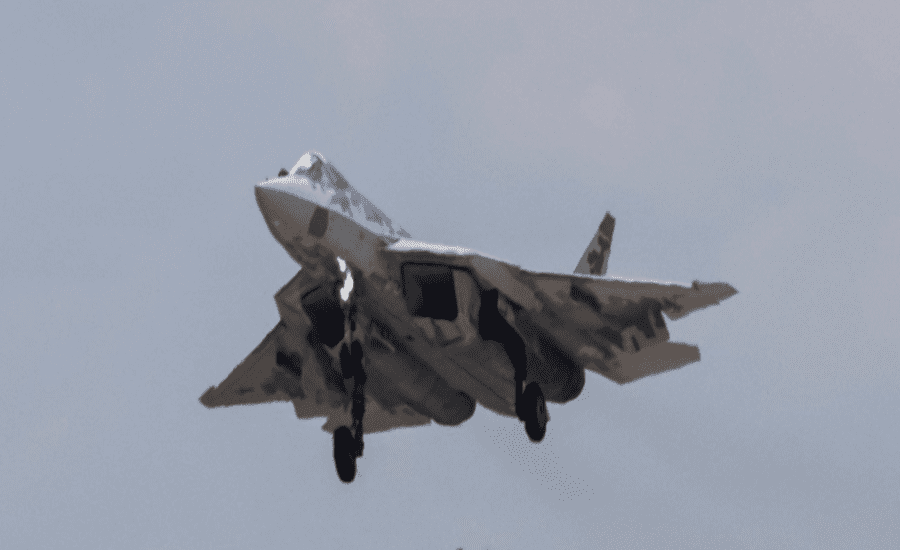
New Delhi: In a significant development poised to reshape India’s future air-combat capabilities, Russia has proposed licensed production and a comprehensive technology transfer package for the Su-57’s advanced Izdeliye-177S engine (also known as Product 177S) to India. This proposal marks a major milestone in bilateral defence cooperation and holds the potential to accelerate India’s fifth-generation fighter ambitions, especially the Advanced Medium Combat Aircraft (AMCA) program and the Super Sukhoi upgrade project for the Su-30MKI fleet.
The offer includes the transfer of critical engine technologies—hot-section components, turbine blades, combustor design data, stealth materials, AI-driven integration systems, and thrust-vectoring nozzle technologies—directly supporting India’s “Make in India” vision in defence production.
Background of Su-57 Izdeliye-177S engine tech transfer
The Izdeliye-177S engine is considered a major evolutionary upgrade over the Saturn AL-41F1 engine. It promises:
- 142 kN of thrust
- Superior fuel efficiency
- Reduced IR signature
- Advanced thrust vector control
- Stealth-optimised nozzle design
- Improved reliability for fifth-generation operations
These capabilities not only strengthen air superiority missions but also enhance survivability and long-range combat performance—placing the engine among the most advanced in current generation fighter propulsion systems.
Su-57 Izdeliye-177S Engine Tech Transfer: Russia Signals Full Support for India’s Requirements
ROSOBORONEXPORT and ROSTEC CEO Sergei Chemezov publicly affirmed Russia’s willingness to meet all of India’s demands, including:
- Full engine technology transfer
- Production of major components in India
- Transfer of software, hot-section metallurgy, and AI-aided diagnostics
- Supply-chain independence from sanctions
- Local manufacturing at Hindustan Aeronautics Limited (HAL)
Russia has also offered to assist HAL in establishing in-house advanced testing and quality-assurance labs required for high-temperature turbine components.
Su-57 Izdeliye-177S Engine Tech Transfer: HAL’s Koraput Division Identified as Core Engine Production Hub
HAL’s Koraput division—already manufacturing AL-31FP engines for the Su-30MKI—has been identified as the primary site for the licensed production of the 177S engine.
Key advantages:
- Existing experience with Russian turbofans
- CNC machining capability
- Ability to localise modules
- Strong supply-chain ecosystem reducing sanction vulnerabilities
Russia’s offer aligns closely with India’s goal to secure full-spectrum engine manufacturing capabilities within the country.
How the Deal Strengthens India’s AMCA and ‘Super Sukhoi’ Programs
1. AMCA (Advanced Medium Combat Aircraft): The Izdeliye-177S technology transfer acts as an accelerator for early AMCA prototypes. HAL Nashik could integrate fifth-generation subsystems such as:
- Thrust-vectoring
- High-temp turbine alloys
- Advanced FADEC & AI-enhanced controls
- Stealth-optimised exhaust systems
Indian defence planners see this as a bridging technology until India develops its own indigenous engine in collaboration with friendly nations.
2. Super Sukhoi Upgrade (Su-30MKI): The Su-30MKI modernisation—covering over 260 aircraft—could benefit massively:
- Extended service life beyond 4,000 hours
- Improved thrust-to-weight ratio of 9.5:1
- Reduced fuel consumption
- Integration of Indian AESA radars (Uttam) and avionics
- New composites and low-observable coatings
This transforms the Su-30MKI into a “near-5th-gen capable” air-dominance platform.
A New Two-Seat Variant of Su-57E Also on the Table
Russia has reportedly showcased a unique two-seat variant of the Su-57E, customised for India. This version is designed to support:
- Complex mission profiles
- Swarm-drone control
- AI-assisted teaming operations
- Weapon testing platforms
The IAF is evaluating the proposal as it aligns with India’s doctrine for manned-unmanned teaming (MUM-T) operations.
Su-57 Izdeliye-177S Engine Tech Transfer Model: Four-Phase Roadmap
Russia’s offer follows an ambitious four-phase execution structure.
Phase 1: Full Access to Engine Design & Digital Blueprints
India receives:
- High-fidelity design data
- Hot-section metallurgy
- Combustor technology
- Thrust-vectoring software
- Testing protocols
- Licensing agreements
Phase 2: Joint Facility Audits & Initial CNC Machining
HAL Koraput undergoes:
- Manufacturing audits by Russian experts
- CNC upgrades for stealth nozzles
- Quality labs for high-temperature alloys
- Kick-off shipments of precision kits
Phase 3: CKD (Completely Knocked Down) → SKD (Semi-Knocked Down)
Production begins with:
- 50% local content
- Assembly of compressive stages, turbines
- Step-up to SKD modules
- HAL mastering fabrication of air-cooled nozzle guide vanes
Phase 4: 100% Localisation & Export Capability
Final stage includes:
- Full indigenous manufacturing
- Ability to export engines to friendly nations
- Integration into Su-30MKI prototypes and AMCA test platforms
Geopolitical Angle: India Gains Leverage, Russia Secures a Major Partner
India’s search for 80%+ engine technology transfer has largely been unmet by Western suppliers. Russia’s readiness to meet this requirement makes the offer extremely attractive.
This partnership also helps:
- Reduce India’s dependence on Western supply chains
- Strengthen Indo-Russian defence ties
- Position India as a future aerospace engine hub in Asia
- Provide Russia with long-term economic and strategic returns
Importance of Su-57 Izdeliye-177S Engine Tech Transfer for India’s Defence Future
If executed successfully, the 177S engine program could become:
- A game-changer for India’s fighter engine ecosystem
- A foundation for India’s indigenous AMCA Mark-2 engine
- A major upgrade for the Su-30MKI fleet
- A strategic hedge against geopolitical supply restrictions
This partnership could mark India’s entry into the elite group of nations capable of producing fifth-generation fighter jet engines.
Read also: ADA’s Advanced Iron Bird Test Facility: Game-Changer for India’s AMCA Stealth Fighter Program