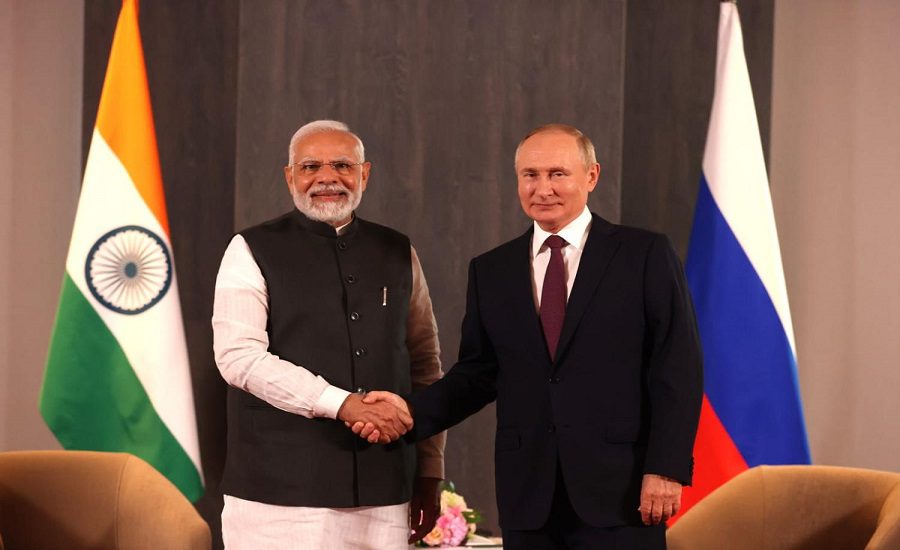
New Delhi: Kremlin Spokesperson Dmitry Peskov has officially confirmed that additional S-400 air defence systems and the Su-57 fifth-generation stealth fighter jet will be major points of discussion during Russian President Vladimir Putin’s state visit to India on 4–5 December 2025.
The clarification ends months of speculation regarding India–Russia defence negotiations, especially at a time when global geopolitical alignments are shifting rapidly and India continues to diversify its military procurement strategy.
Background of India–Russia Defence Ties
India and Russia have shared a long-standing defence partnership spanning over five decades.
From the MiG-21 fighters to the BrahMos missile programme, the collaboration has evolved into joint manufacturing, licensed production and advanced military technology transfer.
- 36% of India’s military inventory currently originates from Russia, according to Peskov.
- India began receiving deliveries of the first batch of S-400 Triumf systems in late 2021, and discussions on additional units have been ongoing since 2023.
- The Su-57, Russia’s first fifth-generation stealth fighter, has been widely seen as a potential future asset for the Indian Air Force (IAF) after the premature closure of the FGFA (Fifth Generation Fighter Aircraft) joint project in 2018.
The upcoming visit marks one of the most strategically significant interactions between New Delhi and Moscow in recent years.
S-400 Expansion: India’s Air Defence Shield to Strengthen Further
According to Peskov, India is likely to discuss procurement of additional S-400 battalions beyond the five initially ordered in the $5.4 billion deal.
Importance of S-400
The S-400 Triumf is regarded as one of the world’s most advanced long-range air defence systems capable of:
- Tracking and engaging up to 80 targets simultaneously
- Neutralizing aircraft, drones and ballistic missiles
- Striking targets at ranges of up to 400 km
For India, the system enhances protection of critical airspace across:
- Western front (Pakistan)
- Northern front (China)
Key military bases and strategic locations: Additional S-400 units will significantly strengthen India’s multi-layered air defence network, especially in view of expanding Chinese capabilities and Pakistan’s acquisition of long-range Chinese missile systems.
Su-57 Stealth Fighter: A Fresh Opportunity for India?
Peskov described the Su-57 as “the world’s finest aircraft”, signaling Russia’s eagerness for India to explore its acquisition.
Why Russia Wants India on Board
- Su-57 production is being scaled up by United Aircraft Corporation (UAC).
- Russia is looking for international partners to support long-term production and export.
- India remains one of the few nations with the technical ecosystem to integrate advanced 5th-gen fighters.
What India Gains
If procurement or co-production discussions progress, India could benefit from:
- Stealth technology access
- Next-generation avionics
- Engine and radar technology transfer
- Potential integration with Indian weapons
The Indian Air Force currently relies heavily on 4.5-generation fighters. As China advances with its J-20 and J-31 stealth jets, acquiring the Su-57 or a modified India-specific variant could bridge the 5th-gen capability gap.
Dubai Airshow 2025: A Preview of Negotiations
The agenda aligns with earlier overtures made by Rosoboronexport during the Dubai Airshow 2025, where Russia proposed:
- Licensed production of advanced air weapons
- Collaboration on next-generation aviation platforms
- Deeper integration of Russian technology with Indian systems
This proposal complemented India’s continued push for local manufacturing under Atmanirbhar Bharat (self-reliance initiative).
Russia’s Defence Industry: Stable Supply Despite Sanctions
Peskov emphasized the robust state of Russia’s military industry, despite persistent Western sanctions.
For India, which wants spare-part reliability and long-term maintenance support for its Russian platforms, this reassurance is crucial.
Key points:
- Russia has expanded indigenous production lines to reduce dependency on imported components.
- Delivery timelines for India have been prioritized despite global supply chain strains.
- Joint ventures in India (e.g., BrahMos) remain unaffected.
Strategic Context of December 2025 Meeting
The Putin–Modi meeting comes at a time when:
- India is diversifying its defence partners (US, France, Israel),
- Russia is strengthening ties with Asia amid Western isolation,
- Global conflict and military modernization cycles are accelerating.
The discussion on S-400 and Su-57 fits into broader geopolitical and defence alignment strategies.
For India
- Balancing Russian ties with deepening US and French partnerships
- Strengthening long-range air defence capability
- Evaluating 5th-generation fighter options
- Ensuring uninterrupted supply of spares and ammunition
For Russia
- Securing a major export customer
- Strengthening political ties with New Delhi
- Expanding the presence of Russian advanced systems in Asia
- Counterbalancing China’s growing defence influence in India’s neighbourhood
What to Expect from the Putin Visit
Based on diplomatic signals and defence analysts’ assessments, the following announcements are likely:
- Confirmation of additional S-400 procurement
- Formal proposal for Su-57 acquisition or joint production
- Enhanced cooperation on: air-to-air missiles, drone technologies, long-range precision weapons, aircraft maintenance and overhaul
- New industrial partnerships between Indian and Russian defence firms
- Strengthening of bilateral security cooperation frameworks