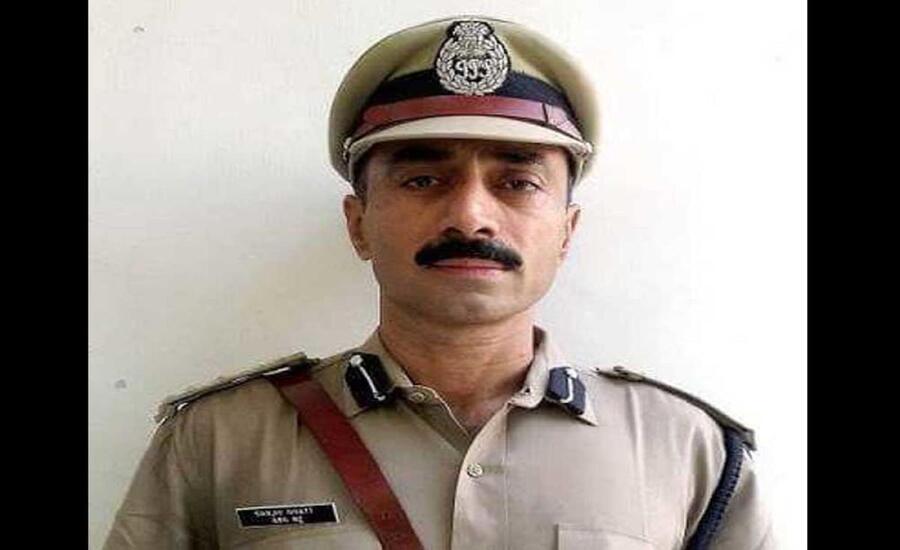
New Delhi: Former Indian Police Service (IPS) officer Sanjiv Bhatt has moved the Supreme Court seeking suspension of the 20-year prison sentence imposed on him in a 1996 drug planting case in Gujarat. The plea was mentioned before a bench of Justices JK Maheshwari and Vijay Bishnoi on Wednesday but was adjourned at the request of Bhatt’s advocate, Kapil Sibal.
Background of the Case
Bhatt, who is already serving a life sentence in a separate custodial death case dating back to 1990, was arrested in 2018 in connection with the NDPS case. The case originated from a complaint by Rajasthan-based lawyer Sumer Singh Rajpurohit, who alleged that Bhatt and others had planted 1.15 kilograms of opium at a hotel in Palanpur, Banaskantha district, Gujarat, in 1996. At the time of the alleged incident, Bhatt was serving as the District Superintendent of Police in Banaskantha. Inspector IB Vyas, another officer named in the case, later turned approver in 2021.
The prosecution claimed that Bhatt and his co-accused conspired to falsely implicate the lawyer under the Narcotic Drugs and Psychotropic Substances (NDPS) Act. In March 2024, a sessions court in Palanpur convicted Bhatt under the NDPS Act, sentencing him to 20 years in prison. In addition, he was found guilty under multiple sections of the Indian Penal Code, including forgery, wrongful confinement, criminal conspiracy, and fabrication of false documents with intent to cause injury.
Read also: Pressure Mounts on IAS Officer Santosh Verma Amid Promotion Controversy in Madhya Pradesh
Previous Legal Proceedings
Following the conviction, Bhatt had approached the Gujarat High Court seeking suspension of his sentence and bail. However, the High Court rejected his plea, highlighting the “seriousness and gravity” of the offence. The court also cited the stringent requirements under Section 37 of the NDPS Act, which deals with cognizable and non-bailable offences, noting that the presumption of innocence is reversed after conviction.
Current Developments
With the Supreme Court hearing pending, Bhatt’s legal team is seeking relief in the form of suspension of his 20-year sentence. The matter is being closely watched due to the high-profile nature of the case, which has drawn attention for both its historical context and the serious legal implications under the NDPS Act.
Bhatt’s plea in the Supreme Court represents the latest step in a prolonged legal battle spanning decades, as he continues to serve a life sentence in the unrelated 1990 custodial death case.