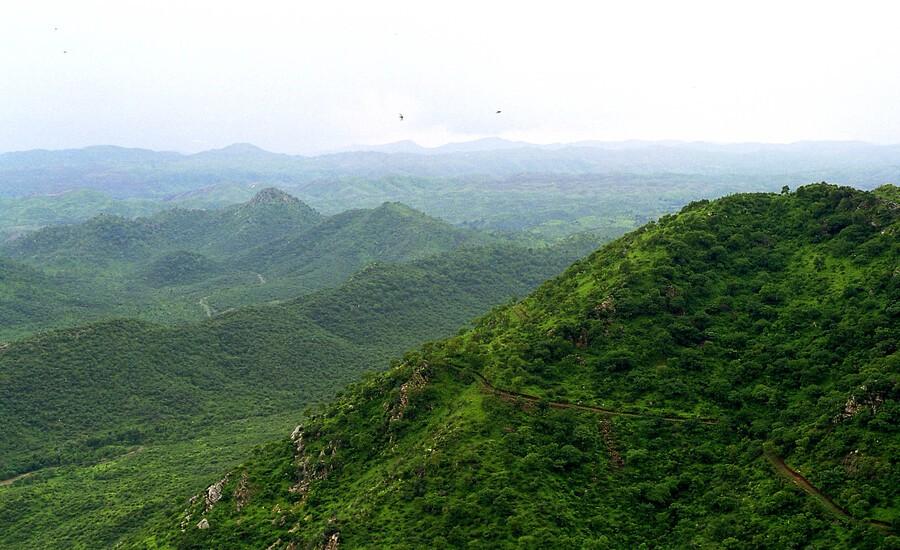
New Delhi: The Supreme Court of India on Monday stayed its recent November 20, 2025, verdict on the Aravalli Hills, stating that certain clarifications are necessary regarding the definitions of the mountain range. The suo motu case was initiated amid widespread protests over potential threats to the Aravallis following the Court’s acceptance of a committee’s recommendations for mining regulations in the region.
A Bench headed by Chief Justice of India (CJI) Surya Kant, along with Justices JK Maheshwari and AG Masih, observed that an independent expert opinion is needed to resolve ambiguities and provide definitive guidance on the definitions of Aravalli Hills and ranges.
Background: Previous Definitions and Committee Recommendations
Last month, the Supreme Court had approved an elevation-linked definition for classifying landforms as part of the Aravalli Hills for mining regulation purposes. According to the earlier ruling:
Any landform in Aravalli districts with an elevation of 100 meters or more from the local relief would be termed as Aravalli Hills.
The Aravalli Range was defined as two or more Aravalli Hills located within 500 meters of each other, measured from the outermost boundary of the lowest contour line.
The Court’s November 20 judgment had accepted the committee’s recommendations, including a prohibition on mining in core or inviolate areas, but decided against a complete ban on mining, citing the risk of illegal mining and associated criminal activity.
Read also: Supreme Court Takes Suo Motu Action to Protect Aravalli Hills; CJI Suryakant to Hear Case on Monday
Reasons for Staying the Verdict
During Monday’s proceedings:
CJI Surya Kant emphasized the need to examine whether the restrictive demarcation could broaden areas where mining might be permitted.
The Court highlighted the importance of studying sustainable and regulated mining within the newly demarcated zones to determine potential ecological consequences.
Solicitor General Tushar Mehta, representing the Union government, said there were misconceptions regarding previous orders and government roles, noting that an expert committee had submitted a report which the Court had earlier accepted.
The Court has now issued notices to the Union government and concerned State governments and ordered that the earlier court directions and committee recommendations remain in abeyance. The case is scheduled to be taken up again on January 21, 2026.
Scope and Importance of the Aravalli Range
The Aravalli range spans Delhi, Haryana, Rajasthan, and Gujarat, and has been a focal point of environmental protection efforts due to its ecological significance. The Court’s suo motu intervention was prompted by public concern over the potential impact of mining and the need for uniform definitions across states.