New Delhi: The Supreme Court of India has taken suo motu cognizance of the dispute surrounding the Aravalli Hills, one of the country’s most ecologically sensitive regions. A three-judge bench, led by Chief Justice Suryakant, will hear the case on Monday. Justices J.K. Maheshwari and A.G. Masih will join the bench for this crucial hearing.
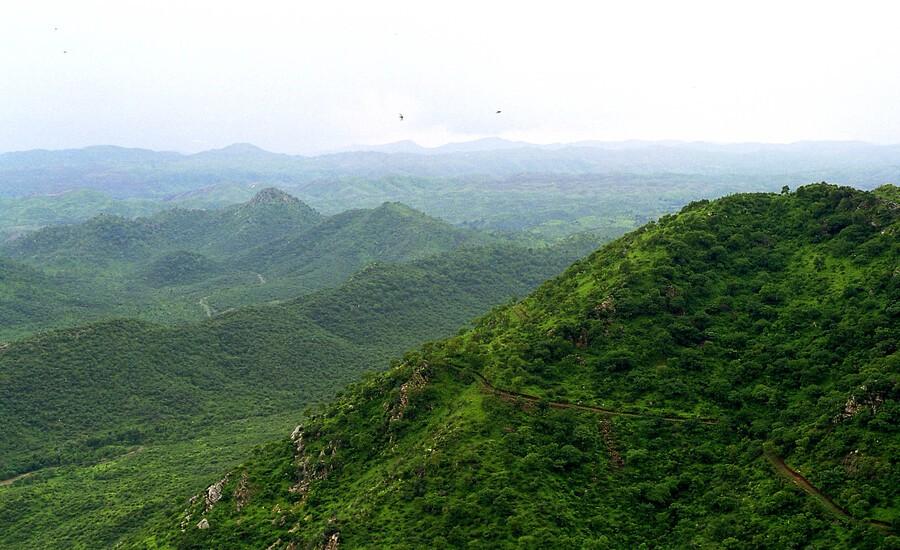
The Aravalli Hills, stretching approximately 700 kilometers, are among the oldest mountain ranges in the world and serve as a natural shield, protecting Delhi and the National Capital Region (NCR) from dust storms and desertification originating from the Thar Desert. The Supreme Court hearing comes amid growing environmental concerns over the government’s new definition of “100 meters high” for classifying parts of the Aravallis, which experts warn could endanger up to 90% of the mountain range.
Central Government Imposes Strict Measures to Protect Aravalli Range
On Wednesday, the Environment Ministry issued strict directives to all states, banning any new mining leases across the Aravalli Range, covering the region from Delhi to Gujarat. The Indian Council of Forestry Research and Education (ICFRE) has been tasked with identifying additional areas where mining will be completely prohibited.
The government has emphasized the importance of stopping unregulated mining to preserve the integrity of the Aravallis. Existing mines must comply with court orders, and the Environment Ministry has promised robust monitoring of mining activities.
In March 2023, the government launched the “Aravalli Green Wall” initiative, aiming to create a 5-kilometer-wide green belt buffer across Gujarat, Rajasthan, Haryana, and Delhi. Covering 6.45 million hectares, the project is intended to prevent desertification and maintain ecological balance.
Controversy Over the New “100-Meter” Definition
The government’s recent definition, recognizing only hills taller than 100 meters as part of the Aravallis, has sparked nationwide concern. Environmental experts argue that this definition ignores smaller hills that are crucial to the ecosystem.
Harjeet Singh, director of Sustainable Sampada, described the move as a “slow deletion” of the Aravallis, calling it akin to erasing North India’s lifeline. Vimalenddu Jha warned that the new definition could lead to the disappearance of nearly 90% of the Aravalli Mountains. Experts also note that the redefinition threatens leopard corridors, village commons, and the biodiversity dependent on these hills.
Delhi’s Toxic Air and the Role of Aravalli Mountains
Delhi, already struggling with toxic air levels, relies on the Aravalli Mountains as its natural defense against dust and pollution. Environmentalist Bharti Chaturvedi stressed that without the Aravallis, Delhi would become nearly uninhabitable, as no plantation or artificial measure can replicate the ecological functions of the mountain range.
The hills act as natural air filters, absorbing toxic emissions and reducing pollution. The disappearance of the Aravallis could have severe health consequences, particularly for children and the elderly, experts warn.
Political Reactions: Opposition Calls the Move a ‘Death Warrant’
The issue of the Aravallis has also reached the Parliament. Congress leader Sonia Gandhi described the government’s actions as signing a “death warrant” for the mountains and demanded the withdrawal of amendments to the Forest Conservation Act. Priyanka Gandhi Vadra highlighted that environmental issues, including pollution, transcend politics and require urgent attention.
The opposition has criticized the government for “bulldozing” environmental regulations, warning that such policies could exacerbate the impacts of climate change and endanger public health. Congress has called for a parliamentary debate on the matter.
What Lies Ahead
Monday’s Supreme Court hearing, led by CJI Suryakant, is being closely watched by environmentalists, policymakers, and residents of Delhi-NCR. The outcome could be decisive in determining the future of the Aravalli Hills, their protection from mining, and the ecological health of the region.