New Delhi: The Union Budget 2026–27, presented in Parliament by Union Minister for Finance and Corporate Affairs Ms Nirmala Sitharaman, has announced a series of transformative initiatives aimed at strengthening India’s pharmaceutical and biopharmaceutical ecosystem. The Finance Minister highlighted that the government has undertaken comprehensive economic reforms focused on creating employment, boosting productivity, and accelerating economic growth.
As part of the government’s strategy to scale up manufacturing in seven strategic and frontier sectors, pharmaceuticals and biopharma have been identified as key drivers of sustained economic expansion and healthcare security.
Biopharma SHAKTI to Position India as a Global Biomanufacturing Hub
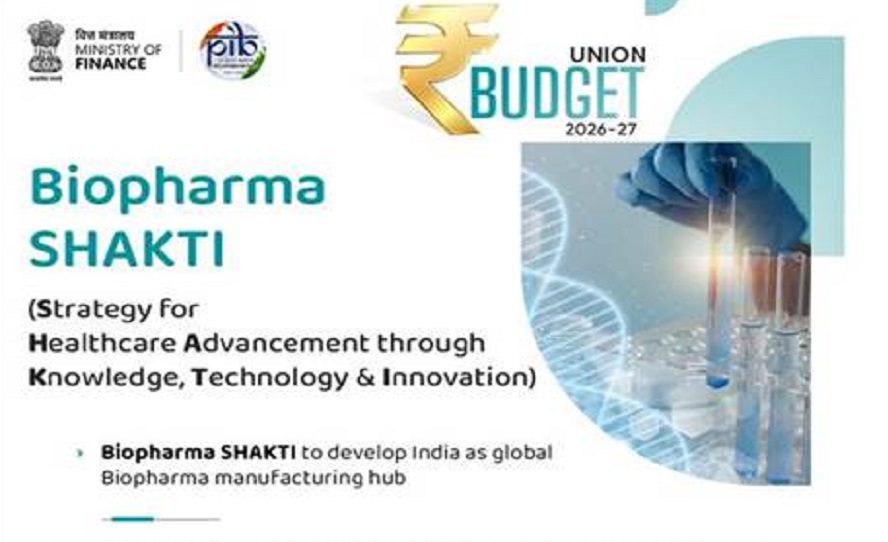
Emphasising the growing importance of biologic medicines in improving longevity and quality of life, the Finance Minister announced the launch of Biopharma SHAKTI (Strategy for Healthcare Advancement through Knowledge, Technology & Innovation).
The programme has been allocated an outlay of ₹10,000 crore over the next five years and is aimed at transforming India into a global biopharmaceutical manufacturing hub.
Biopharma SHAKTI seeks to:
- Build a self-reliant ecosystem for domestic production of biologics and biosimilars
- Reduce import dependence in critical biopharma products
- Strengthen healthcare security through indigenous manufacturing
- Catalyse investments in advanced biomanufacturing infrastructure
- Promote innovation and next-generation therapies
The initiative is expected to enhance India’s competitiveness in high-value biopharmaceutical products while ensuring the availability of affordable biologic medicines for patients.
1,000+ Accredited Clinical Trial Sites to Boost Research Capacity
To strengthen India’s position as a preferred global destination for clinical research, the Budget announced the creation of a network of over 1,000 accredited clinical trial sites across the country under Biopharma SHAKTI.
This expansion will:
- Improve the quality, credibility, and global acceptance of clinical research conducted in India
- Accelerate drug development timelines
- Enable faster access to cutting-edge therapies for Indian patients
- Create employment and growth opportunities for researchers, healthcare professionals, and allied sectors
In addition, the Central Drugs Standard Control Organisation (CDSCO) will be strengthened to meet global regulatory standards and faster approval timelines through the creation of a dedicated scientific review cadre and specialist teams.
Strengthening Pharmaceutical Education and Research: New NIPERs Announced
Highlighting the need for a skilled workforce and cutting-edge research capabilities, the Finance Minister announced the establishment of three new National Institutes of Pharmaceutical Education and Research (NIPERs).
Alongside this, the government will undertake the upgradation of seven existing NIPERs to enhance infrastructure, research facilities, and academic capacity.
These measures aim to:
- Strengthen advanced pharmaceutical education and high-end research
- Promote industry–academia collaboration
- Develop a globally competitive talent pool for pharma and biopharma sectors
- Support innovation-led growth in drug development and biomanufacturing
The expansion of NIPERs is expected to play a crucial role in building India’s long-term capabilities in pharmaceuticals and biologics.
A Strategic Step Towards a Self-Reliant, Innovation-Driven Pharma Sector
Taken together, the announcements under Union Budget 2026–27 mark a significant step towards building a robust, innovation-driven, and globally competitive pharmaceutical and biopharmaceutical sector. By combining manufacturing scale-up, research infrastructure, regulatory strengthening, and education reforms, the government aims to position India as a global leader in biopharma manufacturing and innovation.