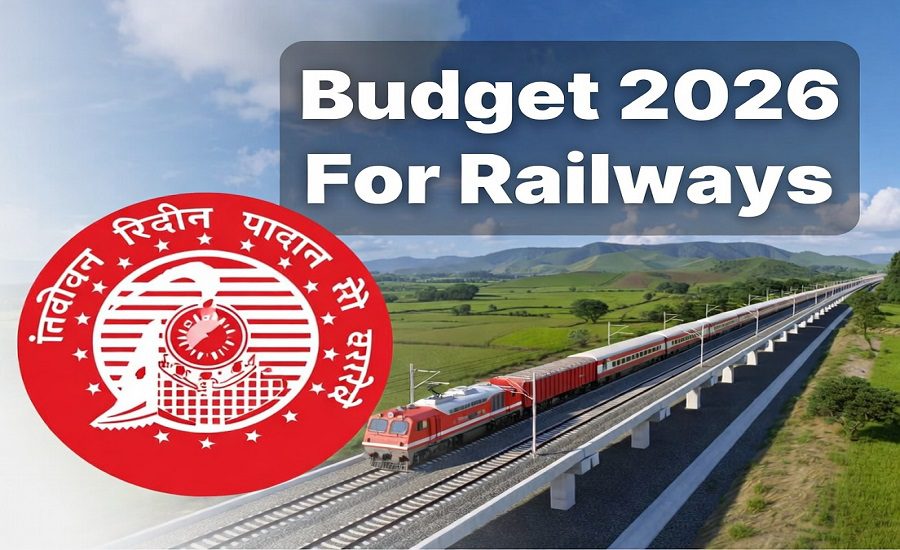
New Delhi: The Union Budget 2026–27 has delivered a major push to India’s railway sector, placing passenger convenience, enhanced safety, high-speed mobility, and balanced regional development at the centre of national infrastructure planning. With record state-wise allocations and a clear focus on modernisation, electrification, freight efficiency, and regional integration, Indian Railways is being positioned as a key engine of economic growth and national connectivity.
The budget reflects the government’s long-term vision of transforming railways into a modern, resilient, and passenger-friendly transport backbone while simultaneously strengthening logistics and freight movement across states.
High-Speed Rail Corridors to Transform Inter-City Travel
One of the most significant highlights of the Union Budget 2026–27 is the planned expansion of high-speed rail corridors across multiple regions, drastically reducing travel time between major economic, cultural, and administrative centres.
Delhi–Varanasi and Varanasi–Siliguri High-Speed Corridors
Uttar Pradesh is set to witness a major transformation through new bullet-train corridors connecting Delhi–Varanasi and Varanasi–Siliguri. The Delhi–Varanasi high-speed corridor is expected to reduce travel time to approximately 3 hours and 50 minutes, dramatically improving access to one of India’s most important religious and cultural hubs.
The Varanasi–Siliguri high-speed rail corridor, passing through Uttar Pradesh, Bihar, and West Bengal, will connect key religious, educational, and medical centres. Travel time between Varanasi and Siliguri is projected to be reduced to about 2 hours and 55 minutes, creating a new economic and tourism corridor across eastern and northern India.
Together, these routes are expected to spur economic activity across the Delhi–UP–Bihar–West Bengal belt, supporting tourism, trade, and urban development.
Eastern India’s First High-Speed Rail Link
West Bengal is poised to benefit from eastern India’s first high-speed rail service, linking Siliguri with Varanasi. This project is expected to significantly enhance inter-regional mobility, improve access to markets and services, and strengthen trade and tourism flows across eastern states.
Southern India’s High-Speed Rail “Diamond” Network
In southern India, railway investments under the Union Budget 2026–27 are aligned around the emerging high-speed rail “diamond” connecting Hyderabad, Bengaluru, Chennai, and adjoining urban centres. This network will sharply compress travel times between the South’s major economic engines.
Once completed –
- Chennai–Bengaluru travel time will reduce to around 1 hour 13 minutes
- Bengaluru–Hyderabad will take about 2 hours
- Chennai–Hyderabad will be covered in around 2 hours 55 minutes
This high-speed network is expected to act as a growth multiplier for Karnataka, Telangana, Andhra Pradesh, Tamil Nadu, Kerala, and Puducherry, supporting IT, manufacturing, services, and talent mobility. Bengaluru, as India’s leading technology hub, is expected to gain substantially through improved business travel and inter-state connectivity.
Mumbai-Pune Corridor to Integrate Western India’s Economic Hubs
In Maharashtra, a major share of the railway allocation is directed toward high-impact, capacity-enhancing projects. The proposed Mumbai–Pune high-speed rail corridor is expected to reduce travel time to around 48 minutes, effectively integrating the two major urban centres.
Further high-speed connectivity from Pune to Hyderabad in around 1 hour 55 minutes, with onward links to southern hubs, will create a continuous high-speed spine across western, central, and southern India, benefiting both passengers and regional economies.
Himalayan and Northern Rail Expansion for All-Weather Connectivity
The Union Budget places special emphasis on rail expansion in Himalayan and northern regions to improve accessibility, tourism, and year-round connectivity.
Uttarakhand and Himachal Pradesh
In Uttarakhand, the Rishikesh–Karnaprayag rail line, featuring complex tunnelling, will improve access to remote hill regions, reduce travel time, and support pilgrim and tourist flows. Investments in electrification and safety upgrades will further enhance passenger experience.
Himachal Pradesh will see focused support for network expansion, modernisation, and electrification, improving rail travel in challenging hilly terrain.
Jammu & Kashmir Rail Extensions
In Jammu & Kashmir, strengthened rail links, including extensions toward Uri, aim to ensure uninterrupted, all-weather connectivity despite winter disruptions. These projects are expected to benefit passengers, trade, and local economies in the region.
Northeast Connectivity and Strategic Underground Corridor
Across Assam and the wider Northeast, record budgetary allocations have enabled new line construction, station redevelopment, and safety enhancements. These projects are improving connectivity within remote areas while strengthening links with the rest of the country.
A key strategic initiative is the planned 40-kilometre underground rail corridor to connect the Northeast with mainland India. In addition, existing tracks will be expanded to four lines, ensuring uninterrupted and resilient movement of both passengers and freight through this critical transit zone.
Electrification and Station Redevelopment Across States
States such as Punjab, Haryana, and Himachal Pradesh have achieved 100% electrification of railway lines. Stations in these states are being upgraded under the Amrit Bharat Station Scheme, improving safety, sustainability, and passenger amenities.
Freight Infrastructure Strengthened Through Dedicated Corridors
Freight efficiency remains a major focus of the Union Budget 2026–27. The East–West Dedicated Freight Corridor, running from Dankuni (West Bengal) to Surat (Gujarat) via Jharkhand, Bihar, Odisha, and Maharashtra, will enable faster and more reliable movement of goods.
This corridor is expected to reduce congestion on passenger routes, lower logistics costs, and support industrial growth across multiple states. Indian Railways’ long-term freight target of 3,000 million tonnes will be supported through modern locomotives, upgraded tracks, advanced signalling, and dedicated freight infrastructure.
Passenger Benefits and Economic Impact
For passengers, these initiatives promise:
- Shorter travel times
- Safer and more comfortable journeys
- Modernised stations
- Reduced overcrowding
- Improved last-mile connectivity
At the macro level, higher capital investment across states is expected to generate employment, stimulate regional economies, and strengthen India’s logistics and transport ecosystem. With coordinated efforts between the Union and state governments, the railway transformation aligns with the broader vision of Viksit Bharat.
State-Wise Rail Budget Allocation Details (Union Budget 2026–27)
Andhra Pradesh
Annual average budget increased 11-fold from ₹886 crore (2009–14) to ₹10,134 crore.
Ongoing projects worth ₹92,649 crore.
Assam & North-East Region
Annual average budget increased fivefold from ₹2,122 crore to ₹11,486 crore.
Ongoing projects worth ₹72,468 crore.
Bihar
Annual average budget increased ninefold from ₹1,132 crore to ₹10,379 crore.
Ongoing projects worth ₹1,09,158 crore.
Chhattisgarh
Annual average budget increased 24-fold from ₹311 crore to ₹7,470 crore.
Ongoing projects worth ₹51,080 crore.
Delhi
Annual average budget increased 28-fold from ₹96 crore to ₹2,711 crore.
Ongoing projects worth ₹8,976 crore.
Goa
Allocation of ₹515 crore in 2026–27.
Ongoing projects worth ₹4,344 crore.
Gujarat
Annual average budget increased 29 times from ₹589 crore to ₹17,366 crore.
Ongoing projects worth ₹1,28,748 crore.
Haryana
Annual average budget increased 11-fold from ₹315 crore to ₹3,566 crore.
Ongoing projects worth ₹12,091 crore.
Himachal Pradesh
Annual average budget increased 27-fold from ₹108 crore to ₹2,911 crore.
Ongoing projects worth ₹17,711 crore.
Jammu & Kashmir
Annual average budget increased from ₹1,044 crore to ₹1,086 crore.
Ongoing projects worth ₹522 crore.
Jharkhand
Annual average budget increased 16-fold from ₹457 crore to ₹7,536 crore.
Ongoing projects worth ₹63,470 crore.
Karnataka
Annual average budget increased ninefold from ₹835 crore to ₹7,748 crore.
Ongoing projects worth ₹52,950 crore.
Kerala
Annual average budget increased nearly tenfold from ₹372 crore to ₹3,795 crore.
Ongoing projects worth ₹18,041 crore.
Madhya Pradesh
Annual average budget increased 24-fold from ₹632 crore to ₹15,188 crore.
Ongoing projects worth ₹1,18,379 crore.
Maharashtra
Annual average budget increased 20-fold from ₹1,171 crore to ₹23,926 crore.
Ongoing projects worth ₹1,70,058 crore.
Odisha
Annual average budget increased 13-fold from ₹838 crore to ₹10,928 crore.
Ongoing projects worth ₹90,659 crore.
Punjab
Annual average budget increased 25-fold from ₹225 crore to ₹5,673 crore.
Ongoing projects worth ₹26,382 crore.
Rajasthan
Annual average budget increased 15-fold from ₹682 crore to ₹10,228 crore.
Ongoing projects worth ₹56,863 crore.
Tamil Nadu
Annual average budget increased ninefold from ₹879 crore to ₹7,611 crore.
Ongoing projects worth ₹35,701 crore.
Telangana
Annual average budget increased sixfold to ₹5,454 crore.
Ongoing projects worth ₹47,984 crore.
Uttar Pradesh
Annual average budget increased 18-fold from ₹1,109 crore to ₹20,012 crore.
Ongoing projects worth ₹92,056 crore.
Uttarakhand
Annual average budget increased 26-fold from ₹187 crore to ₹4,769 crore.
Ongoing projects worth ₹39,491 crore.
West Bengal
Annual average budget increased threefold from ₹4,380 crore to ₹14,205 crore.
Ongoing projects worth ₹92,974 crore.