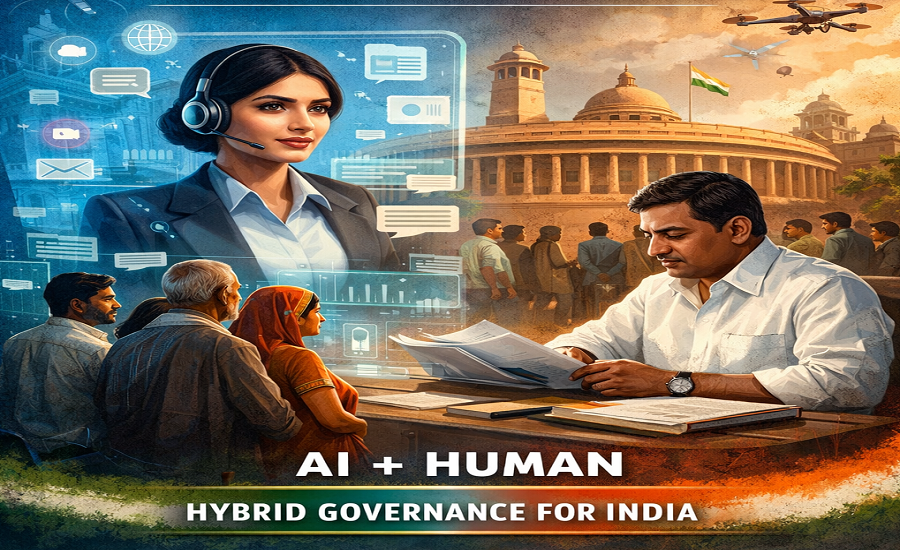
Albania has shown the way by appointing first ever virtual minister in the world. Can this be the new norm of governance in a giganteum country like India. This article was first published in the IIPA Digest. Artificial Intelligence (AI) is advancing with great speed, scope and scale in the domain of governance. The concept of AI-assisted hybrid governance becomes significant in Public Administration as it avoids over-bureaucratisation and over-automation in the process of decision-making. In this article, the authors make an attempt to deliberate upon a topic ‘Could a virtual minister or bureaucrat help solve governance challenges in countries like India’. The query becomes important as Albania introduced the World’s first AI Minister, Diella few days ago. The deliberations become significant as the concept of ‘virtual bureaucrat’ aligns closely with Max Weber’s ideal-type bureaucracy.
A New Face of Governance Edi Rama, Prime Minister of Albania unveiled ‘Diella’, the world’s first ‘virtual minister’ on 11 Sep 2025. This was the resultant of promotion from the post of a ‘virtual assistant’ which has been on their government website for several months. As the ‘virtual assistant’, it was offering around 1000 services and issued more than 36,600 digital documents to citizens. Now, it will be more interesting to see its performance as the ‘virtual minister’. When the tiny Balkan country made this unique experiment, it sparked curiosity across the globe. In this context, it is significant to deliberate upon a crucial topic such as ‘Could a virtual minister or bureaucrat help solve governance challenges in countries like India’. Such a query becomes unique while one examines the lessons from Albania and others on ‘Hybrid Governance’.
A New Face of Governance
Edi Rama, Prime Minister of Albania unveiled ‘Diella’, the world’s first ‘virtual minister’ on 11 Sep 2025. This was the resultant of promotion from the post of a ‘virtual assistant’ which has been on their government website for several months. As the ‘virtual assistant’, it was offering around 1000 services and issued more than 36,600 digital documents to citizens. Now, it will be more interesting to see its performance as the ‘virtual minister’. When the tiny Balkan country made this unique experiment, it sparked curiosity across the globe. In this context, it is significant to deliberate upon a crucial topic such as ‘Could a virtual minister or bureaucrat help solve governance challenges in countries like India’. Such a query becomes unique while one examines the lessons from Albania and others on ‘Hybrid Governance’.
Hybrid Governance
Hybrid governance refers to a model of governing where human and technology (especially Artificial Intelligence and digital tools) work together in the process of decision-making. Here, each will do what they are capable of delivering the best. It does not indicate replacing human with machines. Instead, it blends the strengths of human as well as machine to bring out the best from both. The attributes of compassion, empathy, ethical judgement, political accountability, negotiation skills, etc. are some of the unique strengths of human whereas speed, efficiency, real-time data processing, scale, etc. are the real strengths of machines.
A ‘virtual bureaucrat’ could automatically process lakhs of applications in seconds, whereas a human officer only could step in to handle disputes or consider cases with compassion, and empathy. During a natural disaster, the system could map flood-affected areas using satellite data by incorporating inputs using artificial intelligence, whereas the human leaders could make decisions about evacuation priorities more effectively by using community intelligence.
Hybrid governance becomes very significant in Public Administration as it avoids the extremes like over-bureaucratisation (where humans slow down things with red tape) and over-automation (where machines take decisions without any accountability) during the process of decision-making. Here, the authors do not visualize a scenario about replacing humans with artificial intelligence. It is about making governance faster, fairer and smarter by letting humans and machines share the workload by blending their strengths.
Similar Initiatives
It is important to touch upon certain initiatives made in the domain of AI in governance. ‘Humphrey’ is a set of AI tool developed by the UK government to enhance the performance and speed of civil servants in their work. While the project is still in its infancy, it is aimed at lowering the daily workload of civil servants significantly by use of generative AI tools to read and process large volume of data and contribute towards decision-making. ‘Consult’, a tool developed as part of Humphrey few months ago, has been used primarily to review public responses to a consultation. It is viewed that ‘Consult’ eliminates the bias and work with more consistency, as well as remove the opportunities for individual analysts to project their own pre-conceived ideas and views.
‘Albert’, an AI tool launched in France in 2024, has been designed to enable public officials to answer frequenly asked questions (FAQ), with the aim of saving time and improving efficiency. It is expected to simplify administrative language and provide assistance with procedures to the citizens. It will contribute significantly towards simplification of administrative system, procedures and practices while placing citizens at the centre of public services. It could be used to accelerate environmental project submissions for various development initiatives, and to automate tasks like transcription of legal hearings, filing of complaints, etc. Such a tool will help effectively to address the online requests/ grievances by making proper use of systemic data, produce verifiable contents and adopt the tone of the administration.
Albanian Initiative towards ‘Hybrid Governance’
Albanian initiative of ‘Diella’ as the virtual Minister is a revolutionary step in hybrid governance. The push factor behind this initiative is very significant. The Balkan country was seriously affected by money laundering, trafficking of drugs and guns, and large scale of corruption in the tender processes for procurement of goods and services. According to the Prime Minister of Albania, ‘Diella’ will ensure that public tenders are 100 % free of corruption. It is significant to note that Diella embodies a woman’s persona and dressed in traditional Albanian attire. During its launch, the Prime Minister of Albania commented that Diella will be the ‘first cabinet member who is not physically present, but is virtually created by AI.’ It is known that the experiment of Diella highlights three important ideas such as:
- Always On: Diella is available 24/7 to respond to citizen queries.
- Accessible: She explains complex policies in plain language.
- Symbolic: She projects Albania as a modern, tech-forward state.
It is important to note that Diella doesn’t replace elected leaders. Instead, she supplements them, improving communication and creating a digital bridge between state and citizens.
India’s Governance Puzzle
When compared to Albania, India is a different story altogether considering its size, scope, and scale. Governing around 142 crore population across 28 states and 8 union territories is no easy task. Despite multiple technological initiatives made by the Government of India with Digital India, Aadhaar, MyGov, CoWIN, and DigiLocker, the following gaps still remain in the eco system.
- Citizens often face delays and red tape.
- Policies are poorly communicated, causing confusion and misinformation.
- Language barriers resulting in exclusion.
- Digital divide
- Bureaucratic processes are still slow and paper-heavy.
In this scenario, it would be interesting to explore ‘whether India needs a virtual minister or a virtual bureaucrat?’ A rapid review of the pros and cons of these propositions will enable to remove the clutter and lead to a better option among them in the present scenario.
Virtual Minister or Bureaucrat? Pros and Cons
The initiative of a ‘Virtual Minister’ is expected to offer a recognizable face of government available round the clock. It will definitely enhance transparency in the system by explaining the decisions and its rationale. It will result in positioning India as a leader in hybrid governance. At the same time, there are legal, political and ethical issues. As the Ministers are elected functionaries, they are primarily responsible to the legislature and citizens. As a ‘virtual minister’, it will be accountable to none in the democratic process. In addition, there will be a ‘trust deficit’ when the citizens realise that machines take important political decisions that affect their life and livelihood.
A ‘virtual bureaucrat’ is capable of performing repetitive tasks like file tracking, FAQs, grievance redressal, etc. very well and in a professional manner. It will be able to bridge the linguistic gaps through application of multi-lingual AI. However, the possibility of algorithmic bias or systemic error cannot be overlooked. In addition, how it could handle sensitive and private information in view of data privacy also cannot be ignored. In addition, digital illiteracy of the citizens could result in social divides also.
In the Indian context, the idea of going for a ‘virtual bureaucrat’ on pilot basis seems to be politically acceptable, technically feasible, socially desirable, financially viable, and administratively doable. At the same time, it will be less disruptive, and more impactful than a ’virtual minister’.
Virtual Bureaucrat and Max Weber’s Ideal -Type Bureaucracy
The concept of the ‘Virtual Bureaucrat’ aligns closely with Max Weber’s ideal-type bureaucracy, particularly in its emphasis on rationalization, rule-based decision-making, and impersonality. As digital agents operate strictly within predefined algorithms and regulatory frameworks, they enhance the consistency and objectivity as envisioned by Max Weber.
Their capacity for exhaustive record-keeping, standardized procedures, and impartial interactions mirrors the bureaucratic goal of eliminating personal bias in administrative processes. By embedding authority and hierarchy within coded logic and system architecture, virtual bureaucrats represent a technological extension of Weberian rational-legal authority, making bureaucratic functions more efficient, scalable, and transparent in a digitally governed eco system.
What a ‘Virtual Bureaucrat’ could offer?
The initiative of a ‘virtual bureaucrat’ could enable faster services where the routine processes can be automated, reducing queues and waiting period. The virtual system can handle millions of queries, much beyond the capacity of human staff. As part of crisis response, the ‘virtual bureaucrat’ can share dynamic updates, verified data and real-time instructions directly to citizens much faster than its human counterpart. And, application of multi-lingual AI tools can bring citizens, especially from the remote and rural areas, closer to governance.
A ‘virtual bureaucrat’ can give instant updates on the status of welfare benefits, land records, passport, etc. It will enable the citizens to lodge complaints online and receive time-bound responses on any issue from potholes to power cuts, making the grievance redressal faster. An AI-powered helpdesk could answer questions on pensions, tax filings, health schemes, etc. on a 24 x 7 basis in multiple languages, as desired.
The initiative of going ahead with a ‘virtual bureaucrat’, even on experimental basis, is embedded with several risks. While welcoming the initiative in the interest of enhancing the scale, scope and speed of services to the citizens, accountability question of this initiative as to who will take the responsibility in case of any error or mistake in the algorithm cannot be overlooked. Absence of compassion and empathy found in AI-assisted governance may be a matter of concern. Hence, job description, functions and responsibility mapping to the ‘virtual bureaucrat’ shall be formulated with utmost care and concern, keeping in view the apprehensions discussed above. As the pilot initiative, it may be possible to begin with the Ministry of Rural Development, Govt. of India (MoRD, GoI) or Ministry of Panchayati Raj (MoPR, GoI) where the status of an application for a welfare scheme like Prandhan Mantri Awaz Yojana (PMAY) or grievance redressal of Mahatma Gandhi National Rural Employment Guarantee Scheme (MGNREGS) could be entrusted to the ‘virtual bureaucrat’.
In this context, it is significant to note that Jitendra Singh, Union Minister of State (IC) for Science and Technology, Prime Minister’s Office (PMO), Personnel, Public Grievances and Pensions who chaired the 327th meeting of the Executive Council of the Indian Institute of Public Administration (IIPA) on 29 Sep 2025 emphasised the need for stronger integration of governance training with emerging technologies such as artificial intelligence, digital platforms and data-driven tools.
Way Ahead
It may not be politically acceptable, socially desirable, emotionally relatable and judicially tenable for India to go for a ‘virtual minister’ in the present times. As the ministers shall remain accountable to the legislature and the citizens, their responsibilities cannot be outsourced to algorithms. But the initiative of going for a ‘virtual bureaucrat’ could be considered as part of the hybrid governance. It will revolutionize India’s governance by cutting red tapism, eliminate bureaucratic arrogance, improving transparency, and making services more accessible as well as citizen-friendly.
The future of the world lies in hybrid governance, where technology takes care of speed and efficiency, and humans provide compassion, empathy, ethical judgment, and accountability. By striking this balance, India could go for a ‘virtual democrat’ on a pilot basis. It is hoped that the model of AI-assisted hybrid governance will be not only modern but also democratic and citizen-friendly to a great extent.