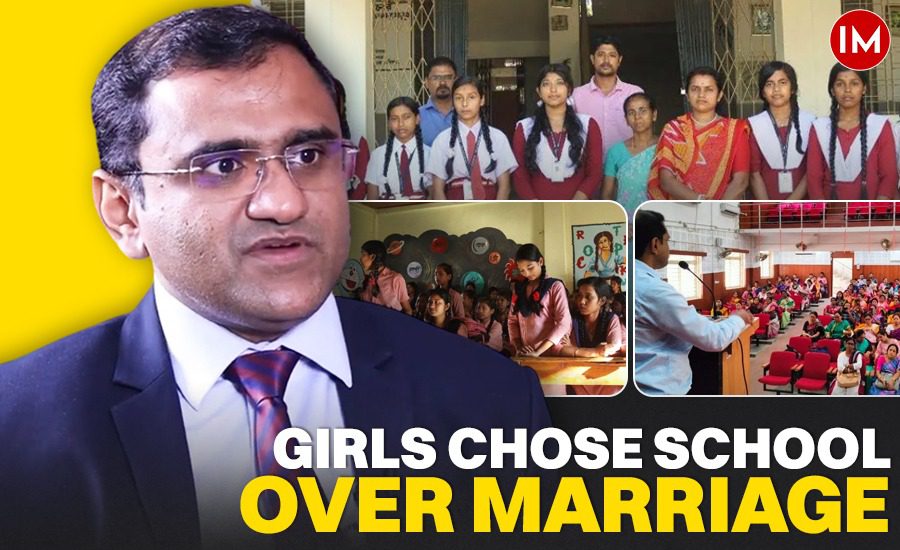
In 2023, an administrative intervention in South Tripura began rewriting the futures of hundreds of schoolgirls. What started as the revival of a dormant school club evolved into one of the district’s most effective strategies to prevent child marriage and reduce dropout rates among adolescent girls.
At the centre of this effort was IAS officer Saju Vaheed (2015 batch from the Tripura cadre), then District Magistrate of South Tripura. During his tenure, 158 school-based clubs were activated across the district, leading to the prevention of 90 child marriages in just one year. Though he has since been transferred, the framework he strengthened continues to influence conversations around girls’ education and child protection in Tripura.
WHEN A WHISPER NEARLY ENDED A GIRL’S EDUCATION
For 16-year-old Jyotsana Akhtar from Amzadnagar village, the turning point came unexpectedly. On her way home from school in 2023, she overheard villagers discussing her wedding. The groom, she later learned, was twice her age and divorced. Her parents had not told her directly.
Shocked and frightened, Jyotsana feared her education would end with Class 10. But she decided to resist. Determined to continue her studies and build a career, she approached her school’s ‘Balika Manch’ — a girls’ club meant to address adolescent issues.
Within days, teachers alerted the district administration. Officials visited her home, explained the legal and health consequences of child marriage, and ensured her parents signed an affidavit promising not to marry her before she turned 18. Jyotsana returned to school.
Her case was not an isolated one. It reflected a deeper issue in Tripura.
THE ALARMING CHILD MARRIAGE DATA IN TRIPURA
In the South Tripura district alone, a survey conducted in mid-2022 revealed that 215 girls were married in 2020 and 209 in 2021 while still of school-going age. More than half of the total dropout rate among girls in Classes 8, 9, and 10 was linked directly to child marriage.
Most marriages were taking place between Classes 6 and 9 — just as girls entered adolescence. Many cases went unnoticed until pregnancies brought them into contact with the health system. By then, administrative action was too late.
When Saju Vaheed assumed charge as District Magistrate in 2021, he found that an earlier initiative under the Beti Bachao, Beti Padhao scheme had lost momentum during the COVID-19 pandemic. The ‘Balika Manch’, started in 2020 by then Collector Debapriya Bardhan, had become inactive after schools shut down.
The challenge was not to create something new but to reactivate and restructure what already existed.
REVIVING ‘BALIKA MANCH’ AS A PREVENTION MECHANISM
In 2022, the district administration revived Balika Manch with a sharper focus: preventing child marriage through early detection and community intervention.
The model was simple but systematic.
Each Balika Manch included girls from Classes 6 to 12. A female teacher served as chairperson, while a student convenor monitored attendance of girl students. If a girl was absent for more than a week, the club flagged it immediately.
Representatives would visit the student’s home to understand the reason for absence. If a marriage was being planned, the club would first counsel the family, explaining legal consequences and the importance of continuing education.
To strengthen coordination, WhatsApp groups connected Balika Manch members with women-led school management committees, Childline representatives, child welfare committees, district child protection units, counsellors, and senior officials.
This created a three-tier system:
First layer: School-level monitoring and counselling by Balika Manch members.
Second layer: Professional intervention through counsellors, psychologists, legal practitioners, and child protection officials if families resisted.
Third layer: Direct administrative and legal action. Sub-divisional magistrates and police would intervene, warn families of FIRs under child marriage laws, and in some cases, register cases when required.
Parents were often asked to sign affidavits affirming they would not marry their daughters before 18.
The strength of this approach lay in early information. Instead of discovering child marriages after the ceremony, the administration began receiving alerts during the planning stage.
PREVENTING 90 CHILD MARRIAGE IN ONE YEAR
Between mid-2022 and 2023, the district successfully prevented 90 child marriages.
The number reflected more than enforcement. It indicated increased confidence among girls to report their situations. Balika Manch became a safe channel for adolescents to speak about pressures at home.
The initiative also addressed a systemic gap: departments such as health and social welfare earlier learned about underage marriages only during pregnancy registrations. By integrating schools into the monitoring network, the district administration shifted from reactive to preventive action.
Importantly, the effort reduced dropout rates among adolescent girls in several blocks. Teachers reported improved attendance, particularly in Classes 8 and 9 — the most vulnerable years.
WHY COMMUNITY COOPERATION WAS
One of the biggest challenges in preventing child marriage in Tripura was local cooperation that enabled such weddings. Ceremonies were often conducted quietly, with community members aware but unwilling to report.
The Balika Manch model worked because it built intervention from within the school ecosystem rather than relying solely on external complaints.
Girls monitored their peers. Teachers acted quickly. Officials responded without delay.
The involvement of women teachers and student leaders also reduced fear and hesitation among adolescents. In many cases, families reconsidered after understanding that legal consequences could include imprisonment and fines.
A MODEL THAT OUTLIVED A POSTING
As of 2026, Saju Vaheed is no longer posted in South Tripura. Administrative tenures change, but institutional systems often remain.
During his tenure, the state government had expressed interest in scaling the strengthened Balika Manch framework across Tripura. Several districts began studying the coordination mechanism, especially the structured three-layer response system.
While child marriage remains a challenge in parts of the state, the South Tripura experiment demonstrated that school-based vigilance combined with legal enforcement can significantly reduce the incidence.
SECURING FUTURES THROUGH EDUCATION
Child marriage is closely linked to poverty, social norms, and lack of awareness. But South Tripura’s intervention showed that timely governance can interrupt the cycle.
By reactivating a school club and connecting it to the administrative machinery, the district created a preventive network that operated at the grassroots level.
For the girls who stayed in school, the story is not about statistics. It is about having a choice — to study, to decide, and to step into adulthood on their own terms.